Cabin Air Filter vs Engine Air Filter: Key Differences

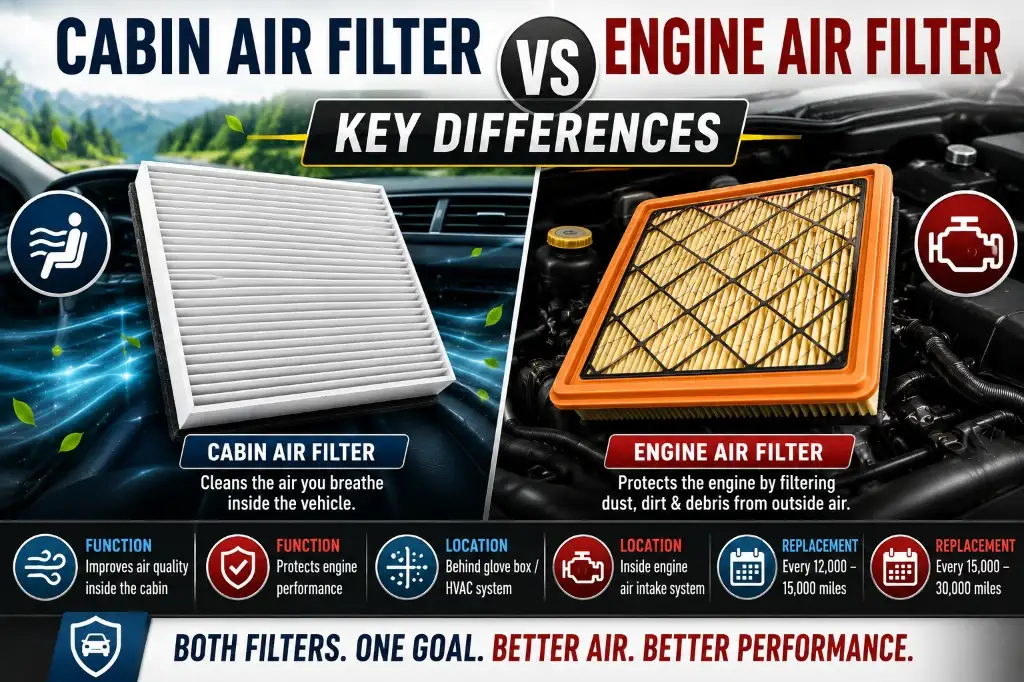
If you have ever stood in an auto parts store trying to figure out which filter you need, you are not alone. "Cabin filter" and "air filter" sound similar enough that confusion is understandable. But these are two entirely separate components with different jobs, different locations, and different replacement schedules.
I went through manufacturer documentation, OEM service manuals, and engineering data to put together the clearest side-by-side comparison possible.


What Does Each Filter Actually Protect?
This is the most important distinction, and it is also the simplest.
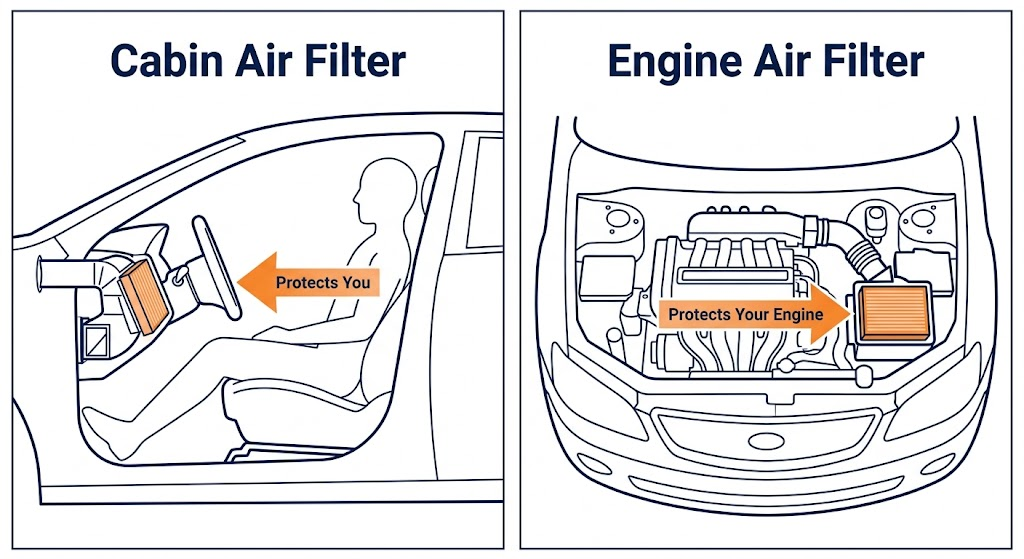
The cabin air filter protects passengers. It cleans the air flowing through your car's heating, ventilation, and air conditioning (HVAC) system before it reaches the people sitting inside the vehicle. Every breath you take with the climate control running has passed through this filter first.


The engine air filter protects the engine. It cleans the air entering the engine's intake system before combustion. Engines are extremely sensitive to abrasive particles. Even fine dust, if it reaches the combustion chamber in sufficient quantities, will cause accelerated wear on cylinder walls, pistons, and rings.
The two filters never interact. Replacing one does nothing for the other. They are completely independent components.

Where Is Each Filter Located?
Cabin Air Filter Location
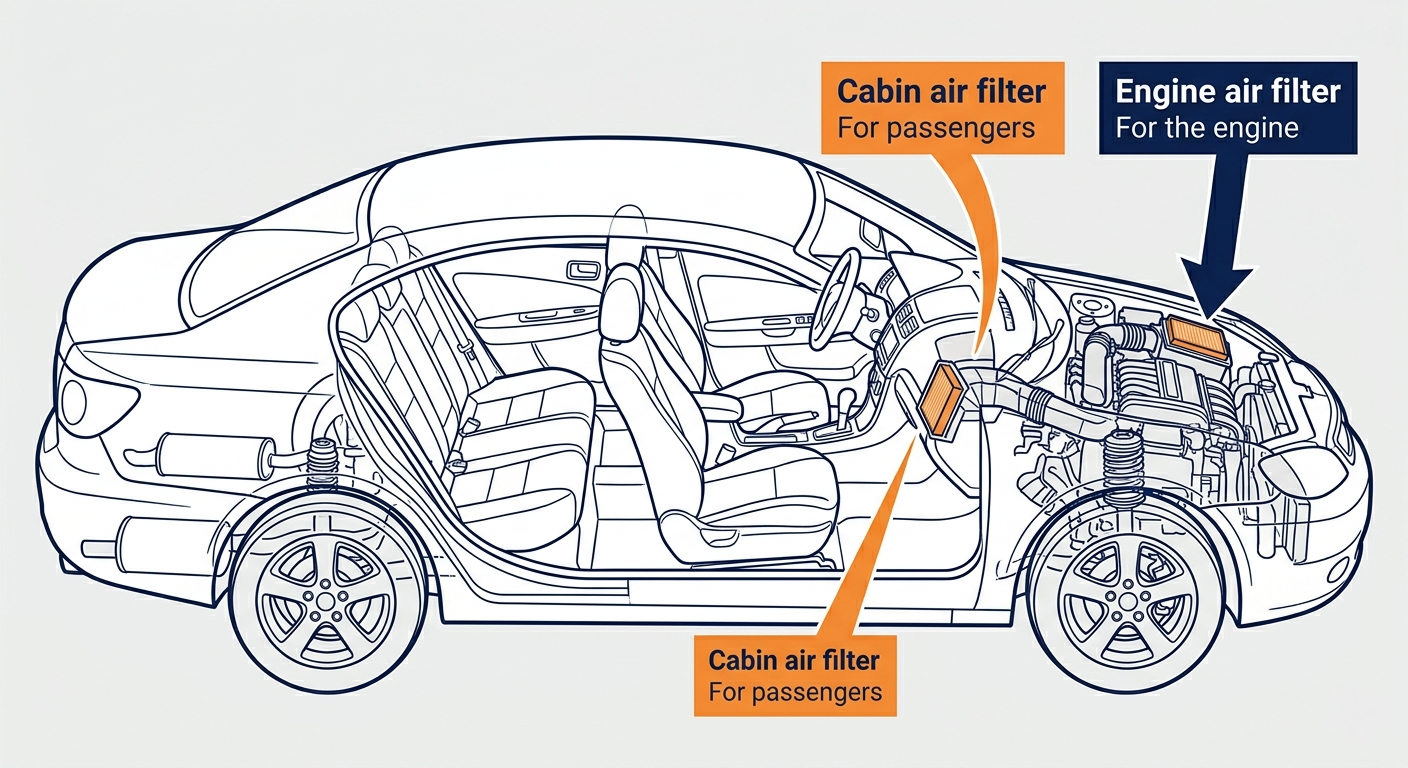
The cabin air filter is inside the passenger compartment area, somewhere along the HVAC air pathway. In most vehicles it sits in one of three places:
- Behind the glove box (most common): You remove or fold down the glove box to reach a filter housing directly behind it.
- Under the dashboard: On the passenger side, accessible via a panel near the footwell.
- Under the hood at the cowl: Near the base of the windshield where outside air enters the HVAC intake.
The behind-the-glove-box location is the most common on modern vehicles. Many drivers replace this filter themselves in under 10 minutes with no tools.

Engine Air Filter Location
The engine air filter is under the hood, inside the engine's air intake system. You will find it inside a plastic airbox connected to the intake tubing that leads to the throttle body.
On most vehicles, the airbox sits near the front of the engine bay. It is a black plastic housing with a large duct on one end and a clamp or series of clips holding the lid closed. The filter sits inside the lid.


The two filters are not near each other. In most cars, the cabin filter is accessed from the passenger compartment while the engine filter is accessed entirely under the hood.
What Does Each Filter Look Like?
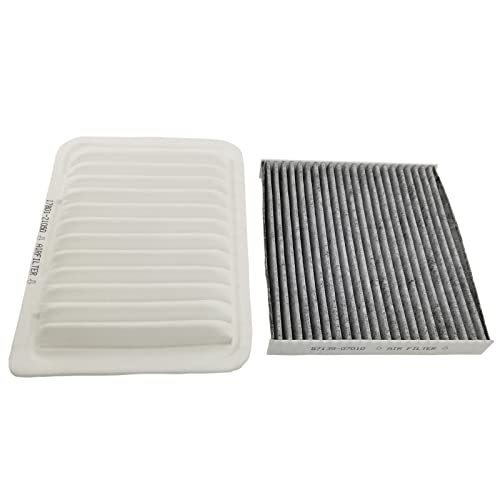
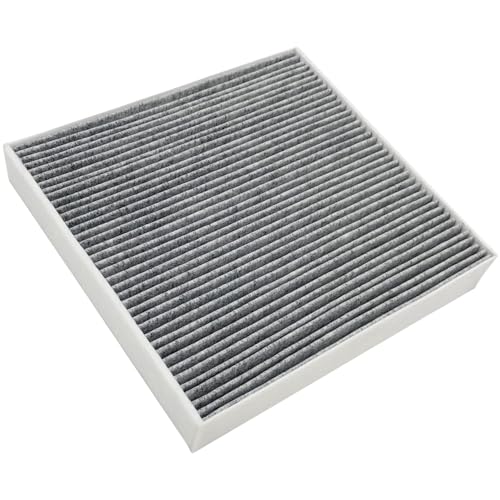
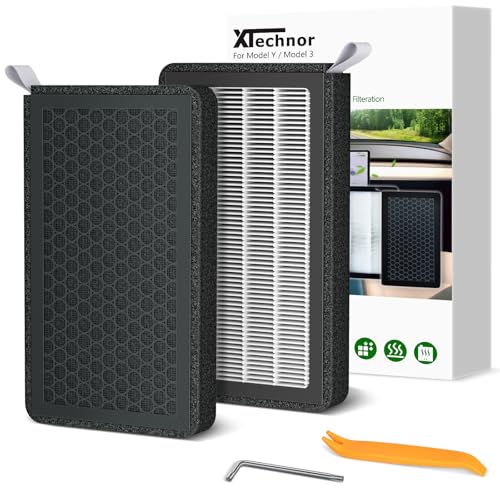
Both filters are pleated panel-style filters, which is part of why they get confused. But they are not interchangeable.
They can look similar at a glance, but the part numbers are completely different and the sizes rarely match.
What Kind of Particles Does Each Filter Capture?
What the Cabin Air Filter Captures
The cabin air filter targets particles suspended in outdoor air that would otherwise reach the passenger compartment:
- Pollen from trees, grasses, and weeds
- Road dust and fine dirt
- Mold spores
- Bacteria
- Soot from diesel exhaust
- Fine particulate matter (PM2.5), which is particles 2.5 microns and smaller
Standard cabin filters are rated down to about 3 microns. Premium multi-layer and activated carbon filters can capture particles as small as 0.3 microns, and the carbon layer also adsorbs gaseous pollutants and odors.
What the Engine Air Filter Captures
The engine air filter targets the same general categories of airborne particles, but for a completely different reason. The engine needs a precisely controlled air-to-fuel ratio for combustion, and any abrasive material in that air causes damage.
What the engine filter keeps out:
- Dust and fine dirt from road surfaces
- Sand and grit, especially in dry climates
- Insects and debris
- Pollen and organic particles
Engines ingest enormous volumes of air relative to their size. The stoichiometric air-to-fuel ratio for gasoline is approximately 14.7:1 by mass, which translates to a vastly larger volume of air than fuel entering the engine on every combustion cycle. Even trace concentrations of abrasive particles add up to significant cumulative wear on precision-machined surfaces over tens of thousands of miles.
How Often Does Each Filter Need to Be Replaced?
Cabin Air Filter Replacement Interval
Most manufacturers recommend replacing the cabin air filter every 12,000 to 15,000 miles, or once per year, whichever comes first. Drivers in high-pollen areas, urban environments with heavy traffic, or dry and dusty regions often need to replace it more frequently.
The filter's condition matters more than the mileage. A visibly gray or clogged filter needs to come out regardless of how many miles are on it.
Engine Air Filter Replacement Interval
Most manufacturers recommend replacing the engine air filter every 15,000 to 30,000 miles under normal driving conditions. Severe conditions, including unpaved roads, construction zones, and dusty environments, shorten that interval significantly.
Some aftermarket reusable filters, such as K&N cotton gauze filters, are designed to be cleaned and re-oiled rather than replaced. These are rated for extended service intervals with proper maintenance.
Side-by-Side Replacement Schedule
What Happens If You Neglect Each Filter?
Neglecting the Cabin Air Filter
A clogged cabin air filter restricts airflow through your HVAC system. The first symptom is usually weak airflow from the vents even at maximum fan speed. A severely restricted filter makes it feel like the blower barely works.
Beyond airflow, a neglected cabin filter creates conditions for mold and bacterial growth inside the HVAC system as moisture accumulates with organic debris. This is a common cause of musty odors that seem to come from the vents.
Your AC and heating performance both suffer because the volume of conditioned air reaching the cabin is reduced.
Neglecting the Engine Air Filter
A clogged engine air filter restricts the air supply to the engine. Your engine needs a precise air-to-fuel ratio for efficient combustion. When air supply is restricted, a few things happen:
- The engine may run richer (too much fuel relative to air), reducing fuel efficiency
- Power output can drop, especially at higher RPMs
- In severe restriction cases, you may notice rough idle or hesitation under acceleration
- The engine works harder to draw air through a blocked filter, which increases intake manifold vacuum
The more significant risk from a neglected engine filter is particle bypass. When a filter becomes so clogged that it can no longer pass enough air, pressure differential can force particles around filter seals or through damaged media. This puts abrasive material directly into the intake stream.
Can You Tell Which One Needs Replacing Without Removing It?
Signs the Cabin Air Filter Needs Replacing
Weak airflow, musty odors, increased dust, and worsened allergy symptoms are the most common indicators. Specifically:
- Weak airflow from vents at high fan settings
- Musty or unpleasant smell when the climate control turns on
- Increased dust accumulation on the dashboard
- Allergy symptoms seem worse inside the car than outside
- It has been more than a year or 15,000 miles since the last replacement
Signs the Engine Air Filter Needs Replacing
- Reduced fuel economy (though this can have many causes)
- Sluggish acceleration, particularly at higher RPMs
- Rough idle in severe cases
- Visible heavy soiling when inspected (holds the filter up to light: if you cannot see light through it, it is past due)
- Service interval has been exceeded for your driving conditions
The most reliable method for both filters is a direct visual inspection. Pull the filter and look at it.
Are They the Same Filter or Interchangeable?
No. They are completely different filters with different part numbers, different sizes, and different installation locations. You cannot use a cabin air filter in place of an engine air filter, or vice versa.
They are ordered separately, priced separately, and have no physical or functional overlap. When a parts store asks "which filter do you need," the answer requires specifying which one: the one for your HVAC system (cabin) or the one for your engine's intake (engine air filter).
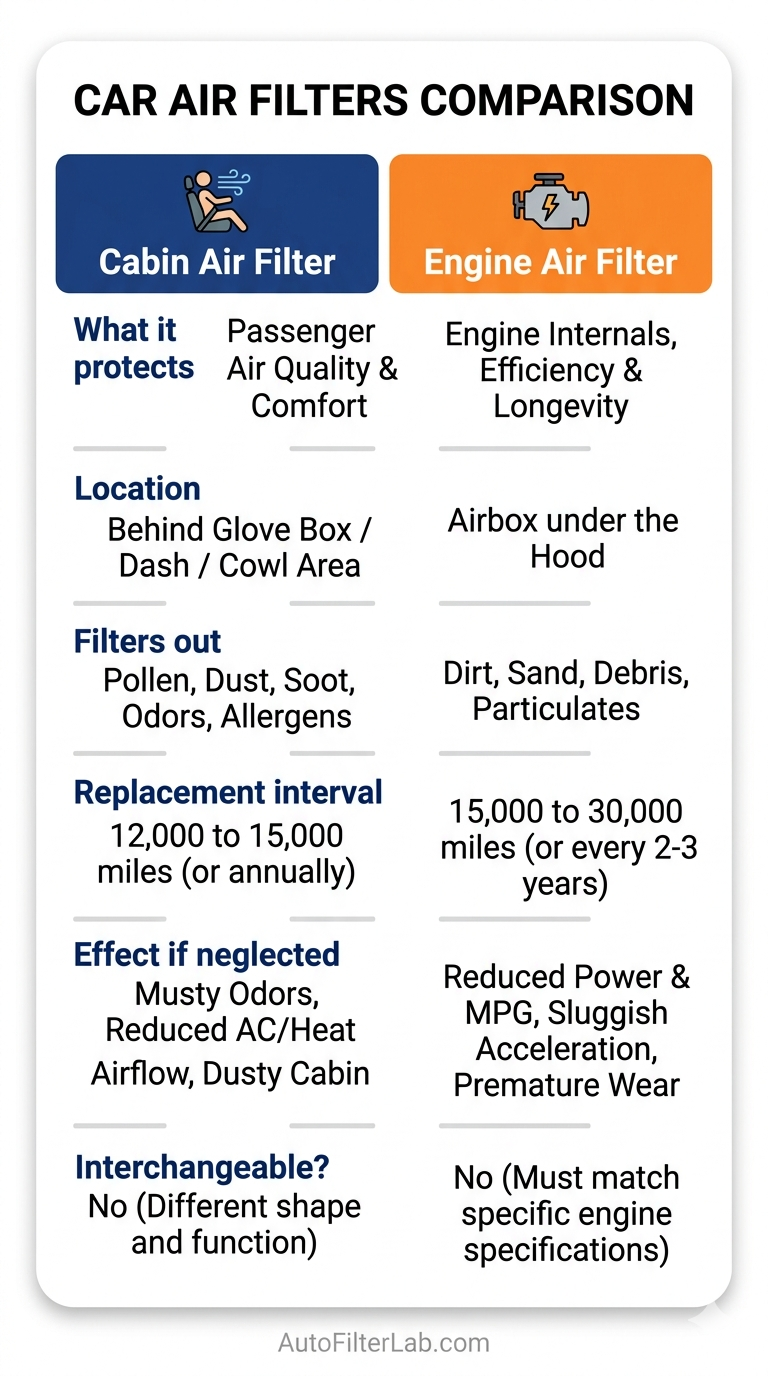
Quick Reference: Cabin vs Engine Air Filter
FAQ: Cabin Air Filter vs Engine Air Filter
Is the cabin air filter the same as the air filter?
No. "Air filter" by itself typically refers to the engine air filter in a workshop or parts store context. The cabin air filter is a separate component. Some people also call the cabin air filter a "pollen filter," but it is not the same as the engine air filter.
Does replacing the cabin air filter improve engine performance?
No. The cabin air filter has no connection to the engine's air intake. It only affects airflow through the HVAC system. Only the engine air filter affects engine performance.
Does replacing the engine air filter improve AC performance?
No. The engine air filter has no connection to the HVAC system. Only the cabin air filter affects the air that reaches the passenger compartment and vents.
Which filter should I replace first if both are overdue?
Replace whichever one is more severely restricted. If you are unsure, the cabin filter is typically cheaper and easier to inspect and replace, so start there. But both should be replaced if they are past their interval.
Do both filters affect fuel economy?
Only the engine air filter has a meaningful effect on fuel economy. A severely restricted engine air filter can reduce MPG by disrupting the engine's air-to-fuel ratio. The cabin air filter does not interact with the engine, so a clogged cabin filter has no significant effect on fuel economy.
The Bottom Line
These two filters share nothing except the word "filter." The cabin air filter lives inside your HVAC system and cleans the air you breathe. The engine air filter lives in the intake system and cleans the air your engine burns.
They are ordered separately, replaced on different schedules, and installed in completely different parts of the vehicle. If a shop or parts store is unclear about which one you mean, specify: cabin air filter for passengers, engine air filter for the intake.
Both are inexpensive maintenance items that cause disproportionate problems when neglected.