Does a Dirty Cabin Air Filter Affect Your AC? (Yes — Here's How)


Yes, a dirty cabin air filter directly affects your AC. When the filter is clogged, it restricts the airflow that the AC system depends on to cool your cabin. The result is weaker air from the vents, longer cool-down times, and a compressor working harder than it should. Changing the filter is one of the cheapest ways to restore AC performance.
How a Cabin Air Filter and Your AC System Are Connected
Most drivers think of the cabin air filter as a pollution screen. That is only part of its job.


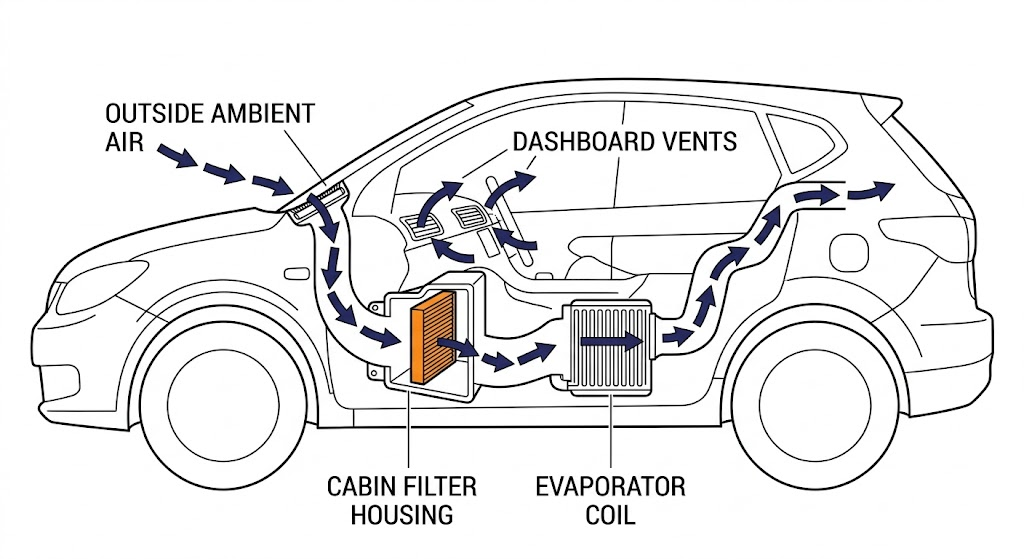
Every cubic foot of air your AC blows into the cabin first passes through the cabin air filter. The filter sits in the air intake path, typically behind the glove box or under the dashboard. Before air reaches the evaporator coil, the blower motor, or your vents, it moves through that filter.
When the filter is clean, airflow is unrestricted. The blower motor spins at the speed it was designed for. Air moves across the evaporator efficiently. Your vents blow cold and strong.


When the filter is clogged, that airflow path narrows. The blower motor strains against the restriction. Less air reaches the evaporator. Less cooled air exits the vents. The entire HVAC system becomes less effective because of one dirty filter.
The Direct Effect: Weak Airflow and Warm-Feeling Air
Why a clogged filter reduces vent output
A clogged cabin air filter forces the blower motor to pull air through a dense layer of captured debris. The motor works harder but moves less air. The volume of air reaching the evaporator drops.

Less air crossing the evaporator means less heat exchange. The AC compressor is running. The refrigerant is cycling. But the system cannot cool air it is not receiving in sufficient volume.
The output at your vents will feel weaker than usual, and the air temperature may feel warmer than it should, even with the AC set to maximum.


Why it takes longer to cool down the car
On a hot day, you get in the car and expect the AC to drop the cabin temperature within a few minutes. A clogged filter slows this process significantly.
The restricted airflow means the system circulates less total air volume per minute. It takes longer to flush out the hot air and replace it with cooled air. A drive that would normally cool down in two minutes might take five or more with a severely clogged filter.
Can a Dirty Cabin Air Filter Cause the AC to Freeze Up?
Yes. This is one of the less obvious effects, and it surprises most people.
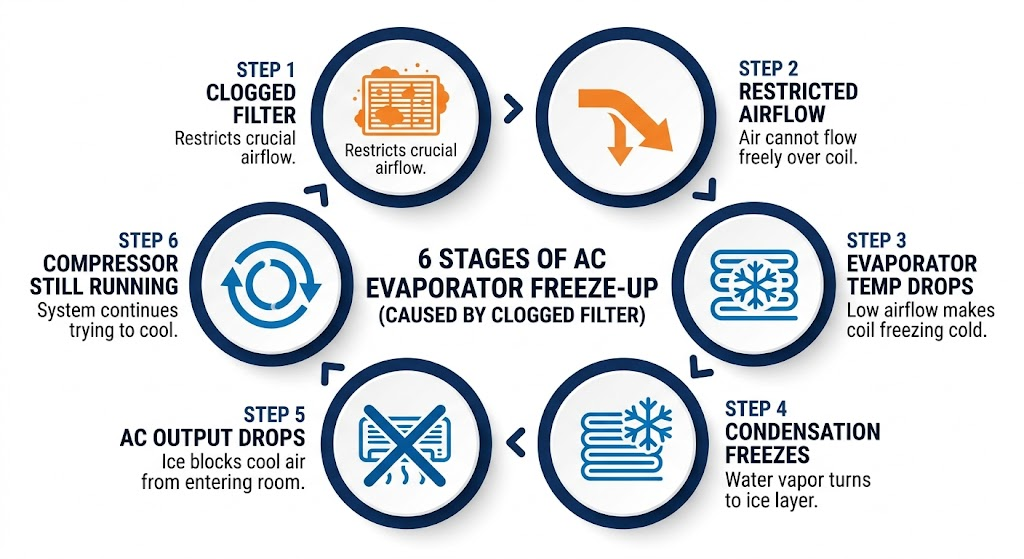
When airflow across the evaporator coil drops too low, the coil cannot shed the cold it is generating fast enough. The moisture that condenses on the coil freezes instead of draining away. Ice builds up on the evaporator.
Once ice forms, it acts as its own blockage. Airflow drops further. The AC output becomes almost nothing, even though the compressor is still running. You might notice the vents go from weak to virtually no air at all.
The fix in this scenario is: turn off the AC, run the fan on heat to thaw the coil, and then replace the cabin air filter.
The freeze-up cycle explained
Here is what happens step by step:
- Clogged filter restricts airflow to the evaporator
- Reduced airflow allows evaporator surface temperature to drop below freezing
- Condensation on the coil freezes rather than draining
- Ice layer grows, further blocking airflow
- AC output drops to near zero
- Compressor continues running while producing no useful cooling
Replacing the filter breaks this cycle at step one.
Does Replacing the Cabin Air Filter Actually Make AC Colder?
This question deserves a direct answer: replacing the filter does not change the refrigerant capacity or the compressor output. The AC system's peak cooling ability stays the same.
What changes is how much of that capacity reaches you.
A clean filter removes the artificial restriction on airflow. The blower motor can move air at its designed volume. The full output of the evaporator coil reaches the vents. You feel the difference as stronger, colder air.
Think of it this way. If you put a pillow over an air vent in your house, the furnace output does not change. But the room stays cold. The restriction is the problem, not the source of the heat. Removing the restriction restores delivery.
If your AC blows cold briefly and then feels weak or warm, a clogged cabin air filter is a reasonable first suspect before calling a shop.
Does a Dirty Cabin Air Filter Damage the Blower Motor?
Yes, over time it can. This is the damage most people do not think about until it becomes expensive.
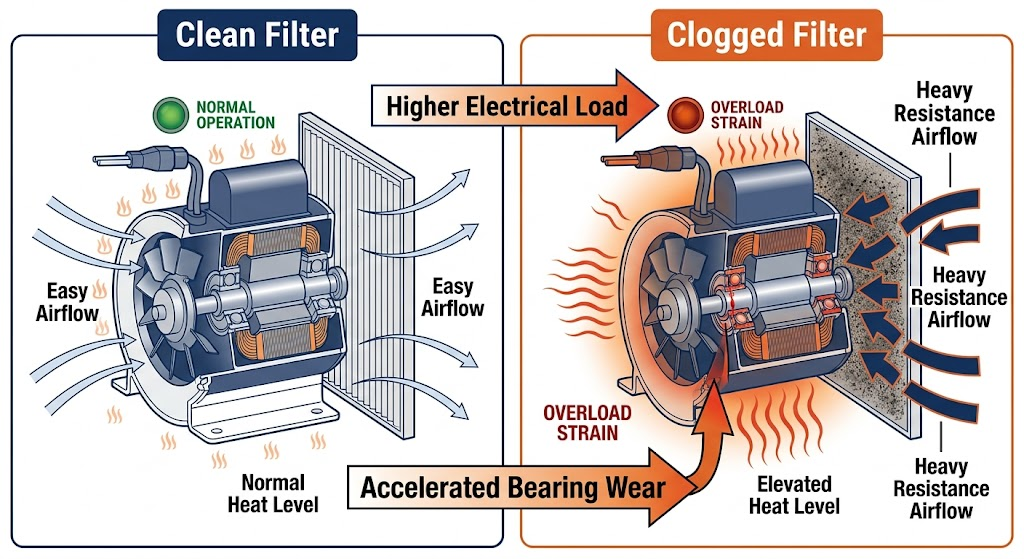
The blower motor is designed to move a specific volume of air at a specific resistance. When the filter restricts airflow, the motor works against greater resistance to maintain its speed. This increases the electrical load on the motor and generates more heat inside its windings.
Running a blower motor against a heavily clogged filter for months accelerates wear on the motor bearings and windings. The motor may still run, but its lifespan shortens measurably.
Blower motor replacement is not cheap. Depending on the vehicle, parts and labor can run $150 to over $700. Compared to a cabin air filter that costs $20 to $50, the math is straightforward.
How to Tell If Your Cabin Air Filter Is Causing AC Problems
You can narrow down a clogged filter as the cause of AC underperformance by looking for this combination of symptoms:
- Airflow from vents is noticeably weaker than it used to be, even on high fan settings
- The air from vents feels slightly warmer than it should on a cool setting
- You notice a musty or dusty smell when you turn on the AC
- The blower sounds like it is straining or louder than normal at high speeds
- The car takes significantly longer to cool down than it used to
None of these symptoms alone proves the filter is the issue. But if you have two or more, and you cannot remember the last time the filter was changed, pull it out and look at it. The condition of the filter is usually self-explanatory.
How to inspect the filter yourself
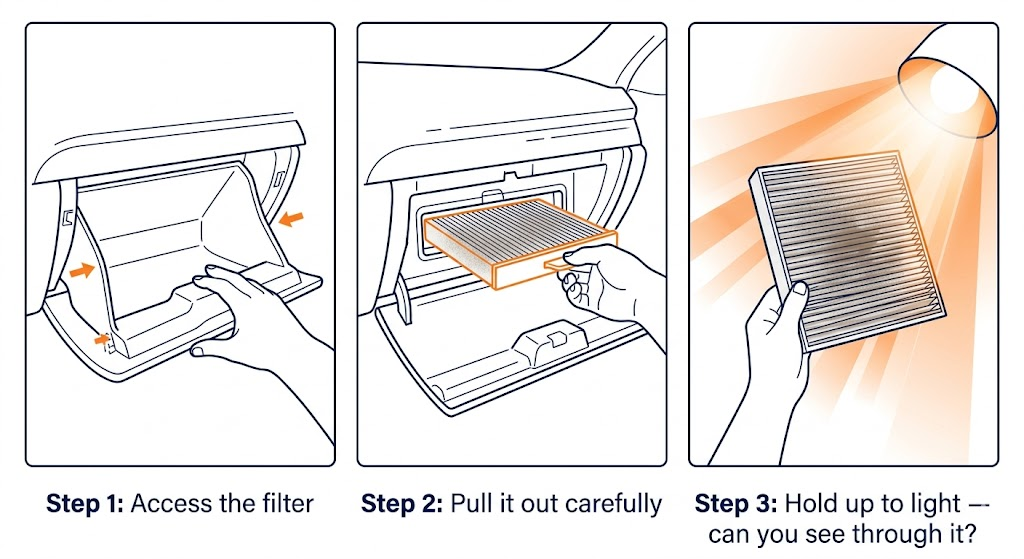
Cabin air filter access varies by vehicle. In most cars it sits behind the glove box. In some it is accessible under the hood near the windshield base.
Once you access it:
- Pull the filter out carefully (debris can fall from a loaded filter)
- Hold it up to a light source
- If you cannot see light through it, or it is visibly grey, brown, or packed with debris, replace it
A filter can look lightly dirty and still flow reasonably well. A filter that is dark, heavy, and opaque is actively restricting airflow.
How Often Should You Change the Cabin Air Filter to Protect Your AC?
The standard replacement interval is every 12,000 to 15,000 miles, or once per year. Manufacturers typically specify this in the owner's manual maintenance schedule.
That interval assumes average driving conditions. If you drive in any of these conditions, change it more often:
- Urban driving with frequent stop-and-go traffic
- Areas with high pollen counts during spring and summer
- Dusty environments such as unpaved roads or construction areas
- Parking under trees where debris accumulates on the air intake
In high-pollen or high-dust conditions, check the filter more frequently than the standard interval. A filter loaded with seasonal pollen can restrict airflow meaningfully before its scheduled replacement date. This matters most in summer when AC demand is highest.
Protecting your AC does not require an expensive repair. In most cases, it requires a $20 to $50 filter and ten minutes.
FAQ
Does a dirty cabin air filter make AC less cold?
Yes. A clogged filter restricts the airflow that carries cooled air from the evaporator to your vents. Less air volume reaches the vents, and the air feels warmer and weaker. The AC compressor itself is still working, but the restricted delivery reduces what you feel at the vent.
Can a clogged cabin air filter cause the AC to stop working?
It will not cause the AC system to shut off, but it can reduce output so severely it feels like the AC is not working. In extreme cases, restricted airflow causes the evaporator to ice over, cutting vent output to near zero. The compressor is still cycling, but almost no air is moving through.
Will changing the cabin air filter fix weak AC airflow?
If the filter is the cause of reduced airflow, yes. Replacing a clogged filter removes the restriction. Airflow immediately increases to normal levels, and the system delivers its full cooling capacity to the vents. If the filter is clean and airflow is still weak, the issue is likely the blower motor or a blockage elsewhere.
How long does it take for a dirty cabin air filter to affect AC?
The effect builds gradually. A new filter has no impact on AC performance. As the filter loads with debris over thousands of miles, airflow restriction increases incrementally. How soon the effect is noticeable depends heavily on driving environment: urban, dusty, or high-pollen conditions load a filter much faster than highway driving in clean air.
Does a cabin air filter affect heat as well as AC?
Yes. All conditioned air, whether heated or cooled, passes through the cabin air filter. A clogged filter reduces the volume of heated air reaching your vents in the same way it reduces cooled air. Weak heat output in winter can also point to a clogged filter.
What to Do Next
If your AC has felt weak or slow to cool down this season, check the cabin air filter first. It takes ten minutes and costs less than most people spend on a single tank of gas.
If the filter is clogged, replace it and retest the AC. In most cases that single step restores normal airflow. If the AC is still underperforming after a fresh filter, the issue is mechanical: blower motor, refrigerant level, or evaporator. At that point, a shop visit is the right call.