HEPA vs Regular Cabin Air Filter: Is the Upgrade Worth It?

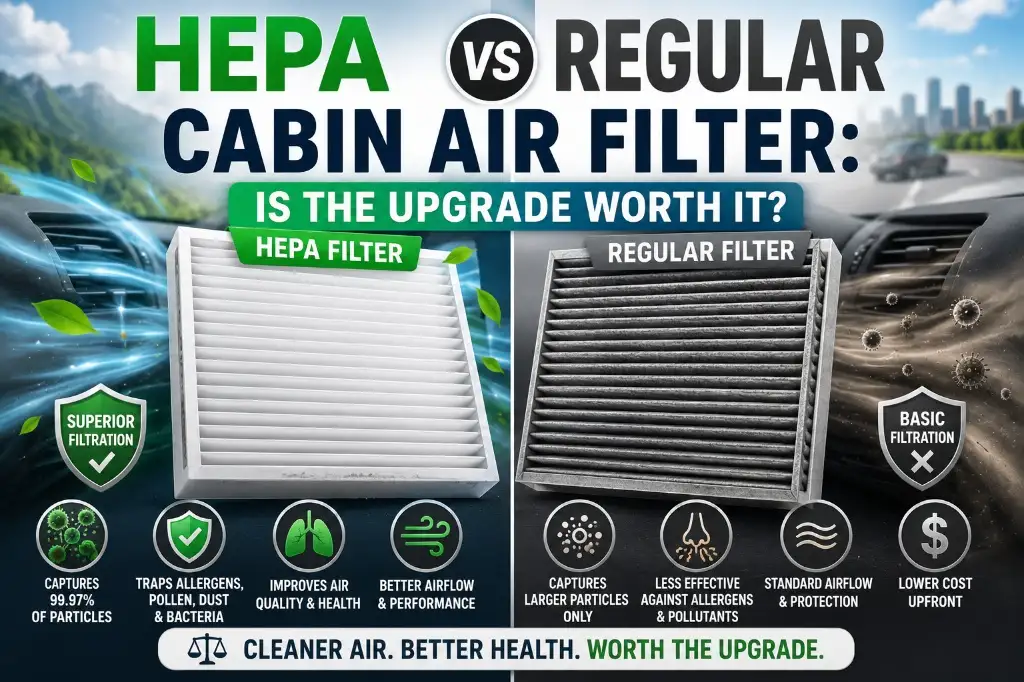
The cabin air filter aisle at any auto parts store has at least three tiers: basic, premium, and something labeled HEPA or "HEPA-type." The price jumps significantly between each tier. Most drivers have no idea what they are actually paying for.
I went through the filtration specs, manufacturer data sheets, and engineering standards behind each filter type to give you a clear, honest answer. Here is what actually changes when you move up the tier ladder, and who genuinely benefits from spending more.


What Is a Regular Cabin Air Filter?
A standard cabin air filter uses pleated paper or cellulose fiber as its filtration media. The pleated design maximizes surface area in a compact frame, which extends the filter's useful life before it becomes so loaded with debris that airflow suffers.
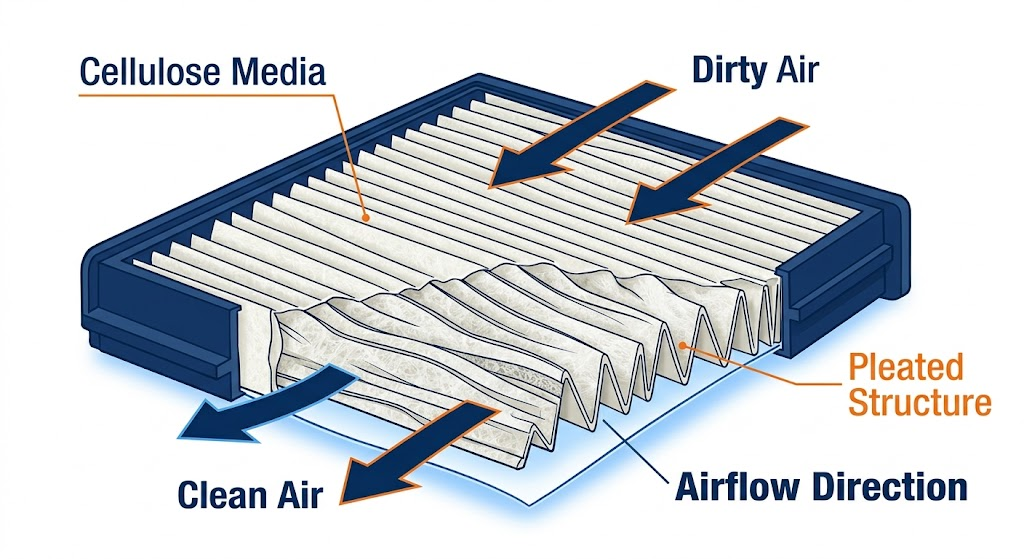
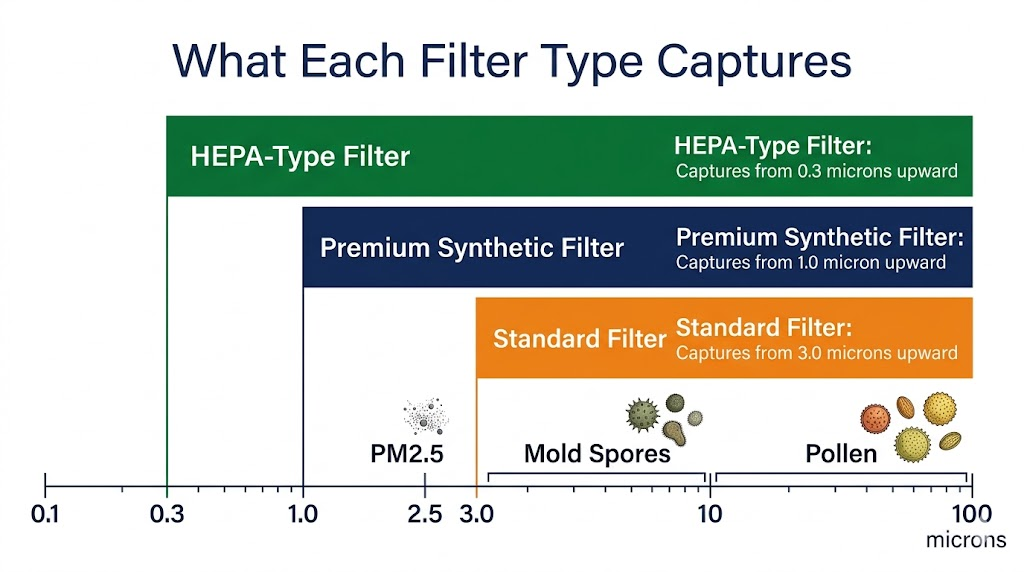
Standard cellulose filters capture around 80 to 90% of particles down to a couple of microns in size, meaning they reliably stop pollen (10 to 100 microns), dust mites, mold spores, and most road dust. Particles smaller than 3 microns pass through at meaningfully higher rates.


The standard filter does nothing against gases or odors. It captures solid particles only.
What a standard filter handles well:
- Pollen from trees, grasses, and weeds
- Road dust and construction particulate
- Mold spores
- Larger soot particles from diesel exhaust
- Insects, seeds, and debris
What it does not handle:
- Fine particulate matter (PM2.5) below 2.5 microns
- Vehicle exhaust gases and VOCs
- Odors from traffic and industrial sources
- Ultrafine combustion particles below 1 micron
For most drivers in moderate environments, a standard filter is adequate. It keeps the gross stuff out of your cabin and prevents HVAC restriction. It is not designed to provide hospital-grade air quality.

What Is a HEPA Cabin Air Filter?
HEPA stands for High Efficiency Particulate Air. It is a performance standard, not a specific material. A filter that meets the HEPA standard captures at least 99.97% of particles at 0.3 microns in diameter.
The 0.3 micron size is used as the test threshold because it represents the most penetrating particle size for fiber-based filters. Particles larger or smaller than 0.3 microns are actually easier to capture. A filter that captures 99.97% at this hardest size is considered true HEPA.


True HEPA vs. HEPA-Type: A Critical Distinction
Most automotive filters labeled "HEPA" or "HEPA-type" are not true HEPA filters. They use higher-efficiency synthetic or micro-glass fiber media that performs significantly better than standard cellulose but does not meet the certified 99.97% threshold at 0.3 microns.
This distinction matters because true HEPA filtration requires tighter media construction that creates higher airflow resistance. In a car's HVAC system, where the blower motor has fixed output, too much filter resistance reduces airflow through the vents.
Most automotive filters marketed as HEPA are actually high-efficiency synthetic filters. They capture far more fine particles than standard filters without restricting airflow enough to matter in normal use.
What Is an Activated Carbon Cabin Air Filter?
Activated carbon is a separate upgrade that addresses a completely different problem: gases and odors.
Standard and HEPA-type filters capture solid particles. They have no effect on:
- Nitrogen dioxide (NO2) from vehicle exhaust
- Volatile organic compounds (VOCs) from traffic and industrial sources
- Ozone
- Combustion gases
- Unpleasant odors from external sources
Activated carbon filters add a layer of carbon granules behind the particle filtration media. Carbon is extremely porous at the microscopic level, with an internal surface area exceeding 1,000 square meters per gram. Gases and odor molecules adsorb (bind) to the carbon surface as air passes through, removing them from the airflow before it reaches your cabin.
This is not filtration in the mechanical sense. It is a chemical process called adsorption.
The activated carbon layer does not affect particle filtration efficiency. It only addresses gas-phase contaminants.
Does Activated Carbon Wear Out?
Yes. The carbon layer has a finite adsorption capacity. Once the binding sites on the carbon surface are saturated, the layer can no longer remove additional gases. For most drivers, this aligns roughly with the standard replacement interval of 12,000 to 15,000 miles. Heavy urban commuters may saturate the carbon layer faster.
The Three Main Types: Side-by-Side Comparison
Who Actually Benefits from a HEPA or Premium Cabin Air Filter?
This is the question most product descriptions avoid answering clearly. Here is an honest breakdown.
Drivers with allergies or asthma
This is the clearest case for upgrading. Standard filters stop pollen effectively. But fine particles, PM2.5, combustion particulate, and mold spores smaller than 3 microns pass through at higher rates. Allergy and asthma sufferers are more sensitive to exactly these smaller particles.
A HEPA-type or high-efficiency synthetic filter captures a meaningfully higher fraction of particles in the 0.3 to 3 micron range. For someone who spends an hour in stop-and-go traffic twice a day, that reduction in particle exposure is real.
Urban commuters in heavy traffic
Vehicle exhaust contains a mix of particle sizes, gases, and VOCs. Standard filters handle the larger particles. They let more of the fine combustion particles through.
An activated carbon filter specifically helps urban commuters with the gas-phase component: NO2, ozone, and exhaust odors. Combined with high-efficiency particle media, a HEPA + carbon filter provides substantially cleaner cabin air than a standard filter for someone spending significant time in dense traffic.
Drivers in wildfire smoke regions
Wildfire smoke contains ultrafine particles (below 1 micron) and significant gas-phase pollutants. Standard filters provide limited protection against either. A high-efficiency HEPA-type filter with activated carbon is the correct choice for drivers who regularly encounter wildfire smoke conditions.
Low-pollution, highway-dominated drivers
If your driving is mostly open highway, suburban, or rural, and you do not have respiratory sensitivities, a standard or premium synthetic filter is almost certainly adequate. The air you are drawing in is already relatively clean. The incremental improvement of a HEPA-type filter in this environment is real but small.
Drivers bothered by traffic odors
The particle tier does not matter if your primary complaint is exhaust smell or highway odors. The answer is activated carbon, regardless of whether the particle media is standard or HEPA-type. A dirty cabin air filter that affects your AC is a separate problem entirely from filter type.
Is a HEPA Cabin Air Filter Worth the Extra Cost?
On pure filtration terms: yes, a HEPA-type filter captures more fine particles than a standard one. The question is whether that improvement matters enough in your specific situation to justify the price difference.
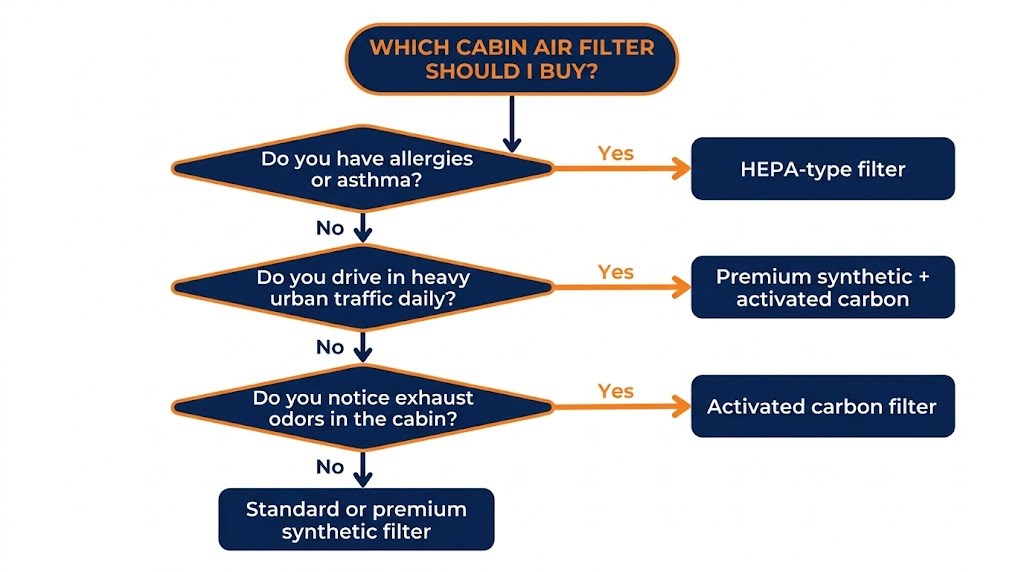
Here is how to make the decision:
Upgrade to HEPA-type or high-efficiency filter if you:
- Have documented allergies, asthma, or respiratory conditions
- Drive daily in dense urban traffic
- Live in or travel through wildfire-prone regions
- Have young children or elderly passengers with respiratory vulnerability
- Notice that standard filters do not seem to reduce allergy symptoms while driving
Stick with a standard or premium synthetic filter if you:
- Drive mostly on open roads in moderate-air-quality areas
- Have no respiratory sensitivities
- Replace the filter on schedule (a fresh standard filter outperforms a neglected premium one)
Add activated carbon regardless of tier if you:
- Notice exhaust odors or traffic smells entering the cabin
- Drive frequently through tunnels, congested highways, or industrial areas
- Have sensitivity to chemical odors or VOCs
The single biggest upgrade you can make to your cabin air quality is simply replacing the filter on time. A fresh standard filter outperforms a clogged HEPA-type filter every time.
Does a HEPA Filter Reduce Airflow in Your Car?
This concern comes up often, and it is worth addressing directly.
True HEPA media is denser than standard media and does create more airflow resistance. In industrial air purifiers with powerful fans, this is managed by sizing the filter and fan together. In a car's HVAC system, the blower motor is fixed.
Most automotive filters marketed as "HEPA" or "HEPA-type" are not constructed to true HEPA density. They use finer synthetic or micro-glass fibers that provide better efficiency than cellulose without creating enough additional resistance to measurably reduce airflow in a properly functioning HVAC system.
If you install a filter and notice immediately reduced airflow on all fan settings, the filter may be too dense for your system's blower output. This is rare with filters designed specifically for automotive use, but worth knowing.
Premium automotive HEPA-type filters are engineered to balance efficiency and flow resistance within the constraints of a car's blower motor.
Can Any Car Use a HEPA Cabin Air Filter?
The constraint is not filtration type but physical size. Cabin air filters are vehicle-specific. The filter for your car must fit the exact dimensions of your vehicle's filter housing.
Most manufacturers that make HEPA-type cabin air filters produce them in the same sizes as their standard versions. If a standard filter is available for your vehicle, a HEPA-type version almost certainly is too.
To confirm, look up your year, make, and model on any filter retailer's site. Filter fitment is determined by housing dimensions, not by filtration type.
What Happens to PM2.5 Inside Your Car?
PM2.5 refers to fine particulate matter with a diameter of 2.5 microns or smaller. These particles come from vehicle exhaust, industrial emissions, and combustion sources. They are small enough to penetrate deep into lung tissue.
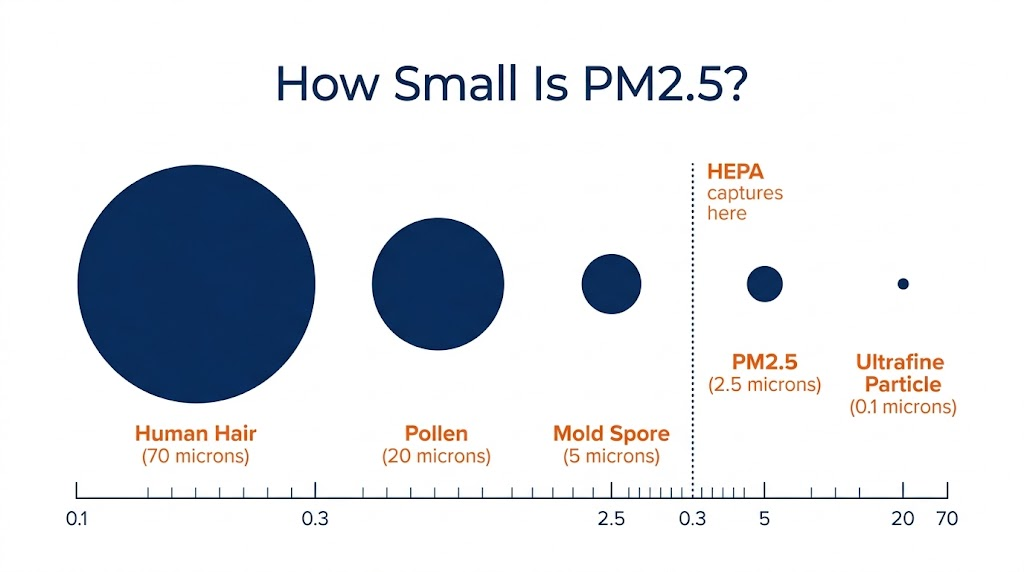
A standard cellulose cabin air filter captures PM2.5 at lower efficiency than it captures larger particles. Research has found that high-efficiency cabin air filters reduced in-cabin PM2.5 concentrations by 37% and ultrafine particles by 47% compared to standard filters. The reduction with a standard filter is real but incomplete.
HEPA-type and high-efficiency filters provide meaningfully better PM2.5 reduction. For someone concerned about fine particulate exposure during a daily urban commute, this is one of the more defensible reasons to upgrade.
FAQ
Is a HEPA cabin air filter worth it?
For drivers with allergies, asthma, or those who commute in dense urban traffic, yes. A HEPA-type filter captures significantly more fine particles, including PM2.5 and combustion particulate, than a standard cabin air filter. For highway-dominant, low-pollution driving, the improvement is real but small. The extra $15 to $30 is a reasonable investment for respiratory health.
What is the difference between HEPA and regular cabin air filter?
A regular cabin air filter uses cellulose media and captures particles efficiently at 3 microns and larger. A HEPA-type cabin air filter uses finer synthetic or micro-glass media and captures particles at 0.3 to 1 micron at higher efficiency rates. The practical difference is better protection against fine combustion particles, PM2.5, and smaller allergens.
Does a cabin air filter with activated carbon remove exhaust smells?
Yes. Activated carbon adsorbs gas-phase pollutants, including the exhaust odors, VOCs, and nitrogen compounds that cause traffic smell to enter the cabin. Standard and HEPA-type filters without carbon do not affect odors or gases.
Can a HEPA cabin air filter restrict airflow?
True HEPA media is denser and creates more airflow resistance than standard media. However, most automotive HEPA-type filters are engineered to balance efficiency with flow resistance within the constraints of a car's blower motor. Properly sized automotive HEPA-type filters do not cause noticeable airflow reduction in a healthy HVAC system.
What type of cabin air filter is best for allergies?
A HEPA-type filter with activated carbon provides the best all-around protection for allergy sufferers. The HEPA-type media captures fine pollen fractions, PM2.5, and mold spores more effectively than standard filters. The activated carbon layer removes gas-phase irritants that standard filters let pass. Replace it on schedule: a clogged premium filter is worse than a fresh standard one.
How much does a HEPA cabin air filter cost compared to a regular one?
Standard cabin air filters typically cost $10 to $20. Premium synthetic and HEPA-type filters run $30 to $50. HEPA-type filters with activated carbon range from $40 to $65. The price difference is $20 to $45 over a filter that lasts 12,000 to 15,000 miles.
The Bottom Line
The filter tier that makes sense for you depends entirely on where you drive and whether you have respiratory sensitivities.
For most drivers: a premium synthetic or activated carbon filter hits the right balance of performance and cost. Standard filters are fine if replaced on schedule. HEPA-type filters are worth it for anyone with allergies, asthma, or a daily urban commute through heavy traffic.
The one thing that matters more than filter type is replacement frequency. A fresh standard filter does more for your cabin air quality than a two-year-old HEPA filter.