How Often Should You Change a Cabin Air Filter?

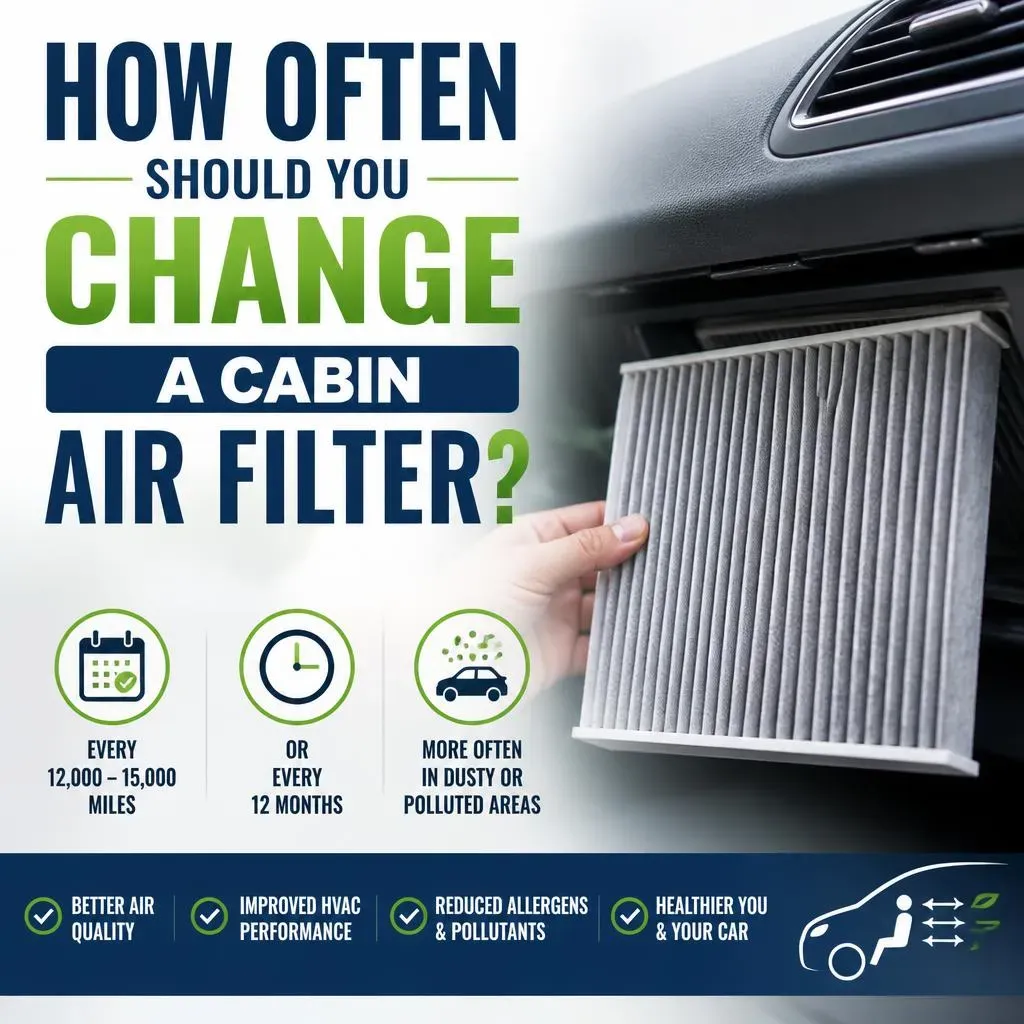
Most manufacturers recommend changing your cabin air filter every 12,000 to 15,000 miles, or once per year, whichever comes first. If you drive in heavy traffic, live in a high-pollen region, or frequently travel on unpaved roads, every 10,000 miles is a more practical target. The filter's condition is the real guide: a visibly gray or blocked filter needs to come out regardless of mileage.
The Standard Replacement Interval: What Your Owner's Manual Says
Most OEM recommendations land in the 12,000 to 15,000 mile range, or once annually. That number assumes normal driving conditions: mostly paved roads, moderate air quality, and a typical mix of city and highway driving.


The once-per-year rule exists because time matters independently of mileage. A filter sitting in a damp environment accumulates mold and bacteria even when the car barely moves. If you drive fewer than 12,000 miles a year,the calendar still matters.
Check your owner's manual for your exact vehicle's recommendation. Manufacturers index the cabin air filter separately from the engine air filter, and the intervals are different.


How Driving Environment Affects the Interval
The mileage recommendation assumes average conditions. Your actual conditions may push that interval significantly shorter.
High-Pollen and Allergy Regions
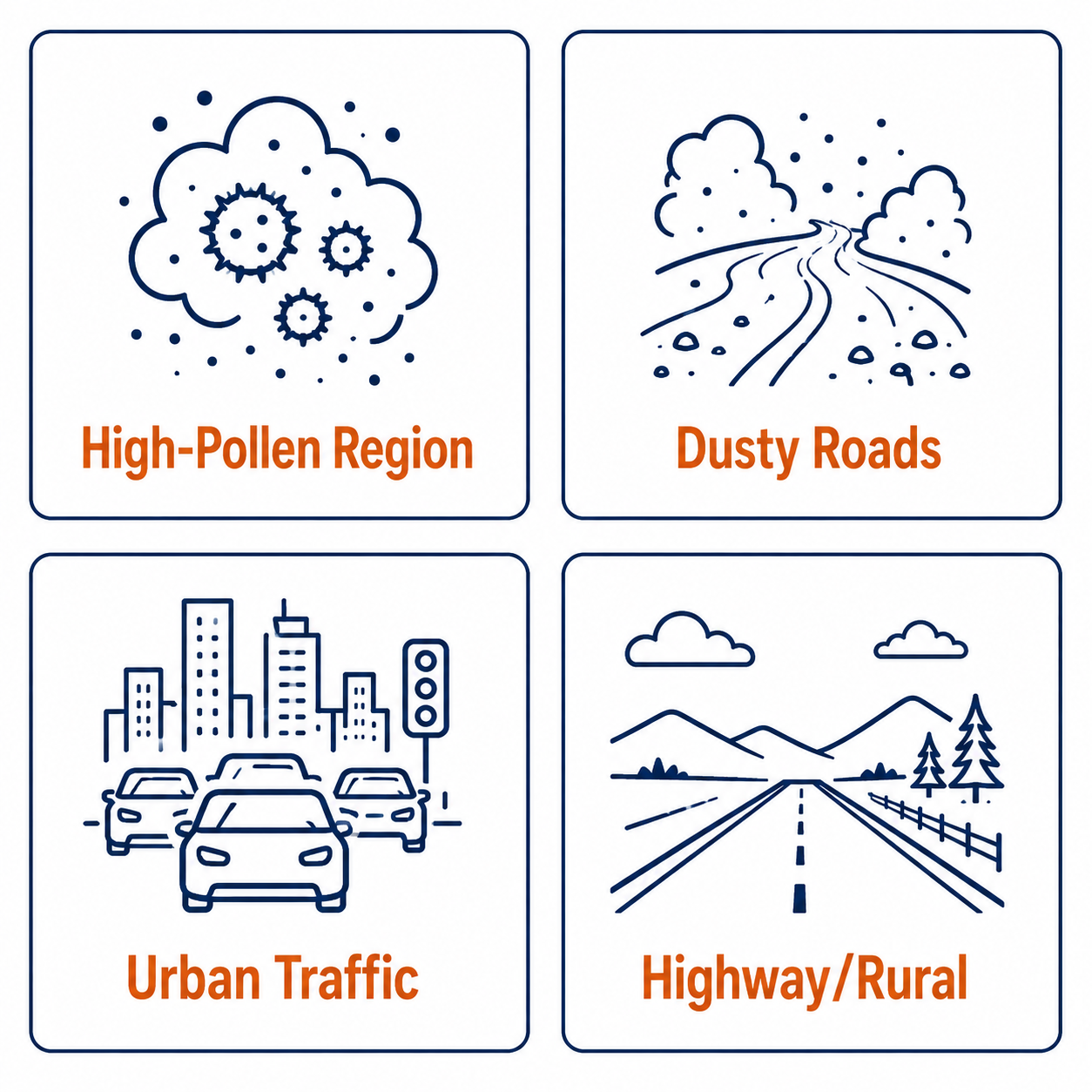
If you live in a region with heavy seasonal pollen — the Southeast, Midwest, or anywhere with dense tree or grass coverage — your cabin air filter accumulates visible pollen layers within a single season. Many drivers in these areas replace the filter every spring regardless of mileage, in addition to the standard annual change.

Dusty and Unpaved Roads
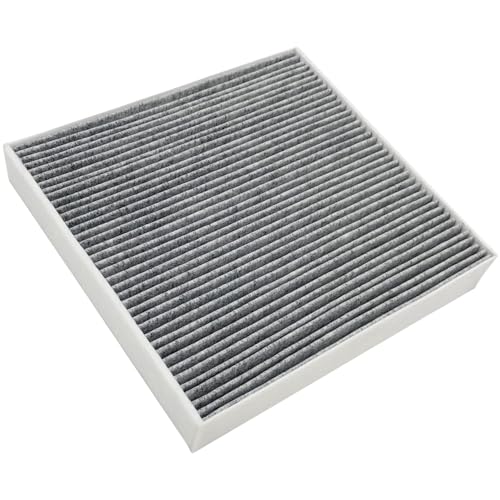
Gravel roads, construction zones, and dry desert environments load filters with fine particulate matter far faster than highway driving. If you regularly drive on unpaved surfaces, check the filter every 5,000 to 7,500 miles. The filter will often look filthy before the standard interval is up.
Urban Stop-and-Go Traffic
City driving exposes the filter to higher concentrations of exhaust particulates, soot, and fine pollution particles than highway driving. The filter works harder per mile in stop-and-go conditions because the car is stationary (engine on, HVAC running) for longer periods.


Rural and Low-Traffic Areas
If most of your driving is on open highways with clean air and low dust, the standard 12,000 to 15,000 mile interval is usually appropriate. You may even find the filter still looks acceptable at 15,000 miles in ideal conditions.
How to Tell If Your Cabin Air Filter Needs Changing Now
Mileage is a guide, not a rule. These symptoms mean the filter needs to come out regardless of where you are in the service interval.


Weak Airflow From the Vents
This is the clearest sign. A restricted cabin air filter chokes the airflow pathway. If your fan is on maximum speed but the output from the vents feels weak or barely noticeable, a clogged filter is the most likely cause.
Unusual Odors From the Vents
A musty, damp, or stale smell when you turn on the climate control points to a filter that has trapped moisture and begun growing mold or bacteria. This is especially common in humid climates.
More Dust Than Usual on Interior Surfaces
A failing or saturated filter that can no longer trap particles will allow more dust to pass through to the cabin. If you are noticing faster dust accumulation on the dashboard and seats, the filter is worth inspecting.
Increased Allergy Symptoms While Driving
If you or a passenger notice allergy or respiratory symptoms specifically when in the car with the HVAC running, the filter may be overwhelmed or, worse, releasing trapped particles back into the airflow.
Visual Inspection: The Most Reliable Method
The most reliable way to assess your cabin air filter is to pull it out and look at it. You do not need a mechanic to do this. On most vehicles, the filter is accessible by opening the glove box or removing a panel under the dashboard.
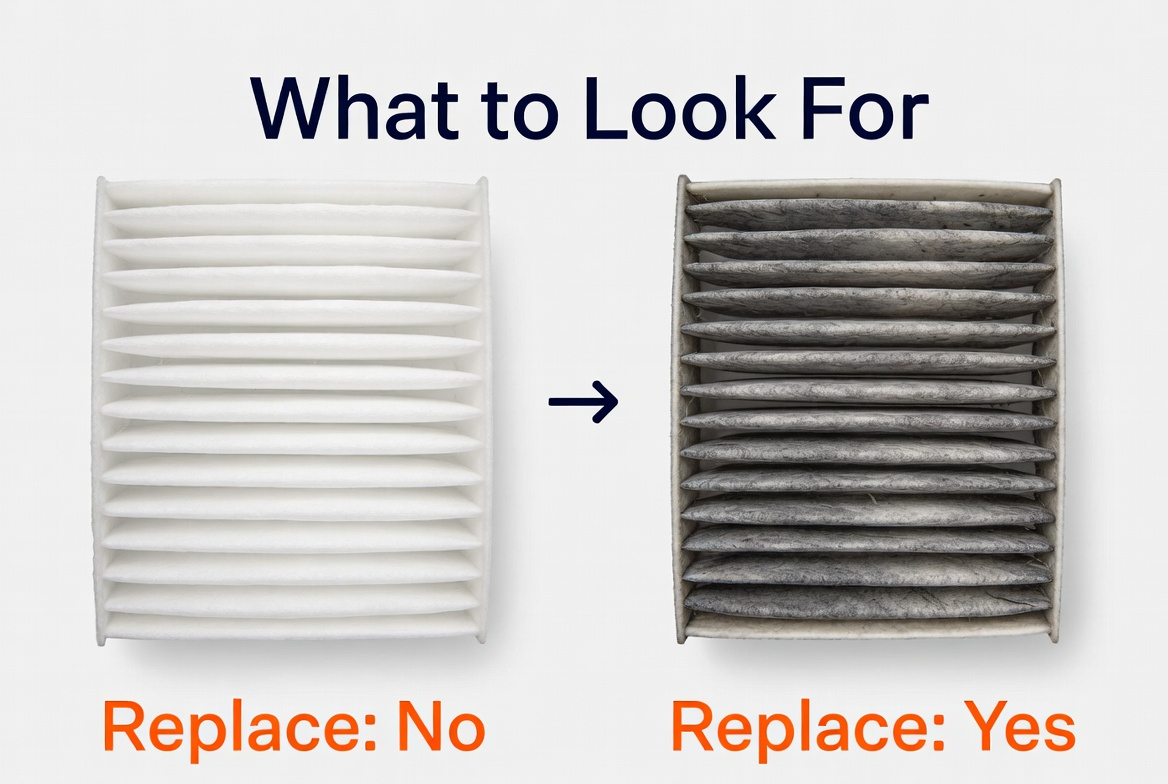
A new filter is white or off-white with clean, well-defined pleats. A filter that needs replacement will be visibly gray or brown, with debris matted into the folds. Some filters will have visible leaves, insects, or heavy pollen deposits.
Rule of thumb: If you hold the filter up to light and you cannot see through the pleating at all, replace it immediately.
Does It Matter If You Rarely Use the AC?
Yes. The cabin air filter is in the airflow pathway for the entire HVAC system, not just the air conditioning. Every time your climate control fan runs — whether it is heat, defrost, ventilation, or AC — air is passing through this filter.
The only time the cabin air filter is not actively filtering is when the fan is completely off. In most modern vehicles with automatic climate control, the fan runs whenever the car is on and the system is in automatic mode.
Driving in cold climates with heat on for nine months a year still loads the cabin air filter at approximately the same rate as driving with AC in a warm climate.
What Happens If You Skip the Cabin Air Filter Change?
Skipping the replacement does not immediately destroy anything. But the cumulative effects build over time.
A severely clogged filter restricts airflow enough to strain the blower motor. Clogged filters cause circulating pumps and fans to work harder, shortening their useful lifespan. Running against a fully blocked filter for months adds load that accumulates.
The air quality inside the cabin degrades steadily. At a certain point, the filter is so saturated that particles begin bypassing the media or pushing through. Pollen, dust, and in humid conditions, mold spores begin reaching the interior vents.
In HVAC systems without a recirculation-only mode, the filter is the only protection between outdoor air and the passenger compartment. There is no backup filter.
Manufacturer vs. Mechanic Recommendations
Some shops recommend replacing the cabin air filter every oil change interval (5,000 to 7,500 miles). This is conservative and unnecessary for most drivers, though it serves a legitimate purpose in very dusty environments.
The manufacturer recommendation of 12,000 to 15,000 miles is a reasonable baseline for normal driving. It is not overly conservative. A high-quality cabin air filter can handle this interval without performance degradation in average conditions.
What mechanics sometimes get wrong is applying the same interval to all drivers regardless of environment. A driver who commutes on a highway through clean suburban air genuinely does not need to replace the filter at every oil change. A driver in a construction zone or pollen-heavy area might.
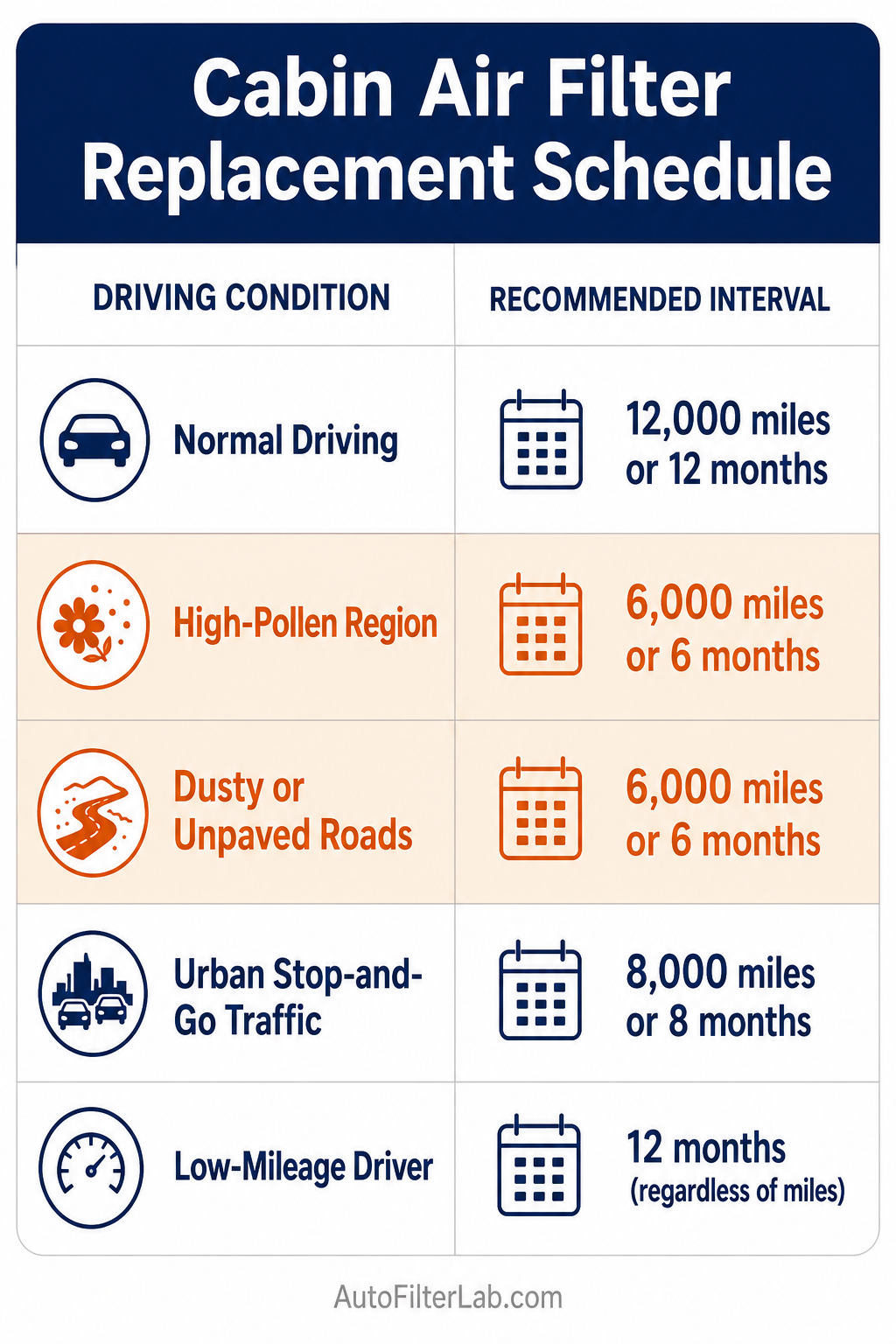
Quick Reference: Cabin Air Filter Replacement Schedule
FAQ
How often should you change a cabin air filter?
Most manufacturers recommend every 12,000 to 15,000 miles or once per year, whichever comes first. Drivers in high-pollen areas, dusty environments, or heavy urban traffic should replace it more frequently — closer to every 10,000 miles or each seasonal peak.
Can you go two years without changing the cabin air filter?
You can, but it is not advisable. After 24 months or 25,000 miles, the filter is almost certainly saturated, regardless of driving conditions. At that point it is restricting airflow, potentially growing mold, and providing little effective filtration. Replace it.
Does a cabin air filter need to be changed every oil change?
Not for most drivers. The oil change recommendation (every 5,000 to 7,500 miles) is more frequent than necessary for average driving conditions. The cabin air filter is designed to last 12,000 to 15,000 miles. Replace it annually or whenever it looks visibly dirty.
What happens if you never change the cabin air filter?
Airflow from the vents weakens, odors develop, and interior air quality drops. Eventually a severely clogged filter puts strain on the blower motor. The filter also stops trapping particles effectively, allowing more pollen, dust, and potentially mold spores to pass into the cabin.
Is there a warning light for a clogged cabin air filter?
No. Most vehicles do not have a sensor for cabin air filter restriction. You have to rely on mileage tracking, visual inspection, or symptoms like weak airflow and unusual odors.
Does the cabin air filter interval change for winter driving?
Not significantly. Cold weather does not clog filters faster on its own. However, if you drive on salted roads or in areas where road grime and dust are heavy in winter, check the filter at your spring inspection. The annual replacement aligns well with a spring service schedule.
Stay on schedule and your cabin air filter will take care of itself. The filter itself is inexpensive and takes most drivers under 15 minutes to replace without tools. When in doubt, pull it out and look at it. The condition tells you everything you need to know.