Dirty Engine Air Filter Symptoms: Signs It Needs Replacing

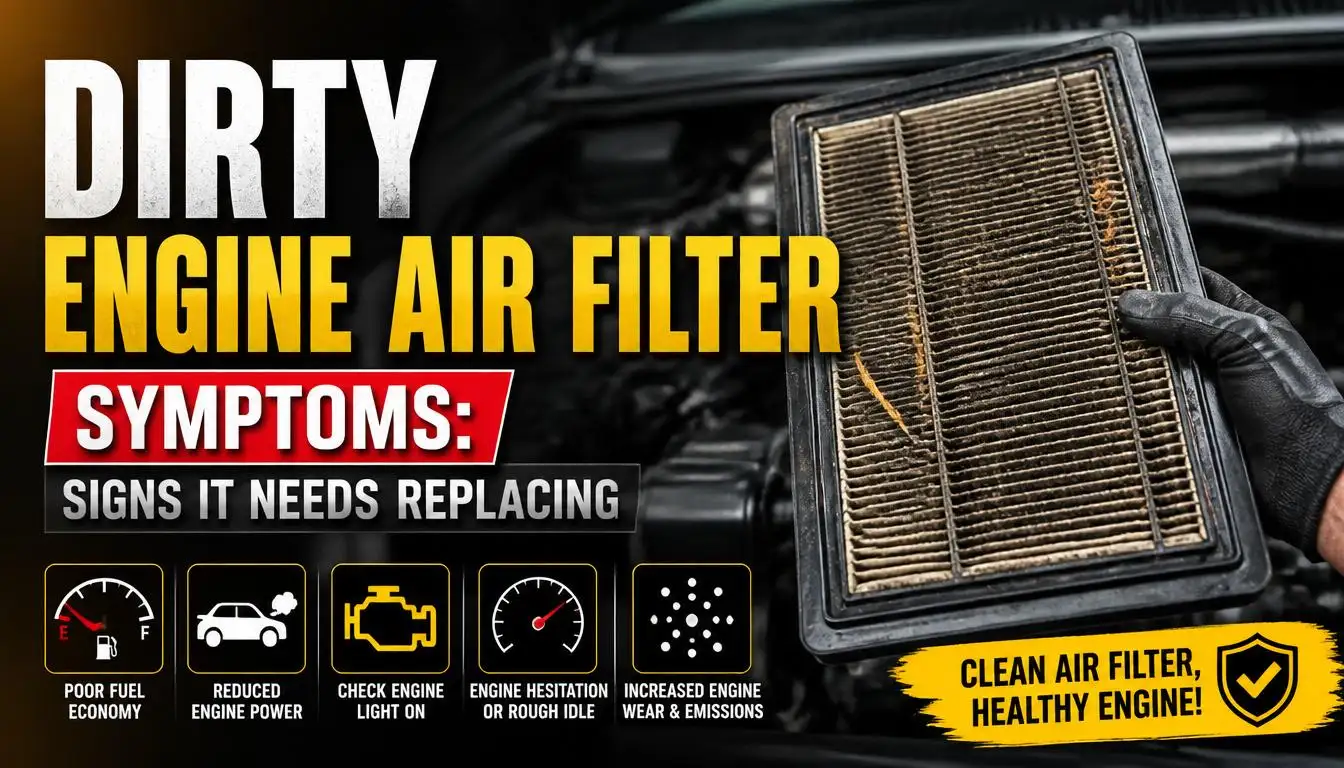
A dirty engine air filter typically shows up as sluggish acceleration, reduced throttle response, and a noticeable drop in fuel economy. In more advanced cases, you may see a check engine light, rough idle, or the engine misfiring under load. The symptoms are gradual, which is exactly why most people miss them until the filter is completely spent.
What Are the Symptoms of a Dirty Engine Air Filter?
Most of the symptoms of a clogged engine air filter come down to one root cause: the engine is not getting enough air. Combustion requires a precise mixture of air and fuel. When air is restricted, that balance is disrupted, and the effects show up across multiple systems.


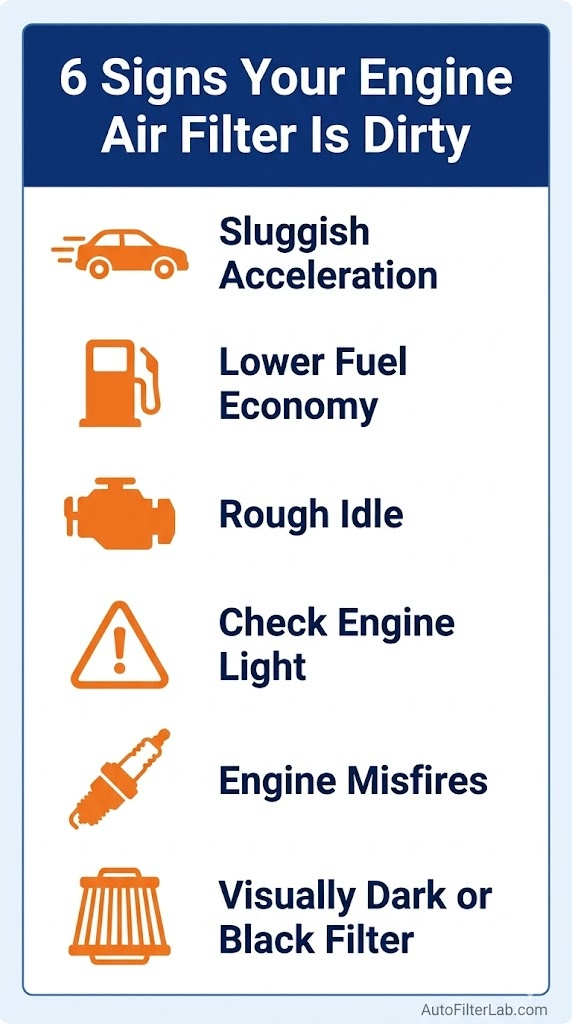
Here is what to watch for:
- Sluggish acceleration — the engine hesitates or feels weak when you press the throttle
- Reduced throttle response — there is a noticeable lag between pressing the gas and the vehicle responding
- Lower fuel economy — you are filling up more often than usual without changing your driving habits
- Rough idle — the engine shakes or surges at a standstill
- Check engine light — the ECU detects an abnormal air-fuel ratio and triggers a code
- Misfires — the engine stumbles under acceleration or at highway speed
- Visually dirty filter — the filter is dark gray or black when pulled for inspection
Not every clogged filter will produce all of these symptoms. Mild restriction often shows up only as sluggishness and slightly worse fuel economy. Severe restriction produces the full set.
Sluggish Acceleration and Weak Throttle Response
This is the most common complaint. You press the gas and the vehicle feels like it is working harder than it should to pick up speed. Passing on the highway takes longer. Merging onto traffic feels sluggish.


Why restricted airflow causes this
An engine produces power through combustion. Combustion needs air. When the air filter is heavily clogged, the volume of air entering the intake is reduced below what the engine needs to run at full output.
Modern fuel-injected engines use sensors to maintain the correct air-to-fuel ratio. When air is restricted, the engine management system compensates by pulling back fuel delivery to avoid running excessively rich. The result is less power, not because something is broken, but because the engine is deliberately throttled back to maintain combustion stability.


You feel this as sluggishness, hesitation on the throttle, and a general lack of responsiveness. The more clogged the filter, the more pronounced the effect.
Reduced Fuel Economy
A dirty engine air filter can cause a measurable drop in fuel economy, though modern vehicles handle this differently than older ones did.
How the fuel economy impact works
On older carbureted engines, a clogged air filter caused a rich condition: the carburetor continued delivering fuel even as airflow dropped, leading to incomplete combustion and wasted fuel. An Oak Ridge National Laboratory study found that a severely clogged air filter reduced fuel economy by up to 14% on older carbureted engines.
Modern fuel-injected engines are more adaptive. The ECU reduces fuel delivery to match the restricted air supply, which limits the direct fuel waste. However, the engine is now producing less power, so the driver instinctively presses harder to maintain the same pace. That extra throttle input burns more fuel. The net result is still a fuel economy penalty, just through a different mechanism.
If you notice you are getting fewer miles per tank without any change in driving habits or season, the air filter is one of the first things worth checking.
Check Engine Light
A clogged engine air filter can trigger a check engine light, though it is not the most common cause compared to other issues like oxygen sensor failures or spark plugs.
What codes appear
A clogged filter creates a rich condition: the engine receives less air than expected while fuel delivery remains calibrated to the original airflow. On older carbureted vehicles this directly causes rich running. On modern fuel-injected vehicles the ECU compensates, but severe restriction can still push fuel trims outside normal range.
The codes most commonly associated with dirty or compromised air filters are:
- P0172 or P0175 (System Rich, Bank 1 or Bank 2) — triggered when the fuel trim correction indicates the mixture is running too rich. In severe restriction cases, the ECU's ability to compensate has a limit.
- P0101 (Mass Air Flow Sensor Circuit Range/Performance) — a heavily clogged filter reduces airflow below what the MAF sensor expects for a given throttle position. This can produce a performance fault code on the MAF circuit.
- P0171 or P0174 (System Lean) — these lean codes can appear when a degraded filter allows unfiltered air past the media, or when the MAF sensor itself becomes contaminated from a filter that is shedding debris. A dirty MAF under-reports airflow, causing the ECU to under-fuel the engine.
Not every vehicle will throw a code from a dirty filter. Many will simply run with reduced performance and efficiency without illuminating the warning light. If you see any of these codes with no other obvious cause, inspect the air filter before replacing sensors.
Rough Idle and Engine Misfires
These symptoms indicate a more advanced stage of restriction. You are unlikely to see rough idle or misfires from a filter that is only moderately dirty. For a complete breakdown of how a dirty air filter causes engine problems, including misfires, check engine codes, and long-term damage, see the full guide.
What causes rough idle from a dirty filter
At idle, the engine runs at its lowest RPM and draws the least amount of air. A severely clogged filter can reduce airflow enough at idle that the air-fuel mixture becomes unstable. The idle speed may fluctuate, the engine may shake or surge, or you may feel vibration through the steering wheel or floorboard.
What causes misfires
Misfires from a dirty air filter happen through two related mechanisms. First, severe restriction disrupts the air-fuel mixture enough to cause incomplete combustion in one or more cylinders. Second, and more commonly, a long-neglected filter running a rich mixture causes excess unburnt fuel to deposit on spark plugs as carbon. Carbon-fouled spark plugs misfire, idle roughly, and cause hard starts even after the air filter is replaced. That is why the advice is always: replace the filter before it gets to this stage.
You will feel active misfires as a stumble or shudder under acceleration or at highway speed. A misfire code (P0300 series) with no other obvious cause is worth investigating with an air filter inspection before chasing other diagnoses.
What Does a Dirty Engine Air Filter Look Like?
Visual inspection is the most reliable way to assess a filter's condition. Pull it from the airbox and hold it up to a light source.
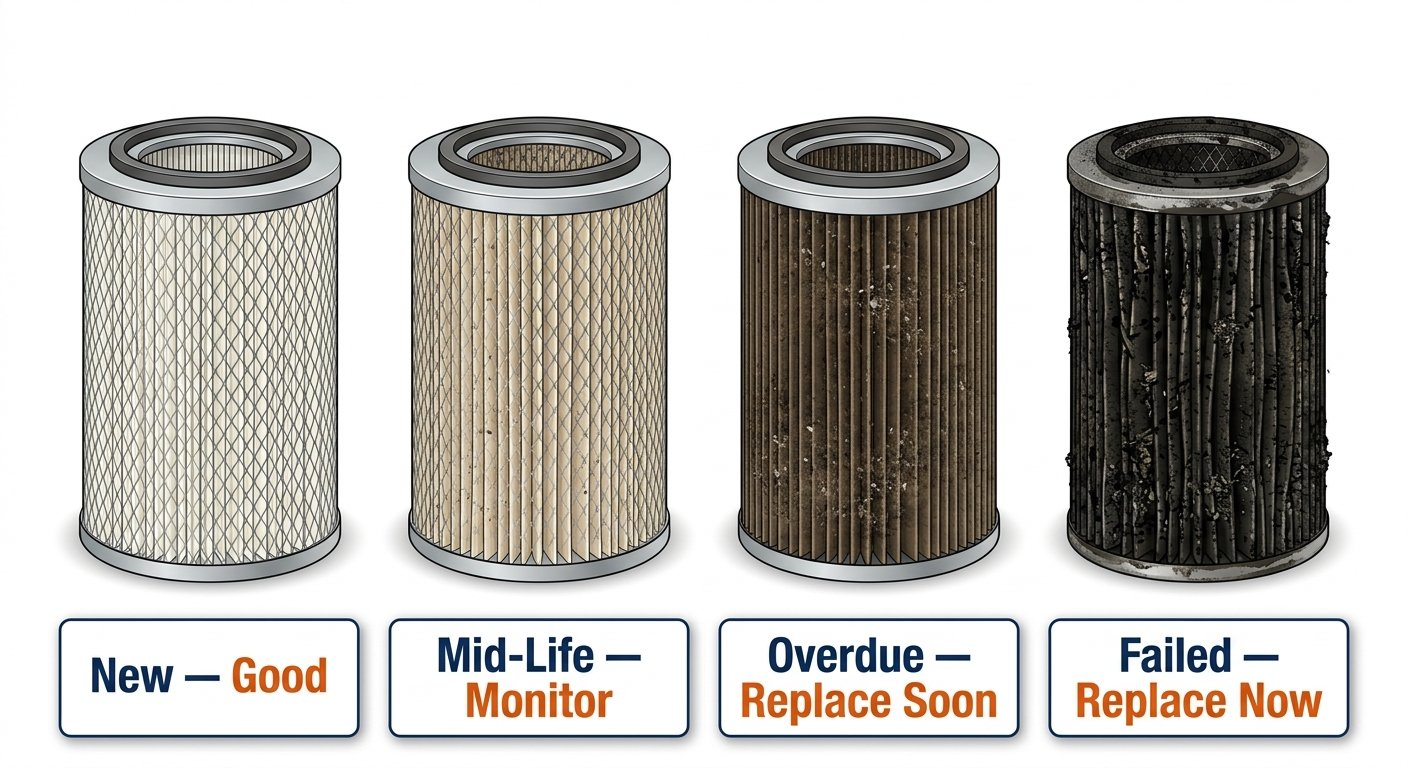
Color progression by condition:
The 50% rule: If the filter looks 50% dirty, treat it as needing replacement. A heavily loaded filter begins restricting airflow before it looks completely black. Waiting for full saturation means you have already been running with reduced performance for some time.
The tap test offers a secondary check. Take the filter outside and tap it firmly against a hard surface. If a visible cloud of fine dust falls out, it is past its useful life. If little or nothing comes out, it has filtering capacity remaining.
Is the Air Filter Causing the Problem, or Something Else?
Sluggish acceleration, rough idle, and check engine lights all have multiple possible causes. The air filter is worth ruling out first because it is cheap, quick to inspect, and easy to replace.
Rule out the air filter first if you see any of these
- Sluggish acceleration with no other symptoms
- Fuel economy drop without any recent mechanical changes
- Check engine codes P0172, P0175, P0101, or P0300 series
- Rough idle that started gradually, not suddenly
Signs the air filter is NOT the cause
- Sudden loss of power, not gradual
- Misfires accompanied by rough running on a specific cylinder (typically a spark plug or coil issue)
- Fuel economy drop accompanied by engine noise or smoke
- Check engine light showing codes unrelated to airflow or fuel trim (e.g., P0420 catalytic converter efficiency)
When symptoms are sudden and severe, the air filter is rarely the culprit. Clogged filters produce gradual degradation, not sudden failures.
What Happens If You Ignore a Dirty Engine Air Filter?
Short term, you deal with reduced performance, worse fuel economy, and occasional rough running. Long term, the risks escalate.
Physical filter failure
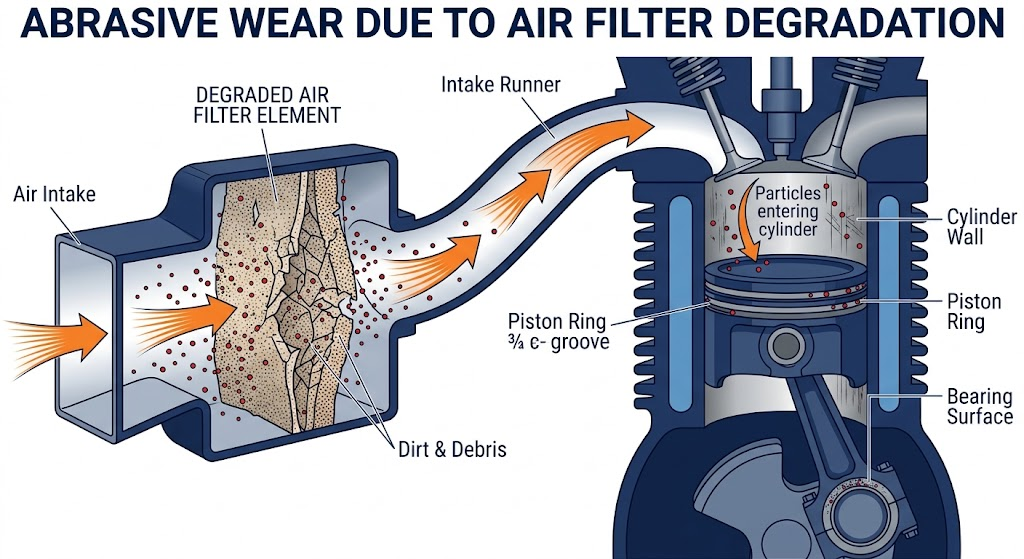
A severely clogged filter that is never replaced will eventually reach a point where debris begins to shed back into the airstream, or the filter medium itself degrades and tears. At that point, unfiltered air carrying abrasive particles enters the engine.
Fine particles of dirt and sand in the oil cause accelerated wear on cylinder walls, piston rings, and bearings. This kind of damage accumulates invisibly. By the time you feel it in the form of oil consumption or engine noise, significant wear has already occurred.
Turbocharger strain
On turbocharged vehicles, a severely restricted air filter puts additional strain on the turbocharger. The turbo has to work harder to pull air through the restriction. Over time, this can contribute to premature turbo wear, particularly the compressor wheel bearings.
Sensor contamination
On oiled cotton gauze performance filters that are over-oiled or have reached end of life, filter oil can migrate onto the mass airflow sensor. MAF contamination causes erratic readings and can produce a range of drivability symptoms. This is less of a concern with standard paper filters.
FAQ
What are the symptoms of a dirty engine air filter?
The most common symptoms are sluggish acceleration, reduced throttle response, and a drop in fuel economy. In more severe cases, a clogged filter can cause rough idle, engine misfires, or trigger a check engine light with rich condition or MAF sensor codes. A visual inspection remains the most reliable diagnostic: a filter that is dark brown to black and blocks light needs immediate replacement.
Can a dirty engine air filter cause a check engine light?
Yes. A severely restricted filter can trigger rich condition codes (P0172, P0175), a MAF sensor performance code (P0101), or misfire codes (P0300 series) from spark plug fouling. Lean codes (P0171, P0174) can appear if the filter is degraded and allowing unfiltered air past the media, or if debris has contaminated the MAF sensor. Not all clogged filters trip a warning light, but if you see these codes with no other clear cause, inspect the air filter first.
Can a dirty air filter cause rough idle?
Yes, but only when the restriction is severe. A moderately dirty filter rarely causes rough idle. When airflow is restricted badly enough, the air-fuel mixture at idle becomes unstable. The idle speed may fluctuate, or you may feel vibration through the car at a standstill. If the rough idle started gradually and you cannot remember the last air filter change, start there.
Does a dirty engine air filter reduce fuel economy?
Yes. On modern fuel-injected engines, the ECU compensates for restricted air by reducing fuel delivery, which limits power output. Drivers then press harder to maintain speed, burning more fuel. The effect is measurable though smaller than on older carbureted engines, where fuel economy losses of up to 14% were documented.
How do I know if my engine air filter is dirty?
Pull it from the airbox and hold it up to a light source. A clean filter is white or off-white. A filter that needs replacing is dark gray to black, and light barely passes through the pleats. If you see visible debris packed into the folds, or any tears in the media, replace it immediately.
How long can you drive with a dirty engine air filter?
A moderately dirty filter will not cause immediate damage. Performance and fuel economy will be reduced. A filter that is severely clogged, visibly black, or structurally compromised should be replaced as soon as possible. A new paper filter typically costs $15 to $50 depending on the vehicle and brand, which is far less than the cost of engine wear from continued neglect.
The Bottom Line
A dirty engine air filter degrades your driving experience before it ever causes serious damage. Sluggish acceleration and worse fuel economy are the first signs. Rough idle, misfires, and warning lights follow if the filter is badly neglected.
The fix is a $15 to $50 part and ten minutes of your time. Inspect the filter at every oil change. If it looks more than halfway loaded with debris, replace it. Do not wait for a symptom to force the issue.