How to Replace an Engine Air Filter: Step-by-Step Guide

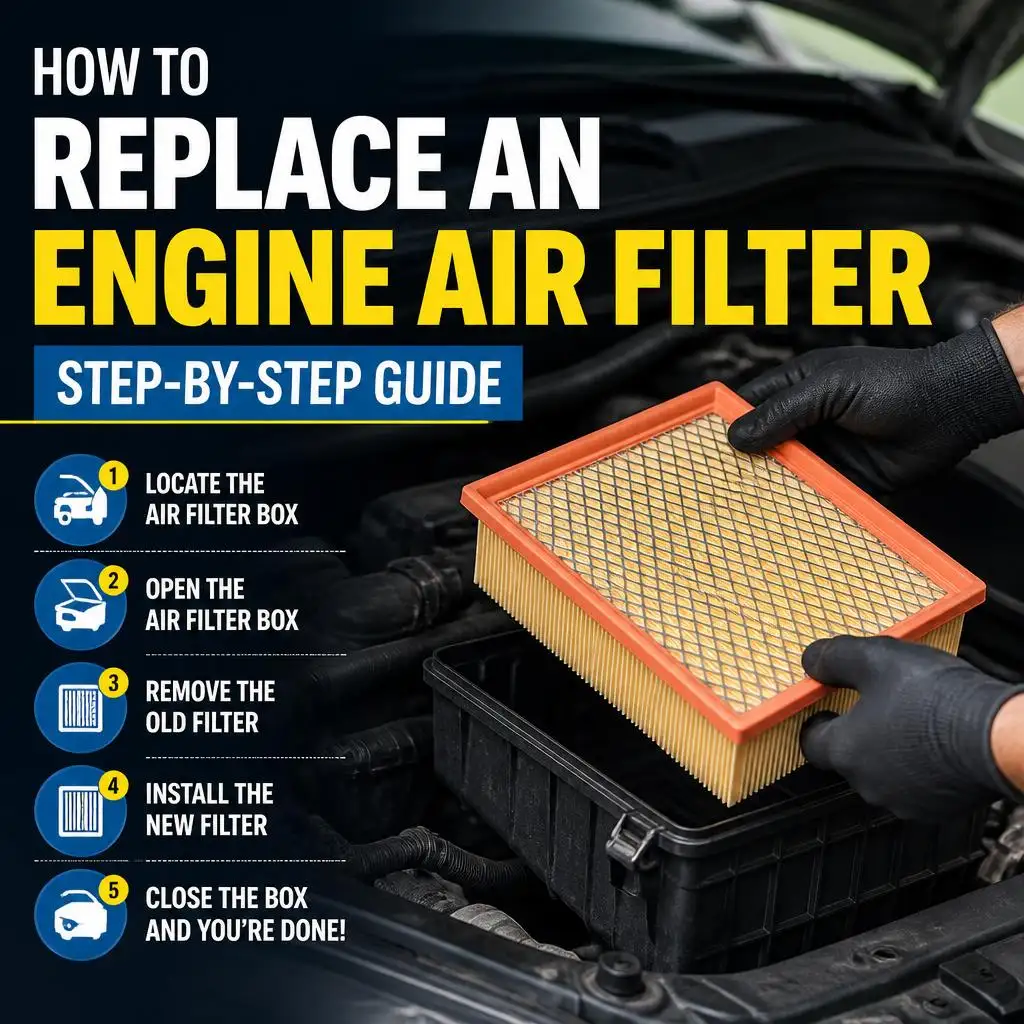
Replacing an engine air filter is one of the easiest maintenance jobs you can do yourself. It takes 5 to 15 minutes, requires no tools on most vehicles, and costs under $30 for parts. You open the air box, pull the old filter out, drop in the new one, and close it back up. That's the whole job.
Here is exactly how to do it on any vehicle.


What You Need Before You Start
You do not need special tools for most vehicles. The air box on the majority of cars and trucks uses clips, tabs, or simple screws that can be loosened by hand or with a basic flat-head screwdriver.
What to have ready:
- The correct replacement filter for your year, make, and model (look this up before you buy)
- A flat-head screwdriver (some air box clips need light prying)
- A rag or shop towel
- A can of compressed air (optional, for cleaning the air box interior)
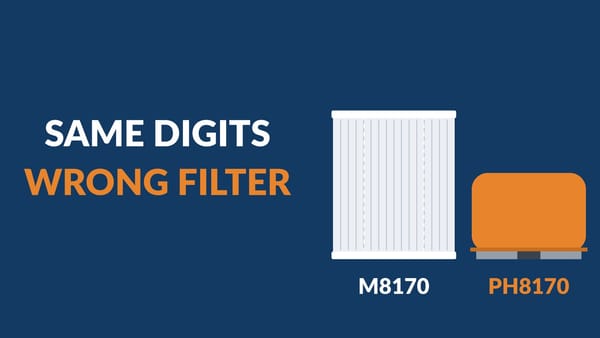
The most important prep step is getting the right filter. Engine air filters are vehicle-specific. An F-150 filter is a completely different shape and size than a Camry filter. Use your vehicle's year, make, model, and engine size to look up the correct part number before you buy anything.


How to Find Your Engine Air Filter
The engine air filter lives inside the air box, a plastic housing connected to the intake ducting in the engine bay.
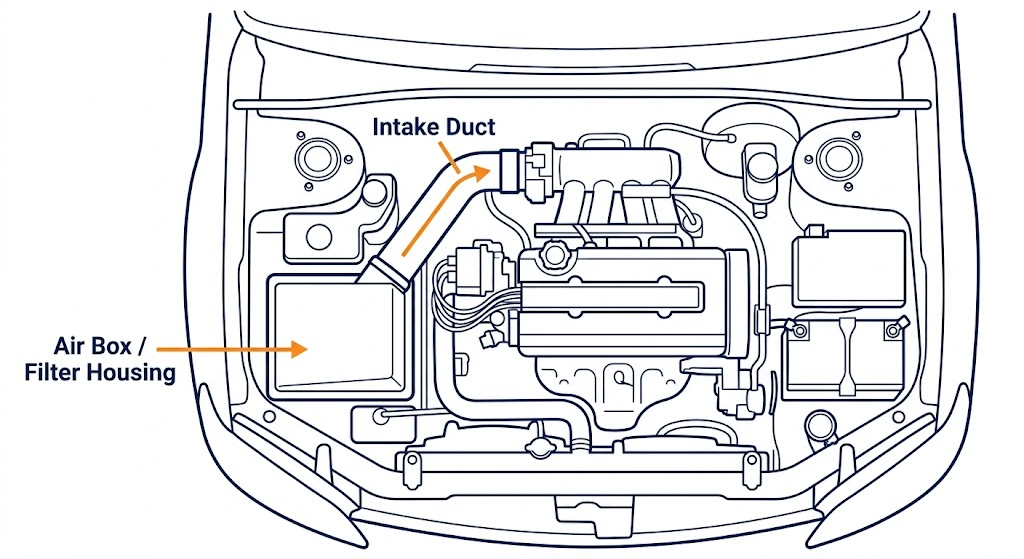
Open the hood and look for a large plastic box, usually near one of the front corners of the engine bay. A thick plastic duct runs from the air box toward the engine's throttle body. Follow that duct toward the box and you have found it.


On most modern vehicles, the air box is black or dark gray and has some form of latching lid. Some air boxes open with a simple flip of two or three wire clips. Others have a couple of screws or bolts holding the lid down.
On older carbureted vehicles, the filter sits inside a round canister mounted directly on top of the carburetor. The lid is held by a single wing nut in the center.


If you are having trouble locating the air box, check the owner's manual. There is usually a diagram of the engine bay that shows filter location.
Step-by-Step: How to Replace the Engine Air Filter
Step 1: Park safely and let the engine cool
Turn the engine off. You do not need to wait for a fully cold engine. The air filter is nowhere near the exhaust or hot engine components. But give it a minute or two after shutting down before you start reaching around in the engine bay.


Step 2: Open the hood and locate the air box
Pop the hood and find the air box using the method described above. Look for the large plastic housing connected to the intake duct.
Step 3: Release the air box clips or screws
Most air boxes use wire bail clips (the metal clips that hinge outward) or plastic push tabs. Work your way around the lid, releasing each clip or tab. There are usually two to four clips total.
If the air box uses screws or bolts, use a screwdriver or socket to remove them. Most air box screws are 8mm or 10mm.
You do not need to fully disconnect the intake duct on most vehicles. The lid typically lifts enough to access the filter without detaching anything.
Step 4: Open the lid and note the filter orientation
Lift or fold back the air box lid. Before touching the old filter, look at how it sits in the housing. Note which direction it faces and how the edges seat against the housing walls.
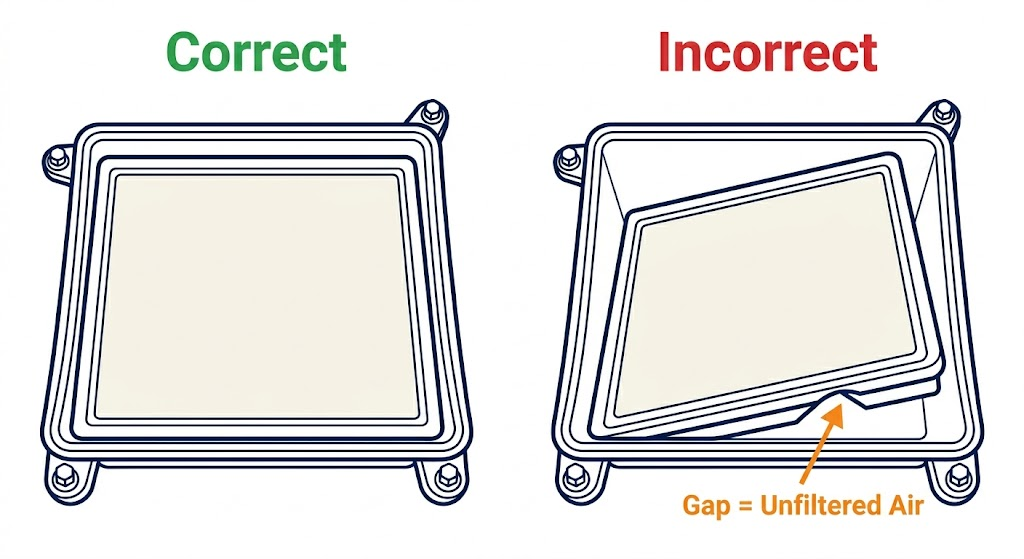
Most filters have a specific top and bottom, and a specific front-to-back orientation. Some filters are labeled with an airflow direction arrow. Others are not, but the shape of the filter itself only fits one way.
Take a mental note or snap a quick photo before removing the old one.
Step 5: Remove the old filter
Lift the old filter straight out of the air box. It may be snug against the housing walls. Grip the filter body firmly and pull it free. Avoid tilting it sideways as you pull it out. Dirt and debris are sitting on the filter surface, and shaking it can dislodge particles back into the air box.
Set the old filter aside on a rag.
Step 6: Inspect and wipe out the air box
With the filter out, look inside the air box. Check for any debris that may have collected at the bottom. Insects, leaves, and loose dirt sometimes get in.
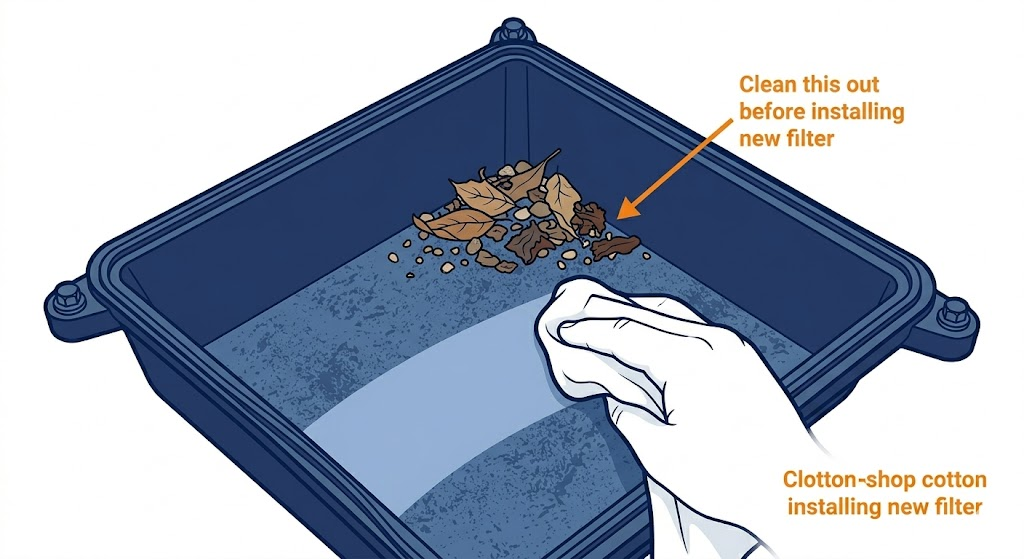
Wipe the interior with a clean rag. If there is visible debris, use a shop vacuum or compressed air to clean it out. Do not skip this step. Any debris left in the housing can get pulled into the engine intake once the new filter is in.
Step 7: Install the new filter
Orient the new filter the same way the old one sat. Set it into the housing so all four edges seat flush against the walls. Press down lightly around the perimeter to confirm the filter is fully seated with no gaps.
Gaps matter. If the filter does not seat fully against the housing, unfiltered air can bypass the filter medium and enter the intake directly. That is exactly what you are trying to prevent.
Check that the filter sits flat and even. There should be no rocking or looseness.
Step 8: Close and secure the air box lid
Set the lid back down on the air box. Align it so it sits flush. Engage all clips, tabs, or screws in the reverse order you removed them. Make sure every clip is fully seated. A clip that looks almost closed but is not fully engaged will allow the lid to lift under pressure from intake vacuum.
Give the lid a firm press around the perimeter after all clips are engaged.It should feel solid with no flex or looseness.
Step 9: Start the engine and check for issues
Start the engine and let it idle for 30 to 60 seconds. Listen for any unusual sounds: a rushing air leak sound near the air box, hesitation at idle, or any rattling from the engine bay.
No issues means the job is done.
Common Mistakes to Avoid
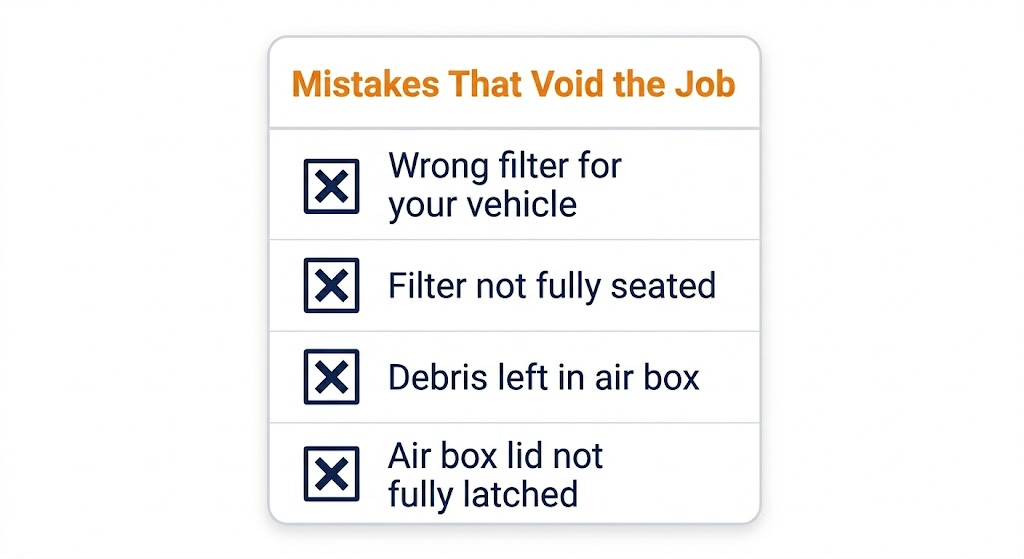
Installing the filter upside down or backwards
A filter installed in the wrong orientation may not seal properly. Always confirm the orientation before closing the air box. If the filter has a printed airflow direction arrow, that arrow points toward the engine.
Not fully seating the filter
A filter that is not flush against all four housing walls leaves gaps for unfiltered air to bypass the filter. Always press the perimeter down and check for gaps before closing the lid.
Leaving debris in the air box
Debris in the bottom of the air box gets sucked into the intake once the engine starts. Wipe it out before installing the new filter.
Buying the wrong filter
Engine air filters are vehicle-specific. An incorrect filter may not fit the housing, which means it will not seal correctly even if you force it in. Always confirm the part number using year, make, model, and engine size.
Using an oiled aftermarket filter without rechecking the MAF sensor
If you are switching from a paper filter to an oiled cotton gauze performance filter, be aware that over-oiling can cause filter oil to transfer onto the mass airflow sensor downstream. This can cause rough running, poor fuel economy, and error codes. If you notice any of these after switching filter types, inspect the MAF sensor.
How Long Does an Engine Air Filter Replacement Take?
For most vehicles, the job takes between 5 and 15 minutes from start to finish. Vehicles with straightforward air box clips fall at the lower end. Vehicles where the air box is tightly packed between other components, or where the lid requires removing a small bracket or hose, fall closer to 15 minutes.
First-timers can add another 5 to 10 minutes for locating the air box and reading the filter orientation. By the second time, it is a sub-10-minute job.
Do You Need a Mechanic to Change the Engine Air Filter?
No. This is one of the simplest maintenance tasks on any vehicle. No specialized knowledge, no lifts, no tools beyond a screwdriver in some cases. A shop will typically charge $37 to $55 in labor to do what you can do in 10 minutes for free.
The one exception: some vehicles, particularly late-model European cars, have air boxes buried under multiple components or housed inside the wheel well. If you cannot locate the air box after 10 minutes of looking, consult a vehicle-specific forum or the owner's manual before proceeding. It may be in an unconventional location.
What Happens If You Never Change the Engine Air Filter?
A filter that is never replaced eventually becomes so restricted that airflow to the engine drops substantially. The engine compensates by running a richer mixture, which wastes fuel and fouls spark plugs over time. Throttle response suffers. Fuel economy drops. In extreme cases, the filter media itself can deteriorate and allow debris to pass through into the intake.
The filter is a low-cost consumable part. Neglecting it risks expensive engine wear and fuel system problems that cost far more to fix.
FAQ
How do I know if my engine air filter needs to be replaced?
Pull it out and hold it up to a light source. If light passes through clearly, the filter has life remaining. If the medium is gray, tan, or dark and light is partially or fully blocked, it is time to replace it. A filter that looks visibly dirty on the intake side or smells musty should be replaced regardless of mileage.
Can I clean my engine air filter instead of replacing it?
For standard paper or cellulose filters, no. Washing a paper filter degrades the filter medium and removes the electrostatic charge that aids particle capture. Replace paper filters rather than trying to clean them. Oiled cotton gauze filters, like K&N, are designed to be washed and re-oiled on a specific schedule. Use only the manufacturer's cleaning kit to do it correctly.
How often should I change my engine air filter?
Most manufacturers recommend every 15,000 to 30,000 miles under normal driving conditions. If you drive frequently on dusty unpaved roads, in heavy construction zones, or in desert environments, the interval is closer to 10,000 to 15,000 miles. Check the owner's manual for your specific vehicle's recommendation.
Will a dirty engine air filter affect my gas mileage?
Yes. A restricted air filter changes the air-fuel ratio the engine is delivering, which reduces combustion efficiency. The effect is gradual and hard to notice until the filter is quite dirty, but fuel economy loss is a confirmed consequence of running a severely clogged filter.
Is it okay to drive with the air box lid off?
No. Driving without the air box lid means completely unfiltered air enters the intake. Dust, debris, and grit go directly into the combustion chamber. Even a short drive like this can cause measurable abrasive wear on cylinder walls and piston rings. Always replace and secure the lid before starting the engine.
Can I use any brand of engine air filter?
Stick to filters that match your vehicle's specifications. Most aftermarket brands (FRAM, Purolator, WIX, K&N, Bosch) offer filters that meet or exceed OEM specifications for your vehicle. Avoid no-name filters with poor fit or suspiciously low prices. A filter that does not seat properly in the housing defeats the purpose entirely.
A Quick Recap
Changing an engine air filter takes 5 to 15 minutes and needs no special tools on most vehicles. Open the air box, pull the old filter, wipe out any debris, drop in the new filter in the correct orientation, close and latch the lid, and start the engine. Check for the correct replacement filter by year, make, model, and engine size before you buy. Replace it every 15,000 to 30,000 miles under normal conditions, or more often if you drive in dusty or demanding environments.