OEM vs Aftermarket Air Filter: High-Flow vs Stock Explained

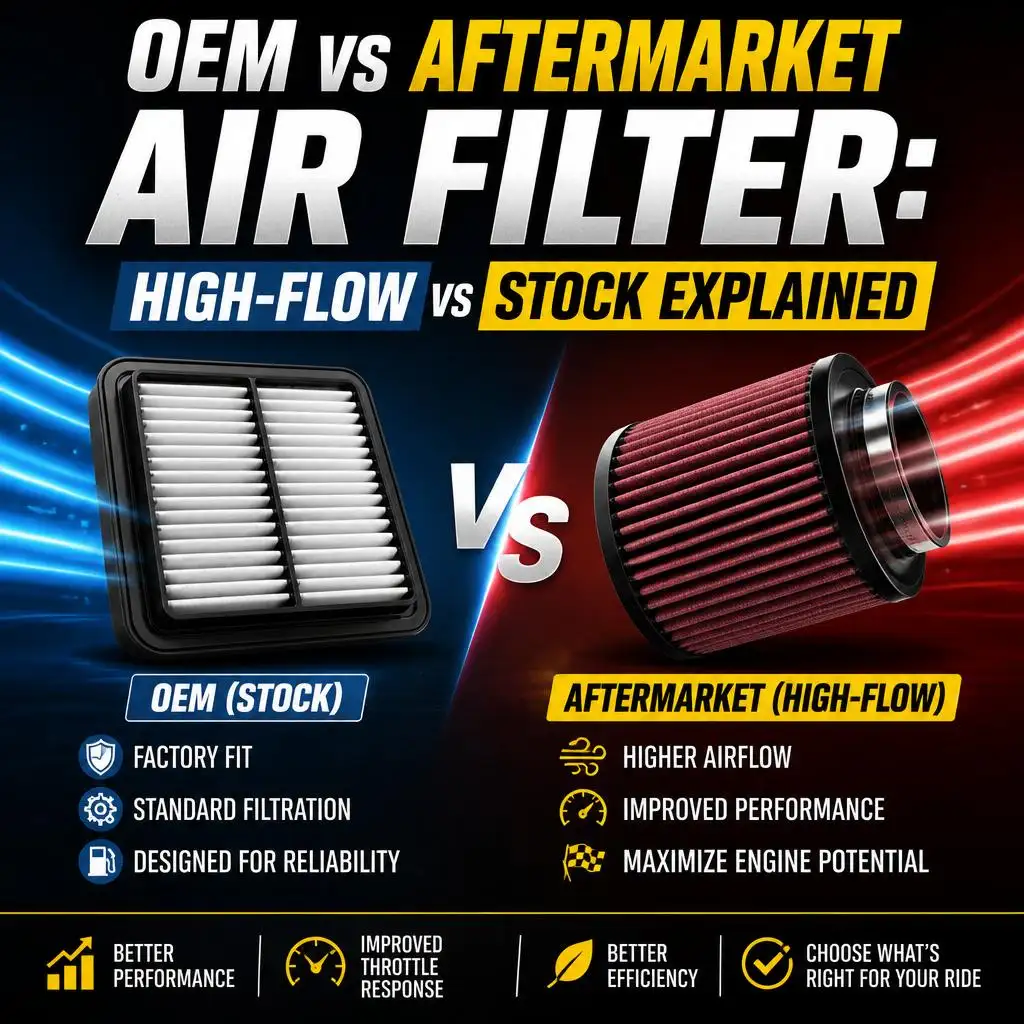
OEM air filters prioritize filtration efficiency and quiet operation. Aftermarket high-flow filters prioritize airflow and are reusable, but they filter less aggressively. For most daily drivers, OEM is the safer choice. For performance-tuned vehicles with supporting modifications, a high-flow filter can add real value.
What Is the Difference Between an OEM and Aftermarket Engine Air Filter?
Your car comes from the factory with an OEM air filter. OEM stands for Original Equipment Manufacturer. That filter was engineered specifically for your engine's airbox geometry, airflow requirements, and filtration targets.


Aftermarket air filters are made by third-party companies to fit the same housing. Some are designed as direct replacements that match OEM specs. Others are specifically built for higher airflow, using different filter media and construction to let more air pass through with less restriction.
The two most recognized names in high-flow aftermarket filters are K&N and aFe Power. Both make oiled cotton gauze filters that fit directly in your factory airbox. These are the products most people are asking about when they search "OEM vs aftermarket air filter."


The Core Engineering Trade-Off
A filter can be optimized for one of two things: maximum filtration efficiency or maximum airflow. These goals pull in opposite directions.
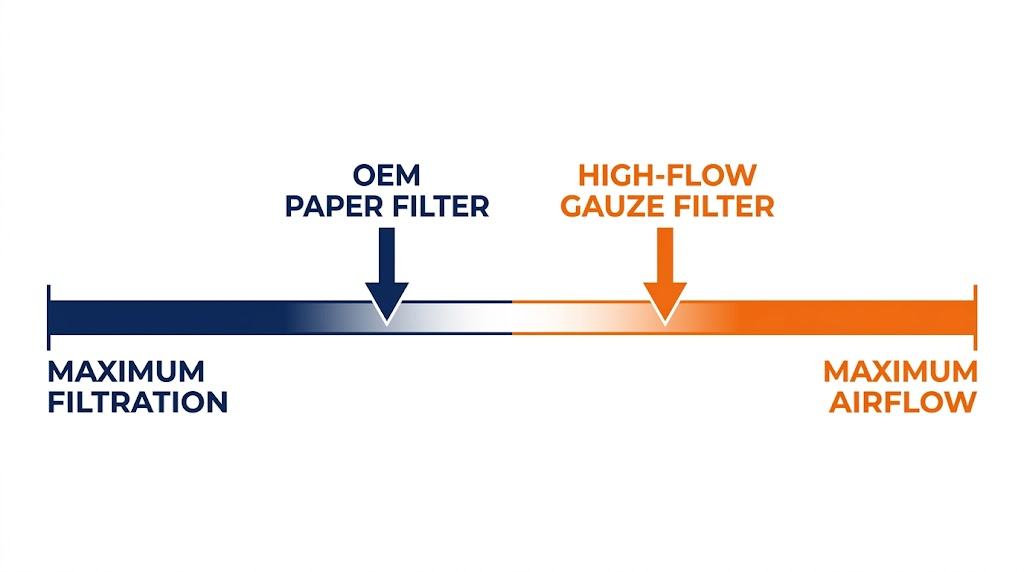
Dense filter media catches more particles but creates more restriction. Open media allows more airflow but lets finer particles through. OEM filters are calibrated toward filtration. High-flow aftermarket filters are calibrated toward airflow.


This trade-off is real. It is the central question every buyer needs to understand before choosing.
How Do Paper Stock Filters Compare to Oiled Cotton Gauze Filters?
Most OEM filters use pleated cellulose or synthetic paper media. Aftermarket high-flow filters typically use layers of oiled cotton gauze stretched over a wire mesh frame.
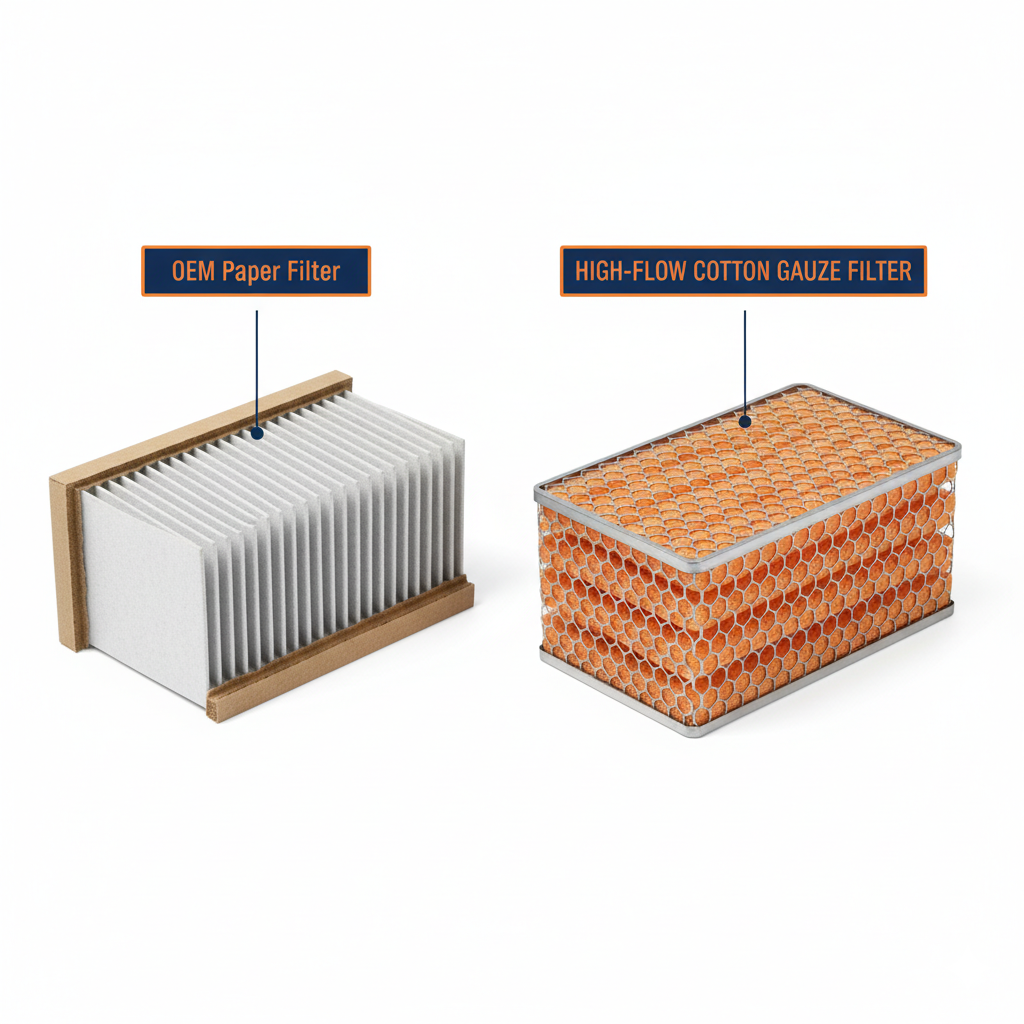
Paper (Cellulose and Synthetic Blend) Filters
Stock paper filters are single-use. When they are full, you replace them. They offer consistent, predictable filtration performance throughout their service life. They do not require any maintenance between changes.
Modern OEM and premium replacement filters use a blend of cellulose and synthetic fibers. The synthetic component adds strength and fine-particle capture. These filters are engineered to meet or exceed the filtration spec the automaker defined for that engine.
Oiled Cotton Gauze Filters
High-flow filters use multiple layers of cotton gauze that are oiled before installation. The oil creates a sticky barrier that catches particles as they pass through. More layers mean higher filtration but more restriction. K&N typically uses 4 to 6 layers of cotton gauze depending on the application.
The key advantage is longevity. A properly maintained oiled cotton gauze filter can last the life of the vehicle. K&N claims up to 50,000 miles between cleanings under normal driving conditions. The filter is washed, re-oiled, and reinstalled rather than replaced.
The key risk is improper re-oiling. Too much oil contaminates the MAF sensor. This is a known issue with oiled filters and is discussed in detail below.
Does a High-Flow Air Filter Actually Improve Performance?
This is the most important question, and the honest answer is: slightly, under specific conditions.
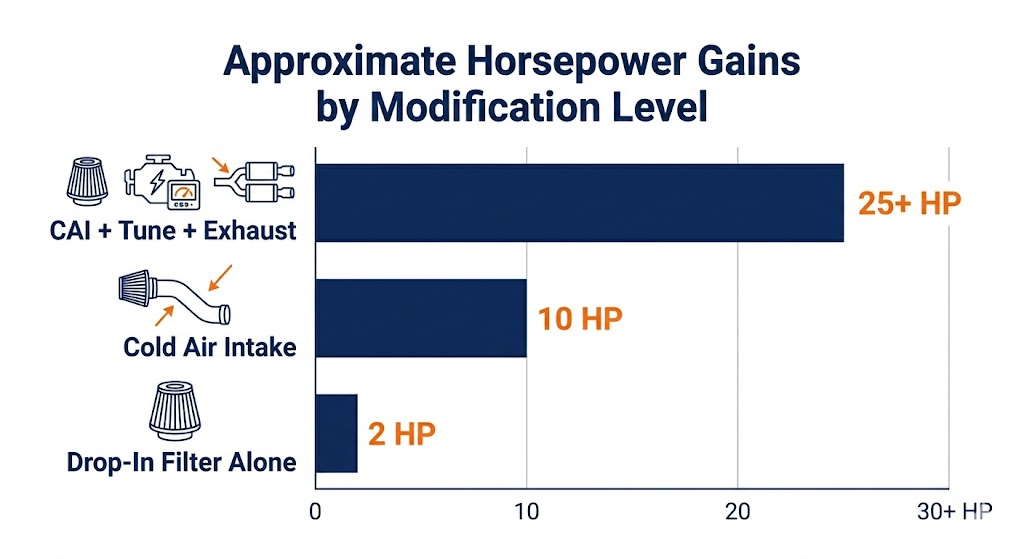
On a Stock, Unmodified Engine
A high-flow drop-in filter replacing the stock paper filter in a factory airbox produces minimal measurable gains. The airbox itself, the intake tubing diameter, and the throttle body are all still the same. Swapping only the filter element rarely produces noticeable seat-of-the-pants feel.
Dyno tests on stock vehicles typically show gains of 0 to 5 horsepower with a drop-in high-flow filter alone. For a 200 horsepower engine, that is a rounding error.
On a Modified or Tuned Engine
Where high-flow filters earn their reputation is in modified applications. An engine with a performance exhaust, a tune, or a cold air intake is already moving more air than stock. In that context, a restrictive OEM filter becomes a bottleneck. A high-flow filter removes one of the choke points in the intake path.
The gains compound with supporting modifications. A high-flow filter paired with a cold air intake, larger throttle body, and an ECU tune can contribute meaningfully to total power output. But attributing the gains to the filter alone is nearly impossible.
On Diesel Engines
High-flow aftermarket diesel filters exist but are less common. Diesel filtration requirements are extremely stringent because diesel injection systems operate at very high pressures and are highly sensitive to particulate contamination. Most diesel owners and diesel specialists recommend staying with OEM or premium OEM-spec replacements.
What Are the Pros and Cons of a High-Flow Air Filter?
Pros
Reusability. One filter can last the entire ownership period of the vehicle when properly maintained. This eliminates recurring filter replacement costs.
Potential airflow improvement. In applications where intake restriction is a bottleneck, a high-flow filter reduces that restriction and can support more power.
Distinctive sound. High-flow filters produce a more pronounced induction noise at wide-open throttle. Many enthusiasts like the sound. Others find it intrusive.
Cons
MAF sensor contamination risk. Over-oiling during cleaning and re-oiling is the single biggest risk with oiled cotton gauze filters. If excess oil reaches the MAF sensor, it coats the sensing wire and causes incorrect airflow readings. This can trigger a check engine light, cause rough running, or reduce fuel economy. The sensor may need cleaning or replacement. Subaru has issued a technical service bulletin specifically addressing this issue with over-oiled aftermarket filters.
Lower filtration efficiency. High-flow filters allow finer particles through than most OEM paper filters. For a high-mileage engine, or an engine operating in dusty environments, this is a meaningful trade-off.
Maintenance requirement. A reusable filter requires periodic cleaning and re-oiling. Skipping this, or doing it incorrectly, defeats both advantages.
Cost. A quality high-flow drop-in filter runs $50 to $80 or more. OEM and standard replacement filters typically cost $20 to $50 depending on vehicle.
Is an OEM Air Filter Better for Filtration Efficiency?
Yes, in most cases. OEM and premium OEM-replacement paper filters are designed to meet the filtration specifications required to protect your specific engine.
Engine tolerances in modern vehicles are extremely tight. The clearance between piston rings and cylinder walls can be as small as a few microns. Even fine dust particles can cause accelerated wear over tens of thousands of miles. OEM filters are calibrated to stop the particle sizes that would cause this wear.
Most standard paper air filters capture particles in the 5 to 10 micron range. Premium synthetic blends capture even finer particles. High-flow oiled cotton filters tend to be less efficient at fine-particle filtration, particularly when they are not properly oiled.
For daily drivers in typical suburban or urban environments, this difference may not manifest in engine wear over a normal ownership period. For vehicles operating in agricultural areas, construction zones, or dusty unpaved roads, the difference is meaningful.
Can an Aftermarket Air Filter Void My Car's Warranty?
This is a common concern, and the answer is more nuanced than a simple yes or no.
In the United States, the Magnuson-Moss Warranty Act prohibits manufacturers from voiding your warranty simply because you installed an aftermarket part. They must demonstrate that the aftermarket part caused the specific failure they are denying coverage for.
So a dealer cannot void your entire powertrain warranty because you installed a K&N filter. However, if you bring in an engine with a failed MAF sensor and there is oily residue on it consistent with filter over-oiling, the dealer has a reasonable case that your aftermarket filter caused that specific failure.
The practical implication: using a high-flow filter does not void your warranty broadly. But if an aftermarket filter causes a specific component failure, warranty coverage for that component may legitimately be denied.
What Is a Cold Air Intake and How Is It Different From Just Swapping the Filter?
A drop-in high-flow filter is a filter element swap. Everything else, including the airbox, the intake piping, and the air filter location, stays exactly where it is from the factory.
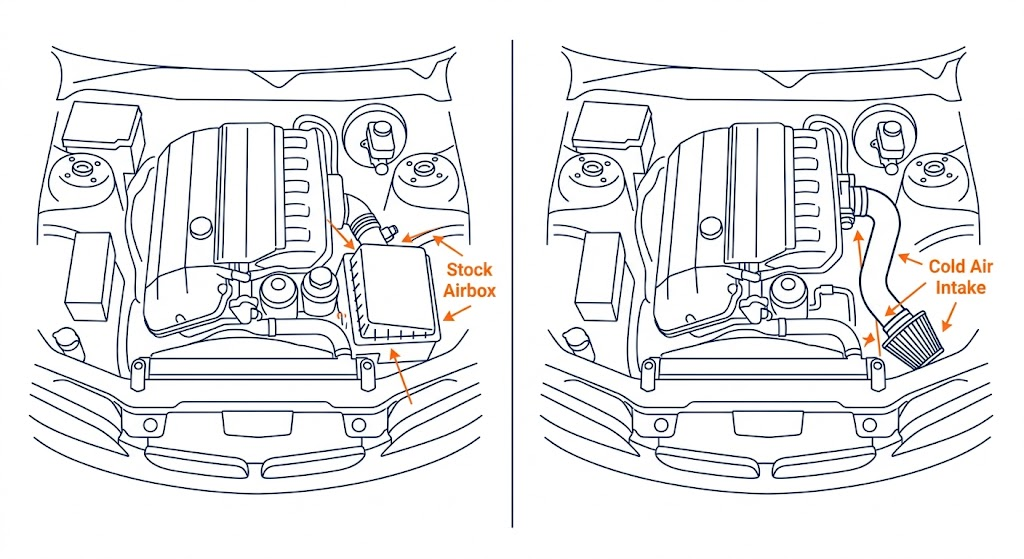
A cold air intake is a system that replaces the entire factory intake path: the airbox, the intake tube, and sometimes the filter housing location. Cold air intakes move the filter outside the engine bay or to a lower position where temperatures are cooler.
Why Does Air Temperature Matter?
Cooler air is denser. Denser air contains more oxygen molecules per unit of volume. More oxygen supports more complete combustion, which produces more power. This is the principle behind cold air intakes.
Engine bays get extremely hot, especially around the exhaust manifold. Factory airboxes often draw in pre-heated underhood air rather than cooler outside air. A cold air intake routes the intake path to a cooler source.
Real-World Gains From a Cold Air Intake
Cold air intakes produce more consistent and measurable gains than a drop-in filter alone, typically in the range of 5 to 15 horsepower on a naturally aspirated engine. On a turbocharged engine, the gains are different because the turbocharger intercooler handles temperature management downstream.
The filter in a cold air intake system is almost always a high-flow cotton gauze cone filter. The same MAF contamination risk applies.
Cold air intakes can also cause a "hydrolocking" risk if the intake is positioned where it can ingest water. Short ram intakes, which keep the filter in the engine bay but use a straighter tube, avoid this risk but sacrifice some of the temperature benefit.
When Does Upgrading to a High-Flow Filter Make Sense?
There are clear situations where switching from OEM to a high-flow filter is a reasonable decision.
You plan to keep the vehicle long-term and want to eliminate recurring filter costs. A reusable filter pays for itself over several service intervals. At roughly $25 to $50 per OEM replacement every 30,000 miles, a $60 high-flow filter breaks even after two or three changes. Over ten years of ownership, the math favors the reusable filter.
Your engine already has supporting performance modifications. If you have already modified the exhaust, added a tune, or upgraded other intake components, a high-flow filter supports the additional airflow the rest of the system is designed for.
You enjoy the induction sound. This is a legitimate reason. High-flow filters change the acoustic character of the intake at wide-open throttle. It is the reason many enthusiasts choose them even without a performance application.
Situations where OEM is the right answer:
A new or nearly new vehicle still under warranty where you want to protect warranty coverage without complication. A diesel vehicle where contamination sensitivity is extremely high. Any vehicle operating in genuinely dusty conditions. Any engine with high mileage where maximum filtration is more protective than marginal airflow gain.
FAQ
Does a K&N air filter really add horsepower?
On a stock, unmodified engine with a factory airbox, the gain from a drop-in K&N filter is typically 0 to 5 horsepower. This is a measurable but not meaningful change for most drivers. Gains become more significant on modified engines where intake restriction is actually a bottleneck.
How long does a K&N air filter last?
K&N and similar oiled cotton gauze filters are rated for up to 50,000 miles between cleanings under normal driving conditions. With proper maintenance, they can last the life of the vehicle.
Can a dirty aftermarket filter hurt my MAF sensor?
An over-oiled cotton gauze filter poses a real risk to the MAF sensor. If excess oil migrates from the filter to the sensor wire, it causes inaccurate airflow readings. The sensor may need cleaning with MAF-safe cleaner or replacement. Use the correct amount of oil and allow it to absorb fully before reinstalling.
Is an aftermarket air filter worth it for a daily driver?
For a stock daily driver with no other modifications, the performance case is weak. The financial case for a reusable filter can make sense over a long ownership period. If performance or sound is the goal, a full cold air intake system delivers more measurable results than a drop-in filter swap.
Do aftermarket air filters require more frequent changes?
No. Oiled cotton gauze filters require cleaning and re-oiling rather than replacement. Paper OEM filters need periodic replacement. The service intervals differ in type but not necessarily in frequency.
The Bottom Line
OEM air filters are the right choice for most vehicles, most of the time. They deliver engineered filtration performance, require no maintenance, and protect your engine and warranty without complication.
High-flow aftermarket filters make a legitimate case for enthusiasts, long-term owners who want to eliminate recurring replacement costs, and modified vehicles where airflow is genuinely a constraint. The gains on a stock vehicle are real but modest.
If you want the full benefit of cooler, less restricted intake air, a cold air intake system is a more complete solution than a filter swap alone. The filter is one component in the intake path. The path itself matters just as much.