Symptoms of a Clogged Fuel Filter: Signs Your Filter Needs Replacing

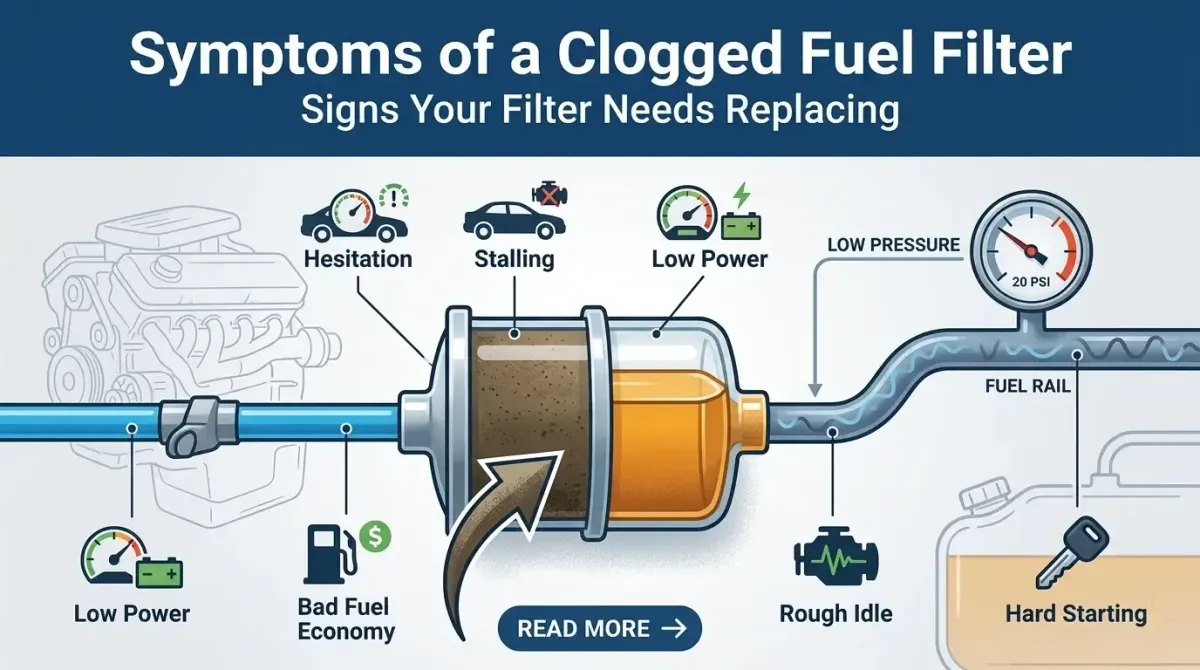
A clogged fuel filter restricts fuel flow to the engine. The symptoms start subtle and get progressively worse: hesitation under hard acceleration, rough idle, difficulty starting, and eventually stalling or a no-start condition. On diesel vehicles,you may also see a water-in-fuel warning light. Left too long, a clogged filter causes fuel pump failure.
What Does a Clogged Fuel Filter Feel Like?
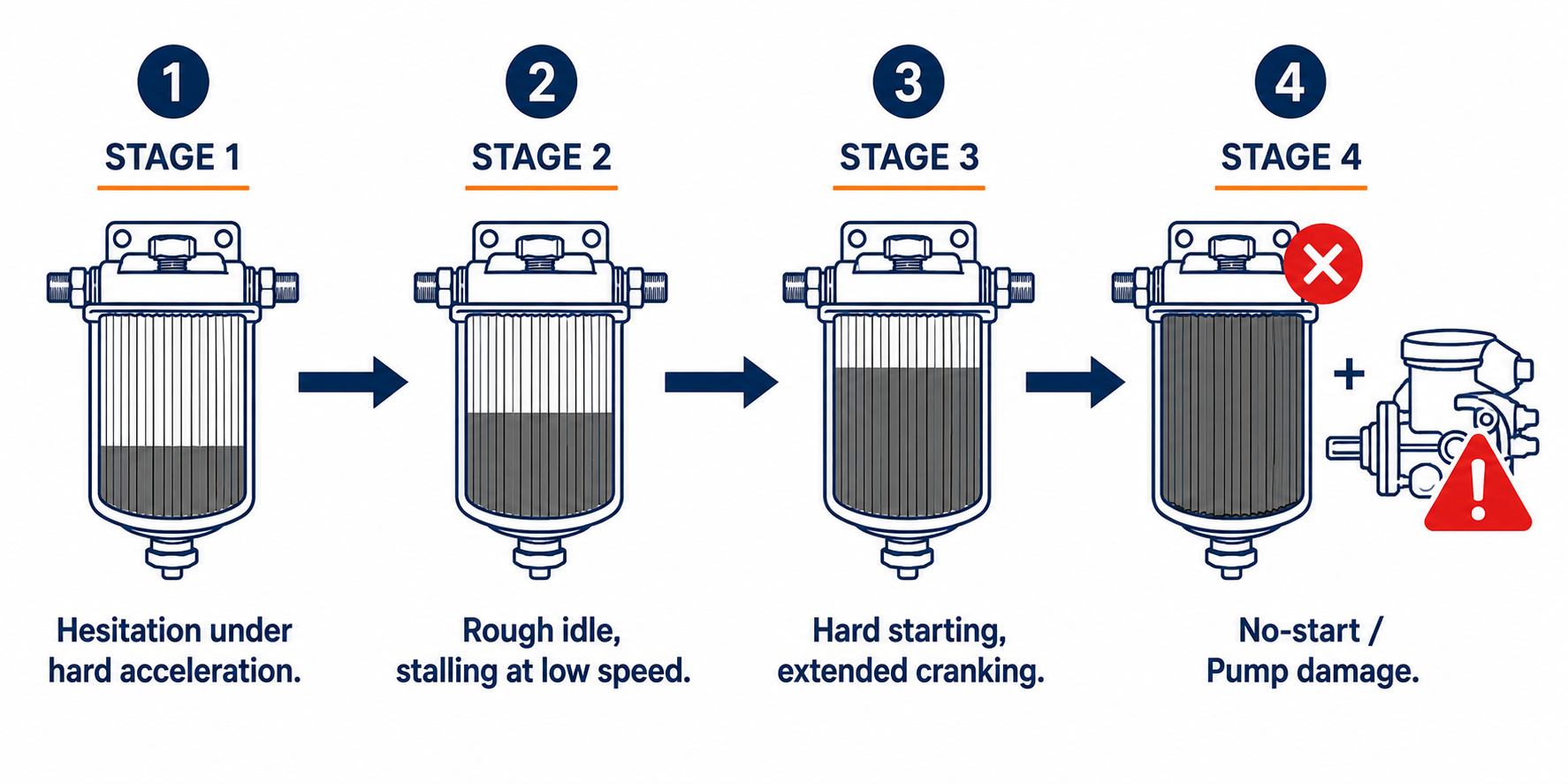
The first thing to understand is that a clogged fuel filter does not fail suddenly. It loads up with debris gradually, and the symptoms follow a clear progression tied to how restricted the fuel flow has become.


Early on, the engine runs fine most of the time. The restriction only becomes apparent when fuel demand spikes, which is why hard acceleration is the first place drivers notice something is off.
As restriction increases, the engine struggles even at lower demand levels. Rough idle and hard starting appear. Eventually, the engine cannot get enough fuel to run at all.


I have outlined each stage below. Knowing which stage you are at helps narrow down whether the filter is the likely cause or whether something else needs to be ruled out.
Stage 1: Hesitation and Stumbling Under Hard Acceleration
This is almost always the first symptom of a clogged fuel filter.


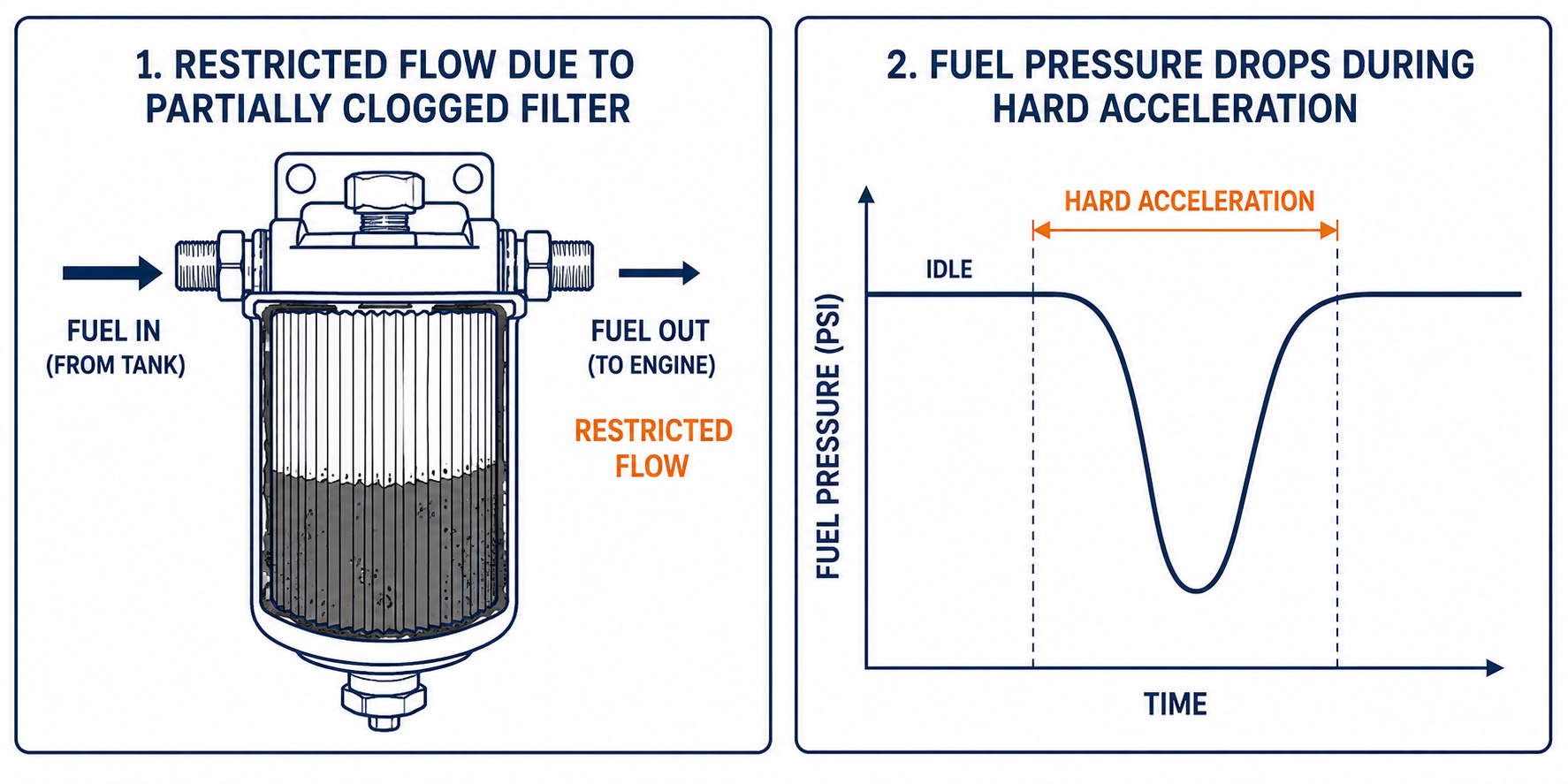
When you press the accelerator hard, the engine demands a surge of fuel. A partially clogged filter can keep up with fuel demand at idle and light throttle, but it cannot deliver the volume needed under hard acceleration. The engine stumbles, hesitates, or lurches before eventually catching up.
Drivers often describe it as the car feeling like it "hits a wall" or "momentarily cuts out" when merging onto a highway or accelerating from a stop. The hesitation typically lasts one to three seconds, then the engine resumes pulling normally.


This symptom is easy to dismiss early on because it is intermittent and does not happen during ordinary city driving. That is exactly why a lot of drivers ignore it until the filter is much more severely clogged.
Why This Happens
The fuel pump is drawing fuel through a restricted element. Under light load, it can maintain adequate pressure. Under hard acceleration, the demand exceeds what the restricted filter allows through. Fuel pressure drops momentarily. The engine stumbles on that pressure drop, then recovers when the demand eases.


Stage 2: Rough Idle and Stalling at Low Speed
As clogging progresses, the restriction becomes significant enough to affect the engine even at light load and idle.
A rough idle from a clogged fuel filter typically feels like the engine is shuddering slightly, as if it is misfiring on one or two cylinders. The RPMs may drop and recover repeatedly. The car may shudder more noticeably when stopped at a light than when moving.
Stalling at low speed, especially when coming to a stop or in stop-and-go traffic, is a more advanced version of the same problem. The engine is receiving less fuel than it needs to maintain idle, so it drops RPMs until it stalls.
At this stage the filter is usually significantly loaded. The pump is working harder than it should to maintain pressure, and the strain is building.
Can a Clogged Fuel Filter Cause Misfires?
Yes. A clogged fuel filter can cause misfires in two ways.
First, if fuel pressure drops enough under load, one or more cylinders do not receive the fuel volume the injectors are trying to deliver. The cylinder fires with a lean mixture. Lean misfires produce rough running and may trigger a misfire trouble code.
Second, sustained low fuel pressure causes some injectors to operate outside their designed spray parameters. Injector atomization degrades at lower-than-spec pressure. Poorly atomized fuel does not combust completely, which produces a misfire.
The misfire codes from a fuel delivery problem are typically random misfire codes (P0300) or individual cylinder misfires (P0301 through P0308) that shift between cylinders. If the same cylinder always misfires, the cause is more likely that cylinder's injector, spark plug, or ignition coil rather than the fuel filter.
Stage 3: Hard Starting and Extended Cranking
A heavily clogged filter makes it difficult to build adequate fuel pressure during startup. The engine cranks for longer than normal before firing, or takes multiple attempts to start.
On fuel injected engines, the fuel pump builds rail pressure for one to three seconds before the starter engages (the prime cycle). If the filter is severely restricted, the pump cannot reach operating pressure during that prime window. The engine may start and then stumble immediately, or fail to catch on the first crank attempt.
Hard starting from a clogged filter typically appears after the vehicle has been sitting. Warm restarts, where the fuel system is already primed and the engine is still warm, may start normally. Cold starts after an overnight sit are where the problem shows most clearly.
Stage 4: Stalling After Startup and No-Start Condition
At the final stage of clogging, the filter is severely restricted and the fuel pump is working under extreme strain.
The engine may start briefly and then stall within seconds, unable to maintain idle because flow through the filter is insufficient even at low RPM demand. Attempting to drive the car may result in the engine dying immediately when put in gear.
A complete no-start is the endpoint. The pump cannot push enough fuel through the blocked element to build any meaningful rail pressure, and the engine will not start at all.
At this stage, the fuel pump has likely been damaged by the sustained strain. Replacing the filter at this point may not fully restore performance if the pump has degraded. Both components may need to be addressed.
Can a Clogged Fuel Filter Cause a Car Not to Start?
Yes, a severely clogged fuel filter can prevent the engine from starting. When the filter element is nearly or completely blocked, the fuel pump cannot build the rail pressure needed for the fuel injectors to operate. The engine cranks but gets no fuel.
This is one of the more difficult no-start causes to diagnose without a fuel pressure gauge, because the symptoms look identical to a failed fuel pump. A technician testing fuel pressure at the rail will find pressure well below spec.
Whether the cause is the filter or the pump requires further testing, often by bypassing the filter temporarily or measuring pump output directly.
If the vehicle has a known serviceable fuel filter and has not been replaced in many miles, the filter is always a logical first test before condemning a fuel pump.
Symptoms of a Clogged Fuel Filter on a Diesel Vehicle
Diesel engines share all of the symptoms above: hesitation, rough idle, hard starting, and stalling. But diesel systems have several additional indicators that are specific to how diesel fuel filters work.
Water-in-Fuel Warning Light
Most diesel trucks include a water-in-fuel (WIF) sensor in the fuel filter housing. When the water separator bowl fills with water that has settled out of the diesel fuel, this sensor triggers a dashboard warning light.
The water-in-fuel light is not technically a symptom of the filter being clogged with particles. But it signals that the filter housing needs immediate attention. Ignoring a full water separator means water reaches the injection pump and injectors, which causes serious damage in diesel systems.
When this light comes on, drain the water separator as soon as possible. If the light comes on frequently between filter changes, the diesel fuel source may be contaminated.
Loss of Power Under Load (Diesel-Specific)
Diesel trucks working under load, towing, or hauling reveal filter restriction earlier than the same truck in light-duty use. A filter that provides adequate flow at normal driving demand may fall short when the engine is pulling hard. The result is a noticeable loss of power that would not appear if the truck were unloaded.
This is one reason diesel filter intervals are shorter than gasoline: the consequences of restriction show up faster under the heavy-duty use these trucks are built for.
White Smoke or Unusual Exhaust Under Load
Black smoke in a diesel engine typically signals an overly rich condition, which is the opposite of what a clogged fuel filter produces. A fuel-restricted diesel is more likely to run lean in some cylinders, which can produce white or grayish smoke from incomplete combustion during hard acceleration or load.
This symptom is not exclusive to a clogged filter and has several causes. But if white or unusual exhaust appears alongside hesitation and power loss, a restricted fuel supply is worth investigating.
Is There a Fuel Filter Warning Light?
On gasoline vehicles, there is no dedicated fuel filter warning light. The check engine light may illuminate if the fuel restriction is severe enough to trigger lean mixture codes (P0171, P0174 for bank-lean) or misfire codes (P0300 to P0308), but the light does not specifically identify the fuel filter as the cause.
On diesel trucks, the water-in-fuel warning light is the closest thing to a fuel filter-specific warning. Some diesel systems also have a fuel filter restriction indicator that signals when filter differential pressure has exceeded a threshold.
If the check engine light comes on alongside hesitation, rough idle, or hard starting, pulling the codes is a useful diagnostic step. Lean codes and misfire codes alongside fuel delivery symptoms point toward a fuel system restriction.
How Do You Test If Your Fuel Filter Is Clogged?
There is no way to test a fuel filter for restriction without specialized tools. Unlike an engine air filter or cabin air filter, you cannot inspect a fuel filter by looking at it.
The practical tests are:
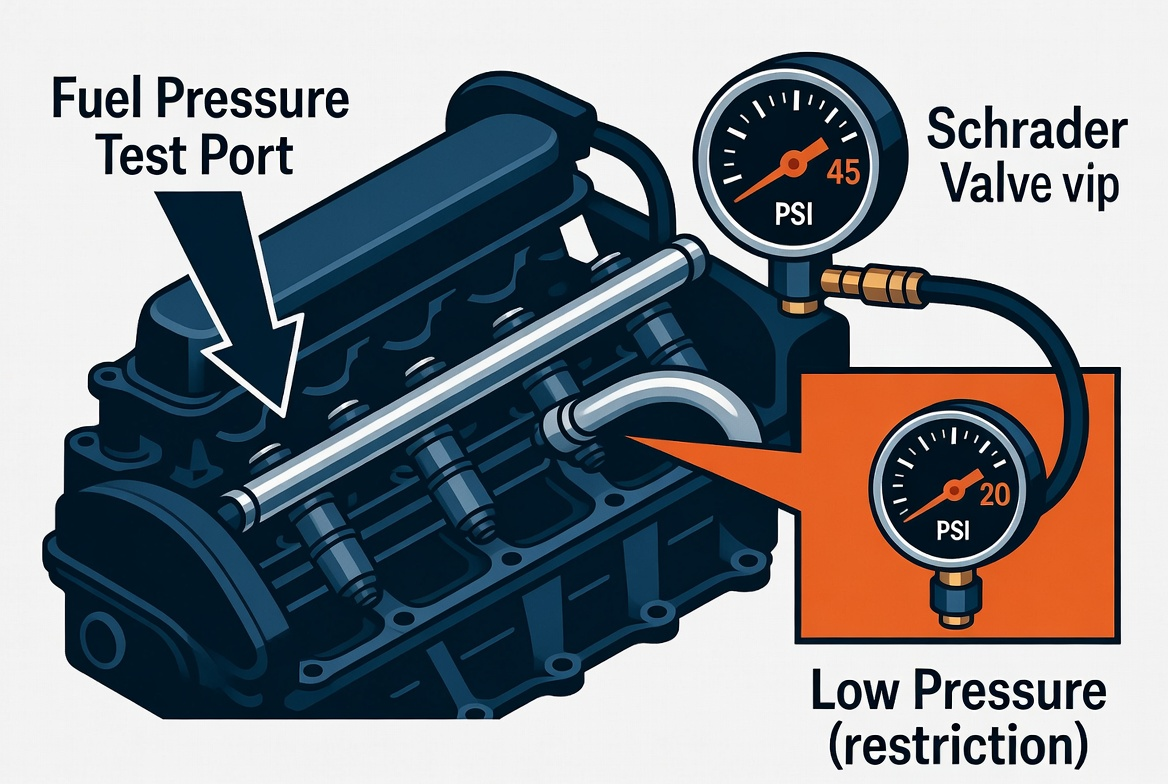
Fuel pressure test. A fuel pressure gauge connected to the Schrader valve on the fuel rail measures pressure at idle and under acceleration. Low pressure at idle, and a pressure drop under acceleration, points to a fuel delivery restriction. This does not confirm the filter is the cause, but it confirms the fuel system is not delivering adequate pressure.
Fuel pressure drop test. After the engine is shut off, rail pressure should hold for several minutes. Rapid pressure drop after shutdown can indicate a leaking injector, but a severely restricted filter that is preventing adequate pressure buildup also shows as below-spec pressure throughout.
Process of elimination. On a vehicle with a known serviceable external filter that has not been changed in many miles, replacing the filter is often the logical first step before expensive pump diagnosis. The filter costs far less than a fuel pump and is almost always the first item to service on a vehicle showing fuel delivery symptoms.
Symptoms That Overlap With Other Problems
The symptoms of a clogged fuel filter overlap with several other fuel system and ignition problems. Getting the diagnosis right matters before replacing parts.
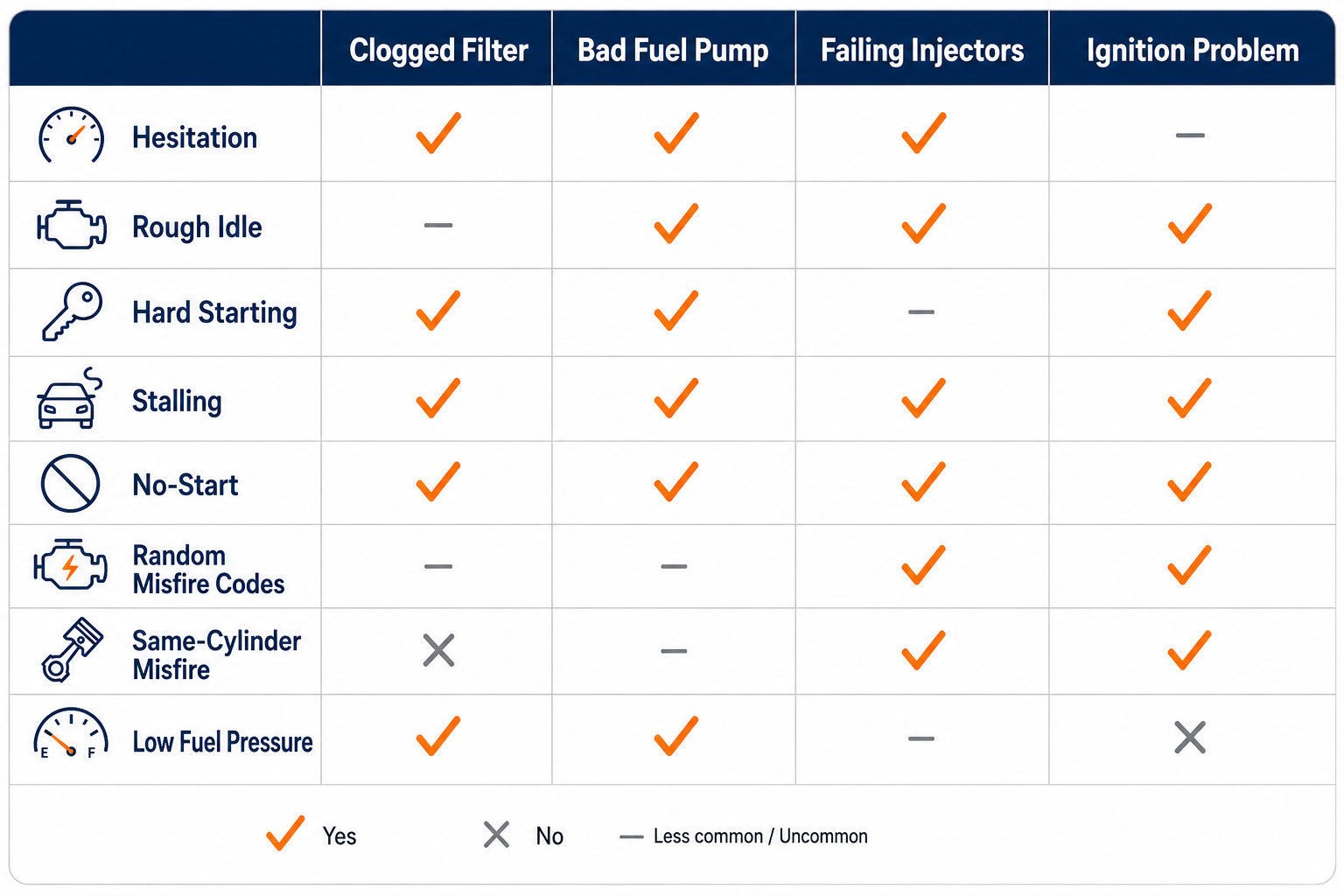
The key distinguishing factor is what the fuel pressure gauge shows. Both a clogged filter and a failing fuel pump produce low fuel pressure. If pressure is low, replacing the filter first is the lower-cost diagnostic step. If the filter is new and pressure is still low, the pump is the next suspect.
What To Do When You Notice These Symptoms
If you are experiencing hesitation, rough idle, or hard starting and the vehicle has a known serviceable external fuel filter:
Check the maintenance history. When was the filter last replaced? If it has been more than 20,000 to 30,000 miles on a gasoline vehicle, or more than 15,000 to 22,500 miles on a diesel, replacement is overdue.
Check the replacement interval for your specific vehicle. Some manufacturers use tighter intervals. Diesel trucks in particular have specific intervals that vary by engine.
Have fuel pressure tested before replacing the pump. If symptoms have reached the hard-starting or stalling stage, test pressure before assuming the pump has failed. If pressure is low and the filter is overdue, replace the filter first and retest.
Do not delay once symptoms appear. The fuel pump works harder against a restricted filter every time the engine runs. The longer you drive on a clogged filter, the greater the risk of pump damage.
FAQ
Can a clogged fuel filter cause a misfire?
Yes. Low fuel pressure from a clogged filter can cause lean misfires. The misfire codes are typically random (P0300) or shift between multiple cylinders. If the same cylinder always misfires, the cause is more likely that cylinder's injector, plug, or coil rather than the fuel filter.
SPONSOREDWhat are the first symptoms of a clogged fuel filter?
The first symptom is almost always hesitation or stumbling under hard acceleration. The engine has enough fuel at idle and light throttle but cannot keep up when you demand a surge of power. This can happen intermittently at first, making it easy to dismiss.
Will a clogged fuel filter cause the check engine light to come on?
The check engine light does not specifically identify a clogged fuel filter. But severe restriction can trigger lean mixture codes (P0171, P0174) or misfire codes (P0300 through P0308) that illuminate the light. Seeing those codes alongside fuel delivery symptoms points toward a restriction in the fuel system.
Can a clogged fuel filter fix itself?
No. A fuel filter traps debris permanently. The particles do not dissolve or clear on their own. The only fix is replacement.
How do I know if my fuel filter or fuel pump is the problem?
Both produce low fuel pressure and overlapping symptoms. Testing fuel pressure with a gauge is the most direct method. If pressure is below spec and the filter is overdue, replace the filter first and retest. If pressure remains low with a new filter, the pump is likely the cause.
What happens if you ignore a clogged fuel filter?
Progressive restriction leads to rough idle, hard starting, and stalling. The fuel pump works harder against the restriction with every engine cycle. Sustained extra load shortens pump life. In many cases, a neglected filter leads directly to fuel pump failure, which is a significantly more expensive repair.
Knowing the symptoms is only part of the picture. See the fuel filter replacement interval guide for how often your specific vehicle's filter should be changed, and the complete fuel filter explainer for how the filter works and where it is located.