PA66-GF33 on a Filter Housing Is Not a Part Number: Here Is What It Means

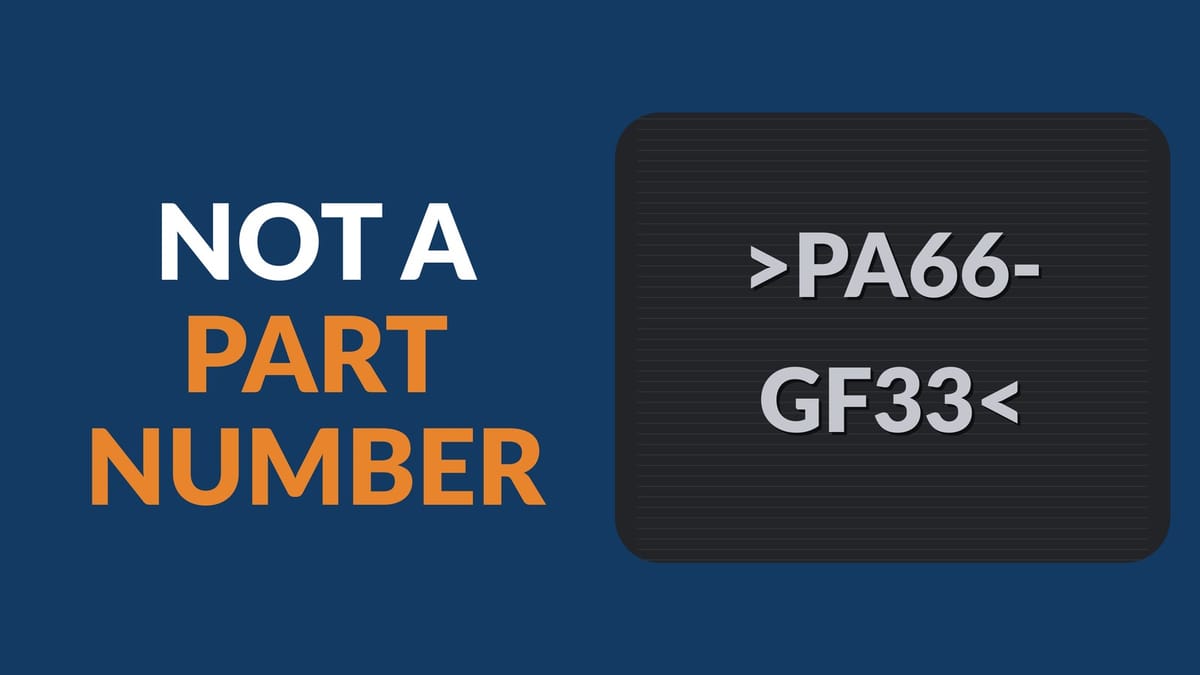
PA66-GF33 is a material code, not a filter part number. It means polyamide 66, the nylon known as nylon 6/6, reinforced with 33 percent glass fibre by weight, and it is moulded into the plastic so recyclers can sort it. The same code turns up on fuel filters, transmission filters and emissions valves, so it cannot be cross-referenced.
What PA66-GF33 Means
The code is read in four pieces. A Zytel resin datasheet lists PA66-GF33 as the ISO 11469 part marking code for a heat-stabilised polyamide 66 with 33 percent glass fibre by weight, which is exactly the grade the letters describe.
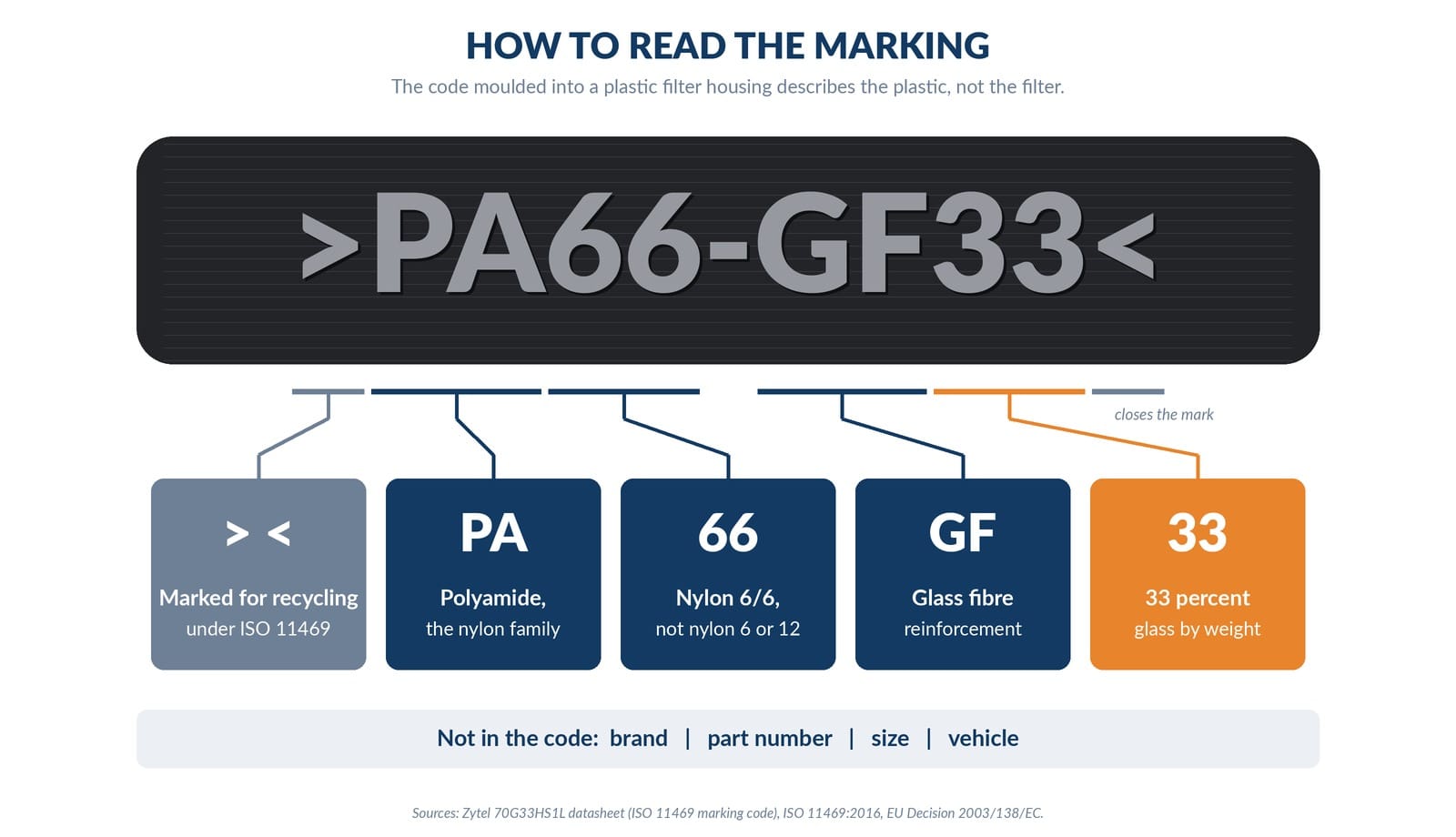
| Piece of the code | What it tells you |
|---|---|
| > and < | The part is marked for identification and recycling |
| PA | Polyamide, the chemical family nylon belongs to |
| 66 | Nylon 6/6 specifically, not nylon 6 or nylon 12 |
| GF33 | Glass fibre reinforcement, 33 percent by weight |
ISO 11469 builds these marks from the symbols in ISO 1043 parts 1 to 4: part 1 covers the base polymers such as PA, and part 2 covers fillers and reinforcements such as GF. Nothing in the code identifies a manufacturer, a part, a size or a vehicle.
Is PA66-GF33 the Same as Nylon?
Yes. PA66 is nylon 6/6, and the GF33 means a third of the material by weight is chopped glass fibre added for stiffness and heat resistance. The Zytel grade above melts at 262 °C and has a heat deflection temperature of 252 °C under a 1.8 MPa load, which is why it is used for parts that sit on a hot engine.
Why the Code Is Moulded Onto Filter Housings
It is there for the scrapyard, not for the parts counter. An EU Commission Decision of 2003 requires vehicle producers to label plastic components over 100 grams with the ISO material coding, from 1 July 2003, so the plastics can be recovered when the vehicle is scrapped.
ISO describes the purpose the same way: the marking is meant to help decisions about handling, waste recovery or disposal. It also states that the marking is not intended to replace the labelling a product standard or the law already requires, so on a properly made part the material code sits alongside the part number rather than instead of it.
Why It Is the Biggest Thing You Can Read
The material code is moulded into the plastic itself, so it survives fuel, heat, pressure washing and years of grime. A printed label or an ink-stamped number can wear off. On an old filter or housing, the bracketed material code is frequently the only legible text left, which is how it ends up being typed into a search box.
Can You Cross Reference PA66-GF33?
No, and the filter makers' own lookups show it. WIX's cross-reference lookup answers "PA66-GF33" with "This is a valid competitive part number and there is no replacement at this time", and gives the same answer for PA66GF33 without the hyphen.
That reply is not a match. The same lookup returns "There is no information available" for PA66GF30 and for a made-up number, so PA66-GF33 sits in WIX's competitor database while mapping to no WIX filter at all. Baldwin's cross-reference search finds nothing for either spelling.
The Same Code on Unrelated Parts
Marketplace listings use PA66GF33 as the part number for a Fleetguard diesel fuel filter, a 1998 Ford Focus fuel filter and an SAE-branded transmission filter. Owners have reported the code on parts that are not fuel filters at all.
| Where the code was reported | What the part actually was |
|---|---|
| Plastic case of a 1999 Pontiac Grand Am transmission filter | The automatic transmission filter, decoded by a BITOG member as Polyamide 66, Glass Fiber 33% |
| A round black component on a Ford F-150 | The EVAP purge solenoid, per a Ford-certified technician |
| Listing title for a Fleetguard fuel filter/separator | The Fleetguard FF266, a cartridge fuel water separator |
The Grand Am owner suspected the marking meant a Chinese-made filter. The reply on the same thread was that it has nothing to do with part numbers or country of origin.
Where the Real Part Number Is
The real number is whatever the brand printed or moulded next to its own name. The Fleetguard listing above shows how far apart the two can be: the part is an FF266, and WIX crosses the FF266 to its WF10590, a 6.01 in (153 mm) microglass cartridge fuel water separator for Cummins and JLG equipment. Baldwin's search sends the FF266 to its PF46253.
- Read the whole housing, not the biggest letters. The material code sits inside angle brackets or on its own. A part number usually sits next to a brand name or logo, and on a cartridge it is often printed on the end cap or the box.
- Check the can or the label. Spin-on fuel filters carry the maker's number printed on the shell, which is where a cross reference starts.
- Look it up by vehicle instead. Year, make, model and engine in any filter maker's catalogue gives the correct part even when nothing on the old filter is legible.
- Match the physical part last. If the vehicle is unknown, the height, diameters, connections and seal have to match before a filter is a fuel filter cross reference rather than a guess.
Is PA66-GF33 Safe With Fuel and Oil?
Yes, within limits. BASF's chemical resistance guide for its PA66 Ultramid A rates it resistant to gasoline at room temperature and at 85 °C, to diesel at 85 °C, and to heavy-duty engine oils up to 130 °C.
The limits are alcohol and hot coolant. BASF lists ethanol as absorbed at up to 15 percent mass increase, a 15 percent methanol fuel blend as only limited at 70 °C, and a 1:1 glycol and water coolant as limited at 106 °C. Those ratings are for unreinforced base nylon, and BASF says glass-reinforced grades may behave differently.
Moisture Changes the Numbers
Nylon absorbs water, and the strength figures change with it. The Zytel PA66-GF33 grade takes up 5.7 percent water at saturation, and its stress at break falls from 200 MPa dry to 140 MPa conditioned. That is why nylon datasheets quote both a dry and a conditioned value for every mechanical property.
PA66-GF33 vs PA66-GF30 and Other Codes
A neighbouring code is a different recipe of the same plastic, not a different filter. The two Zytel grades below differ by three points of glass and both melt at 262 °C.
| Material code | Tensile modulus, dry / conditioned | Stress at break, dry / conditioned |
|---|---|---|
| PA66-GF30 (Zytel 70G30HSLR) | 10,000 / 7,000 MPa | 200 / 130 MPa |
| PA66-GF33 (Zytel 70G33HS1L) | 11,000 / 8,000 MPa | 200 / 140 MPa |
The PA66-GF33 datasheet lists the resin against a GM material specification written as GMW3038P-PA66-GF35H. The number in a material code is a nominal grade label, not a measurement of the part in your hand.
A Fuel Filter Housing Can Carry a Different Code Entirely
Not every plastic fuel filter is PA66. LANXESS supplied Mann+Hummel with a polyamide 6 reinforced with 30 percent glass and carbon fibre for a fuel filter housing and lid, because the carbon fibre makes the housing conductive and stops static building up from the fuel flowing through it. A housing like that would carry a PA6 code, and it still would not be a part number.
Frequently Asked Questions
Is PA66-GF33 a Fleetguard part number? No. PA66-GF33 is the ISO material code for nylon 6/6 with 33 percent glass fibre, and it can appear on plastic parts from any maker. A listing that names a Fleetguard filter "PA66-GF33" is describing the plastic. The filter in that listing is the FF266, which WIX crosses to its WF10590.
What does GF33 mean on a filter? GF stands for glass fibre and 33 is the reinforcement content, 33 percent by weight. Together with PA66 it describes glass-filled nylon 6/6. It says nothing about the filter's micron rating, size, thread or which vehicle it fits, so it cannot be used to find a replacement.
Why can't I find a PA66-GF33 cross reference? Because there is nothing to cross. WIX's lookup answers PA66-GF33 as a valid competitor number with no replacement, and Baldwin's search finds nothing. Look for the brand name and number printed or moulded beside it, or look the filter up by year, make, model and engine instead.
Does PA66-GF33 mean the filter was made in China? No. It is an international material code under ISO 11469, and EU rules have required vehicle plastic parts over 100 grams to carry this kind of coding since 2003. It identifies the plastic for recycling and has nothing to do with country of origin or the brand.
What is the difference between PA66-GF30 and PA66-GF33? Three percentage points of glass fibre. In two Zytel grades, the 33 percent version is slightly stiffer, at 11,000 MPa tensile modulus dry against 10,000 MPa, and both melt at 262 °C. Neither code identifies a filter, so the marking alone cannot tell you whether two parts are interchangeable.
What to Do Next
Ignore the bracketed code and look for the brand name and number beside it, on the label, the can or the end cap. If nothing legible is left, look the filter up by year, make, model and engine, then cross reference that number.