Fuel Filter Cross Reference: How to Find Compatible Replacements



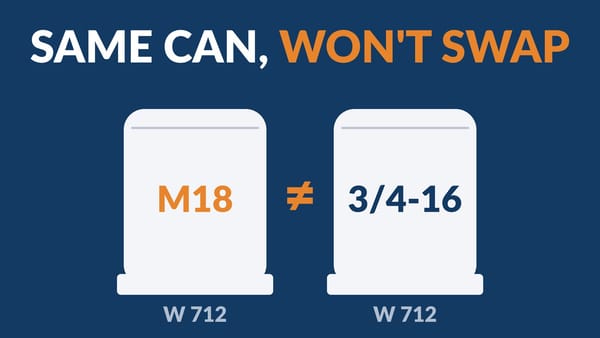
A fuel filter cross reference lists the filters from other brands that replace a given part number. For fuel filters, matching the fitment is only half the job: the replacement also has to match the system's pressure class and micron rating, and most published interchange lists say nothing about either.
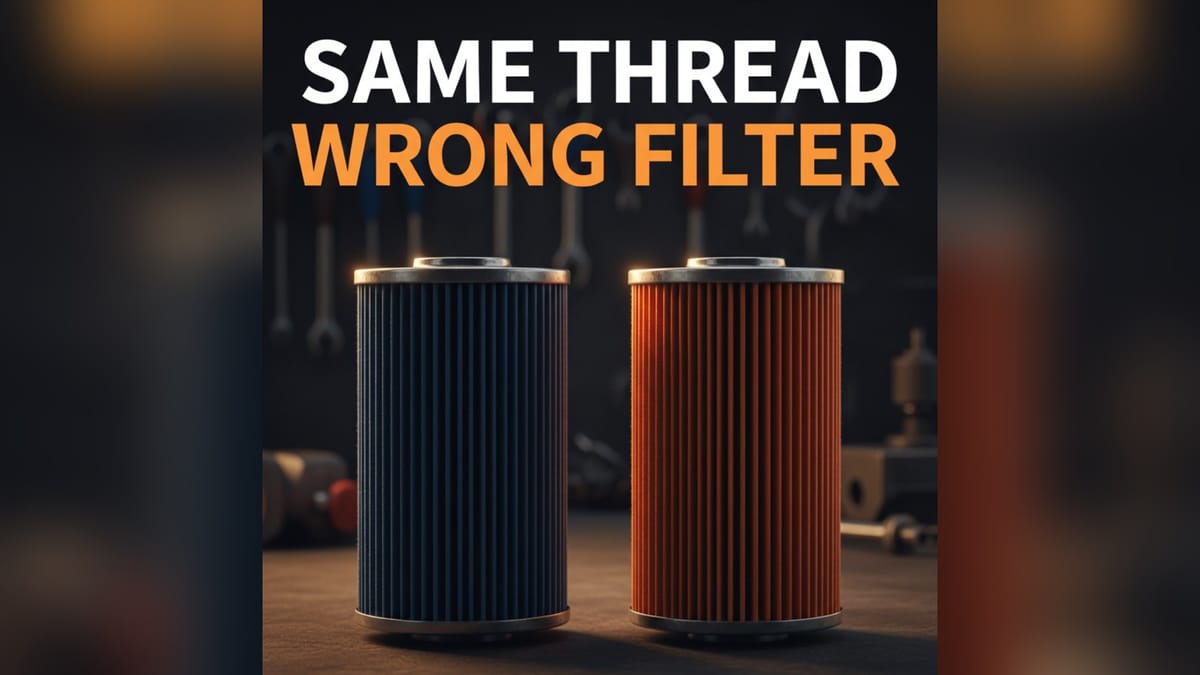
Cross referencing an oil filter is mostly a fitment exercise. Cross referencing a fuel filter is not, because fuel filters that thread onto the same housing can be built for completely different pressures, different micron ratings and, on a boat, different safety approvals.
That is the part the charts leave out, and it is where most wrong parts come from.


As an Amazon Associate we earn from qualifying purchases.
What Does a Fuel Filter Cross Reference Mean?
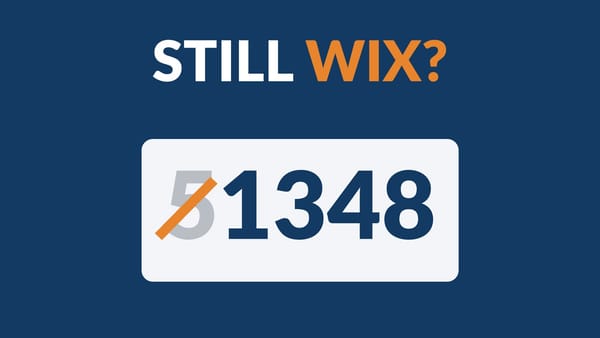
A cross reference is a table that maps one manufacturer's part number to the equivalent numbers from other brands. Baldwin lists what replaces a Caterpillar filter, WIX lists what replaces a FRAM filter, and so on.
These exist because every filter brand builds to the same envelope of housings and threads, but numbers them in its own system. The oil filter cross reference guide covers how those numbering systems work, and the same logic applies here.
What a cross reference does not tell you is whether the filter suits your fuel system. Two filters can share a thread, a gasket and an overall height while being rated for very different jobs.
What Has to Match Before a Cross Reference Is Safe?
Four things, and only the first one appears on most charts.
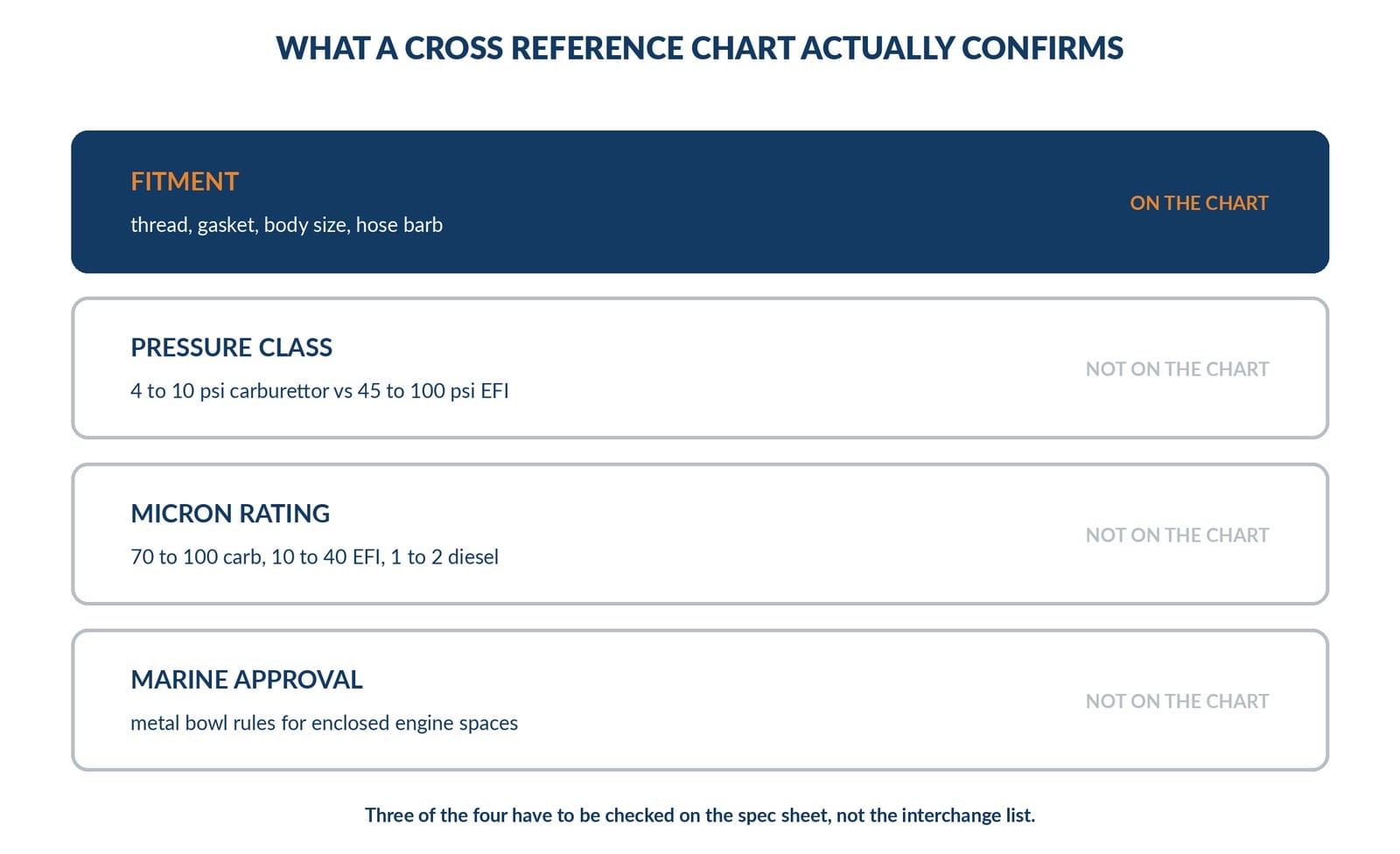
1. Fitment. Thread size and pitch, gasket diameter, body diameter and length for a spin-on. Inlet and outlet hose barb size for an in-line filter, along with the direction of flow marked on the body.
2. Pressure class. Low-pressure carbureted systems run at 4 to 10 psi, while fuel-injected systems run at 45 to 100 psi or higher. A filter built for a carburettor has no business on an injected engine, and the two are often the same physical size.
3. Micron rating. Older carbureted filters stop particles down to roughly 70 to 100 microns. Fuel-injected filters work in the 10 to 40 micron band, and diesel filters go as fine as 1 to 2 microns. The fuel filter micron rating guide explains what those numbers mean in practice.
4. Approvals, for marine and enclosed engine spaces. On a boat this is a legal and fire-safety question, not a preference, and it is covered below.
Position in the system matters too, since a filter ahead of the pump and one after it are rated differently. Speedway Motors gives the usual targets for a built fuel system: a 70 to 100 micron pre-pump filter with a 40 to 60 micron post-pump filter on a carburettor, against a 40 to 100 micron pre-pump and a 10 micron post-pump filter on EFI. Which side of the pump your filter sits on is covered in fuel filter before or after the pump.


As an Amazon Associate we earn from qualifying purchases.
Where to Find a Fuel Filter Cross Reference Chart
Work down this list in order. The further down you go, the more you have to verify yourself.
Manufacturer Lookup Tools
Every major filter brand publishes its own catalogue, and these are the only sources that are maintained. WIX's filter lookup searches by vehicle or by a competitor's part number. FRAM, Baldwin, Donaldson, Fleetguard and Racor all publish equivalents.
Manufacturer Cross-Reference PDFs
The printed quick-reference charts are often better than the web tools, because they show several brands side by side on one page. Baldwin publishes a quick cross reference covering Caterpillar, Baldwin, Donaldson, Fleetguard, Fram, Luber-finer and WIX numbers, grouped by the engine maker the filters fit.
Search for the brand name plus "cross reference PDF" and look for a file hosted on the manufacturer's own domain. That is the version that has been checked.
Third-Party Aggregator Sites
The interchange sites that let you type any number and get a list are convenient and frequently wrong. They merge data from several catalogues without resolving conflicts, so one filter can appear against two incompatible applications.
Treat anything from an aggregator as a candidate, then confirm the number in the manufacturer's own catalogue before buying it.
Matching by Specification
When no chart covers your filter, measure. Thread size and pitch, gasket outside and inside diameter, body diameter, overall height, then micron rating and pressure rating from the spec sheet. This is the slowest route and the only one that works on obsolete parts.
Diesel Primary and Secondary Filters Are Not Interchangeable
A diesel fuel system almost always runs two filters in series, and cross referencing one to the other is a common and expensive mistake.
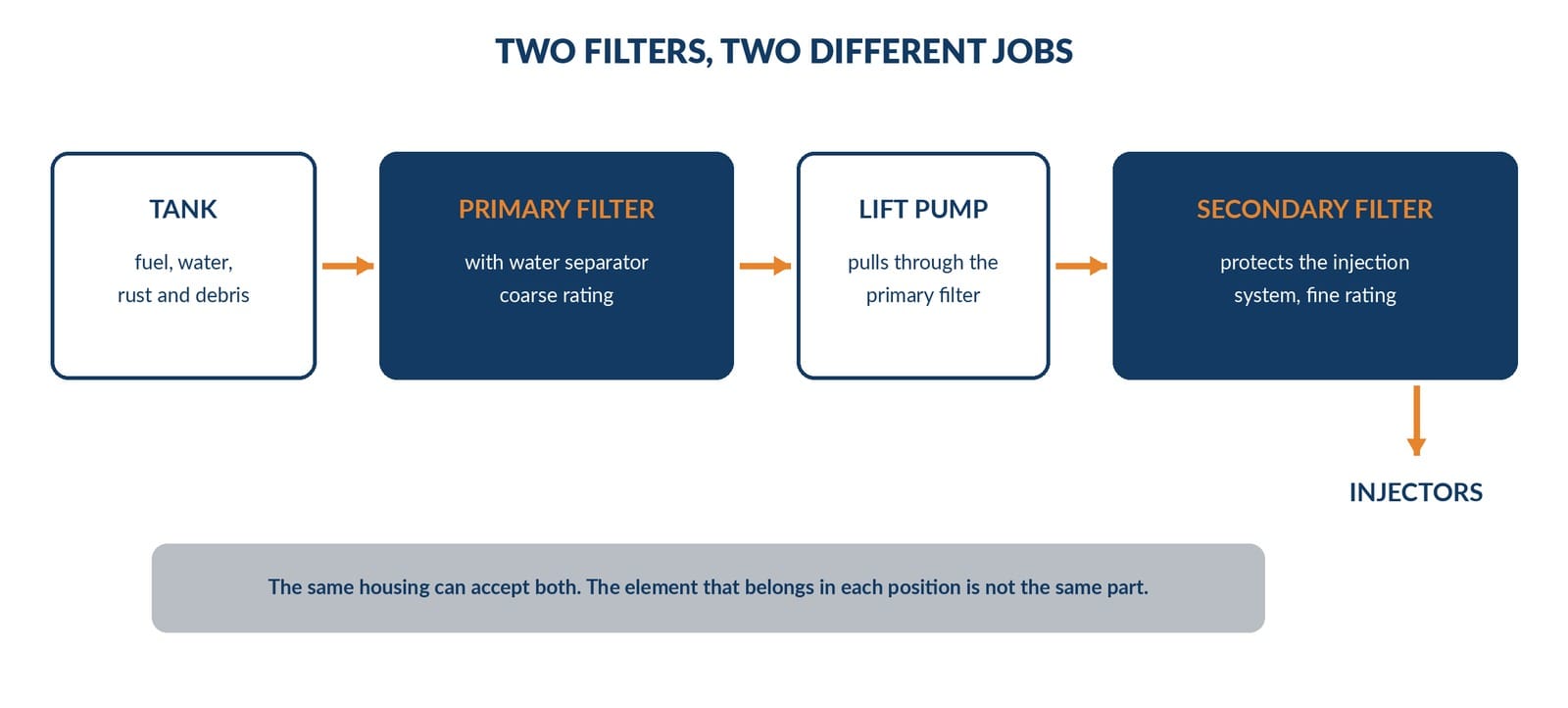
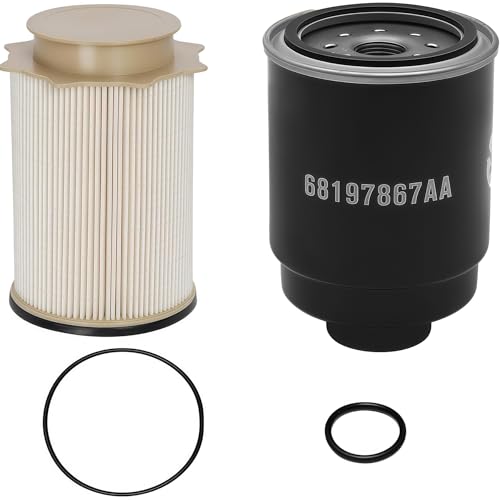
The primary filter sits between the tank and the lift pump, usually as a filter and water separator, and is coarse enough not to restrict flow. The secondary filter sits after the pump and protects the injection system, so it is much finer.
Racor's element range shows the split clearly, colour coded by rating: red for 30 micron primary filtration, blue for 10 micron secondary, brown for 2 micron final filtration. The same housing takes all three. Nothing about the fitment tells you which one belongs in your system, and fitting a 2 micron element where a 30 micron primary belongs starves the pump.
If you run a diesel, treat the primary and secondary as two separate cross references and keep the water separator's drain schedule in mind, which is covered in draining water from a diesel fuel filter.
Marine and Outboard Fuel Filter Cross References
Marine is the category where a cross reference stops being a parts question and becomes a safety one.
Filters used in an enclosed engine space have to be approved for it. Racor's guidance is to use metal bowl versions for all marine engine room applications, and the units carrying that construction are the ones listed as UL listed and USCG, ABS or Bureau Veritas accepted. A clear plastic bowl that is fine on a tractor is not an equivalent part on a boat.
Outboard filters are usually water separating spin-ons, and the ratings are coarser than people expect. Mercury's published description of its 802893Q01 water separating filter names a 25 micron element, so an automotive spin-on of the same thread is not a like-for-like swap in either direction.
For Mercury and Mariner outboards and MerCruiser engines, start from the engine maker's own filter chart rather than an automotive interchange, then check the micron rating of whatever the chart points at.


As an Amazon Associate we earn from qualifying purchases.
What to Check After You Find a Cross Reference
Before the part goes in:
- Compare the two spec sheets, not the two part numbers. Thread, gasket, height, micron rating, pressure rating.
- Confirm the flow direction on an in-line filter, since the arrow has to point toward the engine.
- Check the media for your fuel. Some elements are specified for diesel or for gasoline, not both, and ethanol blends are called out separately.
- Check the interval. A coarser or finer substitute can change how long the filter lasts, which shifts the fuel filter replacement interval.
- Keep the old filter until the engine has run and you have checked the housing for leaks.
If the engine runs rough after a substitution, the filter is the first thing to suspect, since the symptoms of a clogged fuel filter look identical to the symptoms of a filter that is too fine for the system.
Frequently Asked Questions
Is there a universal fuel filter cross reference chart? No. Each manufacturer publishes its own, and the printed multi-brand quick-reference charts only cover popular applications. The nearest thing to a universal chart is a manufacturer PDF that lists several brands side by side for one engine maker's filters.
Can I use any filter that has the same thread size? No. Thread size is one of four things that have to match, along with the pressure class, the micron rating and, on a boat, the approval for an enclosed engine space. Filters with identical threads are built for very different systems.
Are third-party fuel filter cross reference sites accurate? They are useful for generating candidates and unreliable as a final answer. They merge catalogues without resolving conflicts, so the same number can be listed against applications that contradict each other. Confirm any result in the manufacturer's own catalogue.
What happens if I cross reference to a finer micron rating? A finer filter restricts flow. In a position designed for a coarse primary filter, that makes the pump work harder and can cause fuel starvation under load. Finer is not safer in fuel filtration; correct is safer.
Does a fuel filter cross reference work for marine engines? Only within marine parts. Automotive interchange lists ignore both the micron ratings outboard makers specify and the bowl material rules for enclosed engine spaces, so start from the engine maker's chart instead.
What to Do Next
Write down four numbers before you shop: the thread size, the micron rating, the system pressure and the position in the fuel line. With those in hand, any cross reference chart becomes a shortlist rather than an answer, and the fuel filter replacement itself is the easy part.