Fram Fuel Filter Lookup & Cross Reference Chart




FRAM fuel filter numbers start with a letter that names the fuel and the body style: G for in-line gasoline, P for in-line diesel, PS for a spin-on diesel water separator. The digits that follow identify the physical filter. Unlike FRAM's oil filters, the fuel filters carry no published micron rating, so every cross reference is a dimensional match.
FRAM's oil filter numbering rewards you for learning it, because swapping the letters keeps the fitment identical. The fuel filter side does not work that way, and treating it as though it does is how people end up with a filter that fits the line and not the system.


As an Amazon Associate we earn from qualifying purchases.
What Do FRAM Fuel Filter Part Numbers Mean?
The prefix carries the useful information. Across FRAM's own product pages the pattern is consistent:
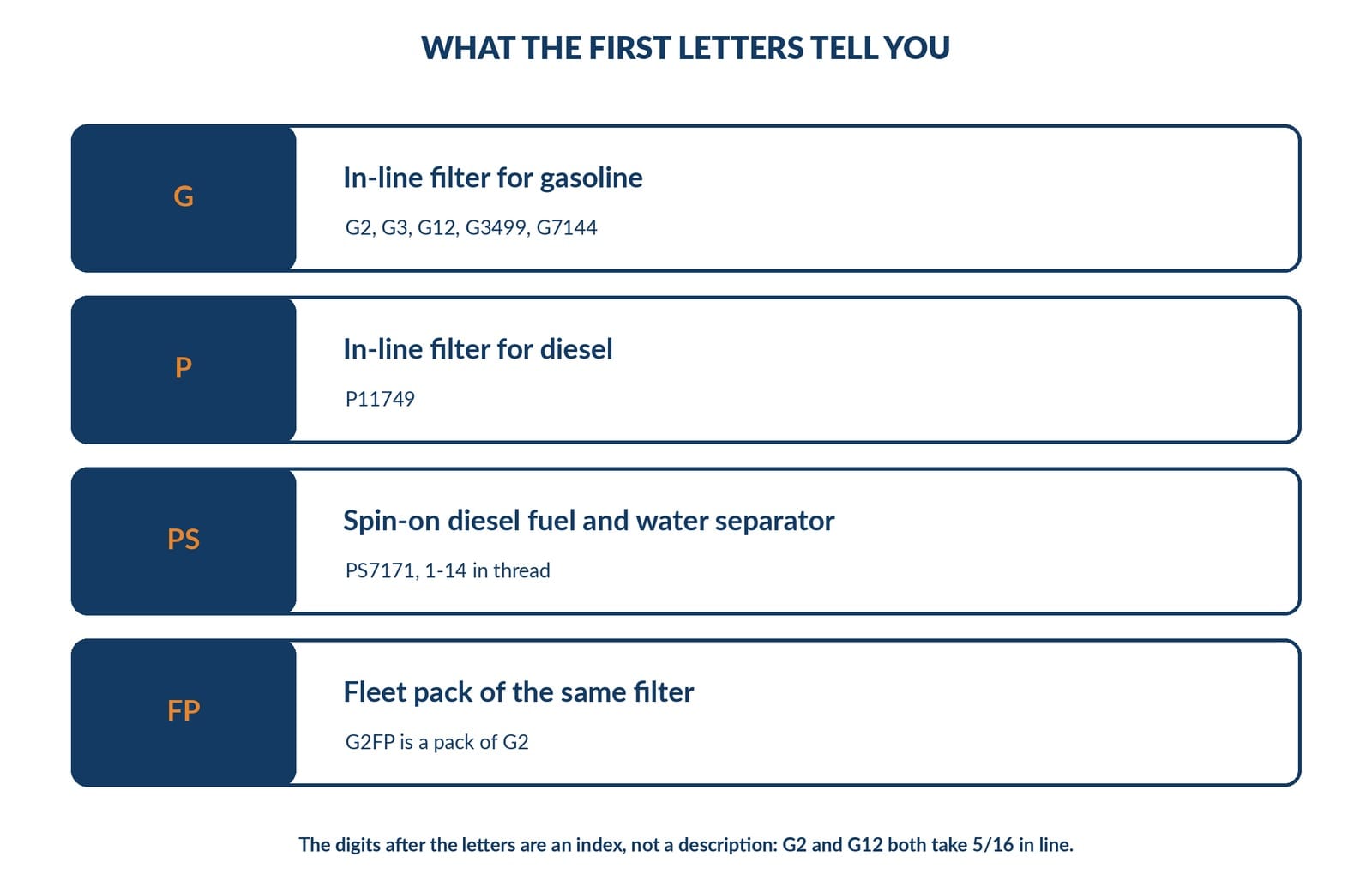
- G is an in-line filter for gasoline. G2, G3, G12, G3499 and G7144 are all in this group.
- P is an in-line filter for diesel. The P11749 is listed with diesel as its fuel type and 3/8 inch lines at both ends.
- PS is a spin-on diesel fuel and water separator. The PS7171 uses a 1-14 inch thread with a base gasket and a drain plug.
- FP on the end marks a fleet pack rather than a different filter.
The digits do not encode the line size, the tier or anything else you can read off. G2 and G12 are both 5/16 inch filters, G3 is 3/8 inch, and G7144 is 1/4 inch. The number is an index, not a description.
Published Dimensions for Common FRAM Fuel Filters
These are the figures on FRAM's own product pages, which is everything the pages publish.
| FRAM number | Fuel and body | Inlet and outlet |
|---|---|---|
| G2FP | Gasoline in-line, clear nylon | 5/16 in |
| G3 | Gasoline in-line, nylon | 3/8 in |
| G12 | Gasoline in-line, clear nylon | 5/16 in |
| G3499 | Gasoline in-line, metal | 5/16 in, plus a 1/4 in return |
| G7144 | Gasoline in-line, nylon | 1/4 in |
| P11749 | Diesel in-line, metal | 3/8 in |
| PS7171 | Diesel spin-on separator | 1-14 in thread |
Body sizes differ even where the line size matches. The G2 fleet pack is listed at 3.672 inches tall and 1.906 inches across, while the G12 is 4.181 inches tall and 2.149 inches across on the same 5/16 inch lines.
What FRAM Publishes About Its Fuel Filters, and What It Does Not
This is the part worth knowing before you shop a cross reference.
FRAM rates its oil filter lines in public: mileage per line, and efficiency figures such as 99% at 20 microns on the premium lines. The fuel filter pages carry none of that. Across the G, P and PS pages, what is published is height, outside diameter, line size, housing material, fuel type and fitment. There is no micron rating, no efficiency figure and no pressure rating on any of them.
That is not a gap in my research, it is what the pages contain, and it changes what a cross reference can tell you. Two filters that match on every published FRAM figure can still differ on the spec that decides whether the filter belongs in a fuel-injected system, because neither brand prints it.
When the manufacturer publishes only dimensions, a cross reference can only confirm dimensions.
If you need a filtration figure for a gasoline application, the practical route is the vehicle's OEM specification rather than the aftermarket listing, and the fuel filter micron rating guide covers the ranges different injection systems expect.


As an Amazon Associate we earn from qualifying purchases.
How to Look Up a FRAM Fuel Filter
Start with FRAM's own tool. The FRAM parts search takes the vehicle's make, model and year and returns the filters listed for it, which is the lookup direction that is actually maintained.
Going the other way, from a part number to its equivalents, FRAM's site is thin. Product pages sometimes carry an applications table and sometimes do not: the G7144 page lists John Deere Gator models, while the G3499 page shows no application data at all.
For the number-to-number direction you end up on third-party interchange databases, and that is where the trouble starts.
What a FRAM Fuel Filter Cross Reference Actually Matches
Look up a common in-line FRAM number and the result is not a shortlist. One interchange database returns 225 cross-reference matches for the FRAM G2, spanning AC Delco, Baldwin, Carquest, Champion, Case and dozens of house brands.
A list that long is a signal, not a service. It means the filter is being matched on line size and body size, which hundreds of parts share, and not on anything that separates them. The fuel filter cross reference guide sets out the four specifications that have to line up, and an in-line gasoline filter list like this confirms exactly one of them.
Use a result like that as a source of candidates to check, never as an equivalence.
Count the Ports Before You Cross Anything
The G3499 is the clearest example of a match that looks right and is not. It is listed with 5/16 inch inlet and outlet plus a 1/4 inch return line, so it is a three-port filter for a return-style system.
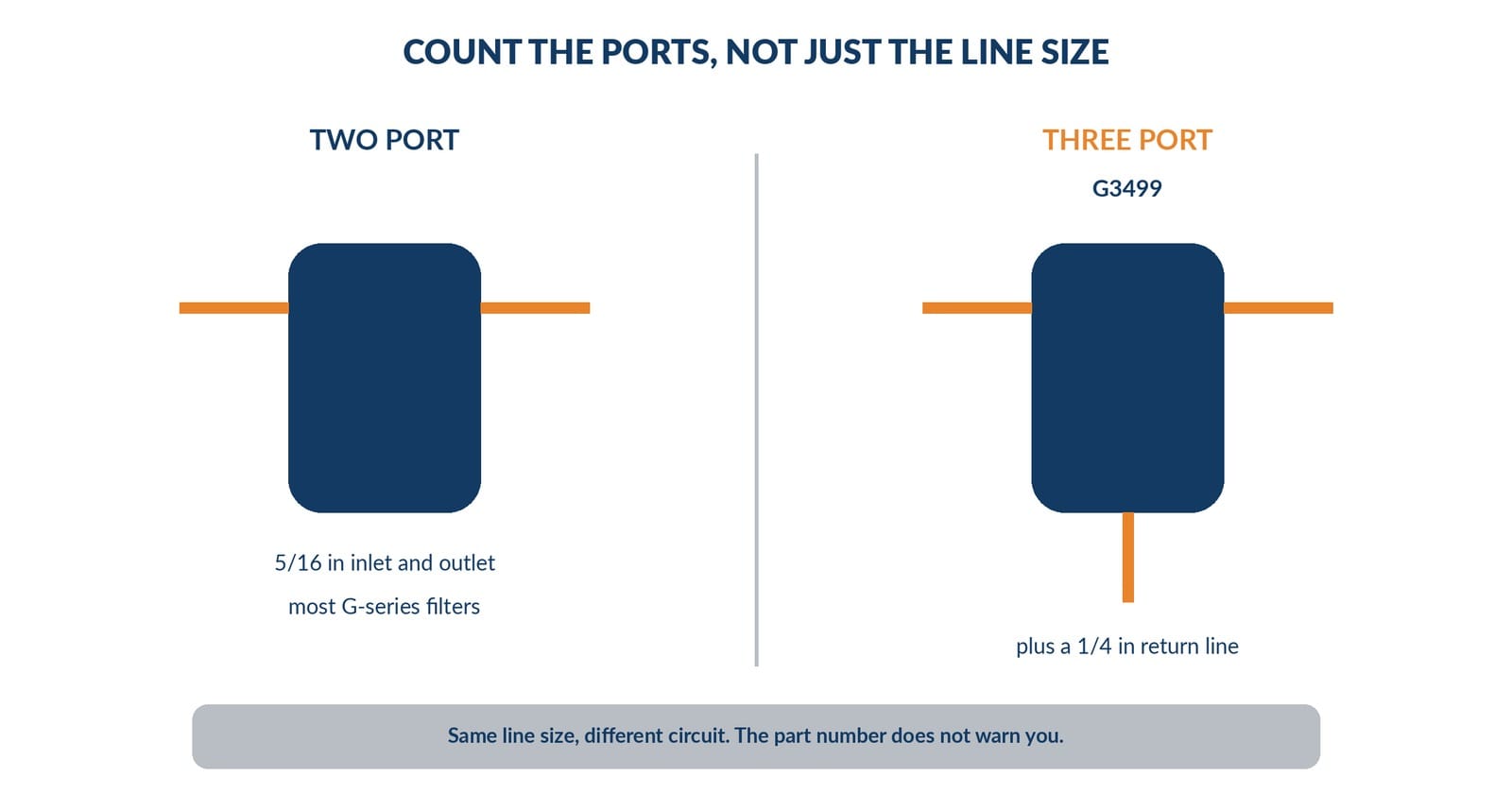
Most G-series in-line filters have two ports. A two-port filter will thread onto the same 5/16 inch lines and leave the return circuit with nowhere to go, which is not a mistake the part number warns you about.
Check the port count and the flow direction on the filter you are replacing before you compare it to anything.


As an Amazon Associate we earn from qualifying purchases.
What to Confirm Before Fitting a Crossed FRAM Number
- Port count and line sizes, including any return line.
- Body length and diameter, since the bracket and the hose runs have to accept it.
- Fuel type. G is gasoline and P is diesel on FRAM's own pages, and the two are not interchangeable.
- Housing material. Clear nylon lets you see the media, metal survives heat and pressure better, and the choice is usually the vehicle maker's, not yours.
- The OEM specification for anything FRAM does not publish, which on fuel filters means the micron rating and the working pressure.
With those confirmed, the fuel filter replacement itself is a short job.
Frequently Asked Questions
What does the G mean on a FRAM fuel filter? G marks an in-line filter for gasoline. P marks an in-line filter for diesel, PS marks a spin-on diesel fuel and water separator, and FP on the end of a number means a fleet pack. The digits after the letters identify the specific filter rather than describing it.
What is the FRAM G2 fuel filter? The G2 is a small in-line gasoline filter with 5/16 inch inlet and outlet and a clear nylon housing, listed at 3.672 inches tall and 1.906 inches in diameter in FRAM's fleet pack listing. It is one of the most widely cross-referenced filters in the catalogue.
Is the FRAM G3499 the same as other G-series filters? No. The G3499 has a 1/4 inch return line in addition to its 5/16 inch inlet and outlet, making it a three-port filter for a return-style fuel system. Two-port G filters with the same line size are not substitutes for it.
What micron rating do FRAM fuel filters have? FRAM does not publish one. Its fuel filter product pages list dimensions, line sizes, housing material and fuel type, with no micron or efficiency figure, unlike its oil filter lines. For a filtration requirement, use the vehicle manufacturer's specification.
Can I use a FRAM gasoline filter on a diesel engine? No. FRAM separates the two by prefix for a reason: diesel filters deal with water and far finer contamination, and diesel injection systems run pressures a gasoline in-line filter is not built for. Match the fuel type before anything else.
What to Do Next
Write down the line size, the port count and the body length of the filter you are taking off, then run FRAM's vehicle lookup rather than a number-to-number search. If the only match you can find comes from an interchange database, treat it as a candidate and confirm those three measurements before it goes in.