Fram Oil Filter Cross Reference Chart (All Series)

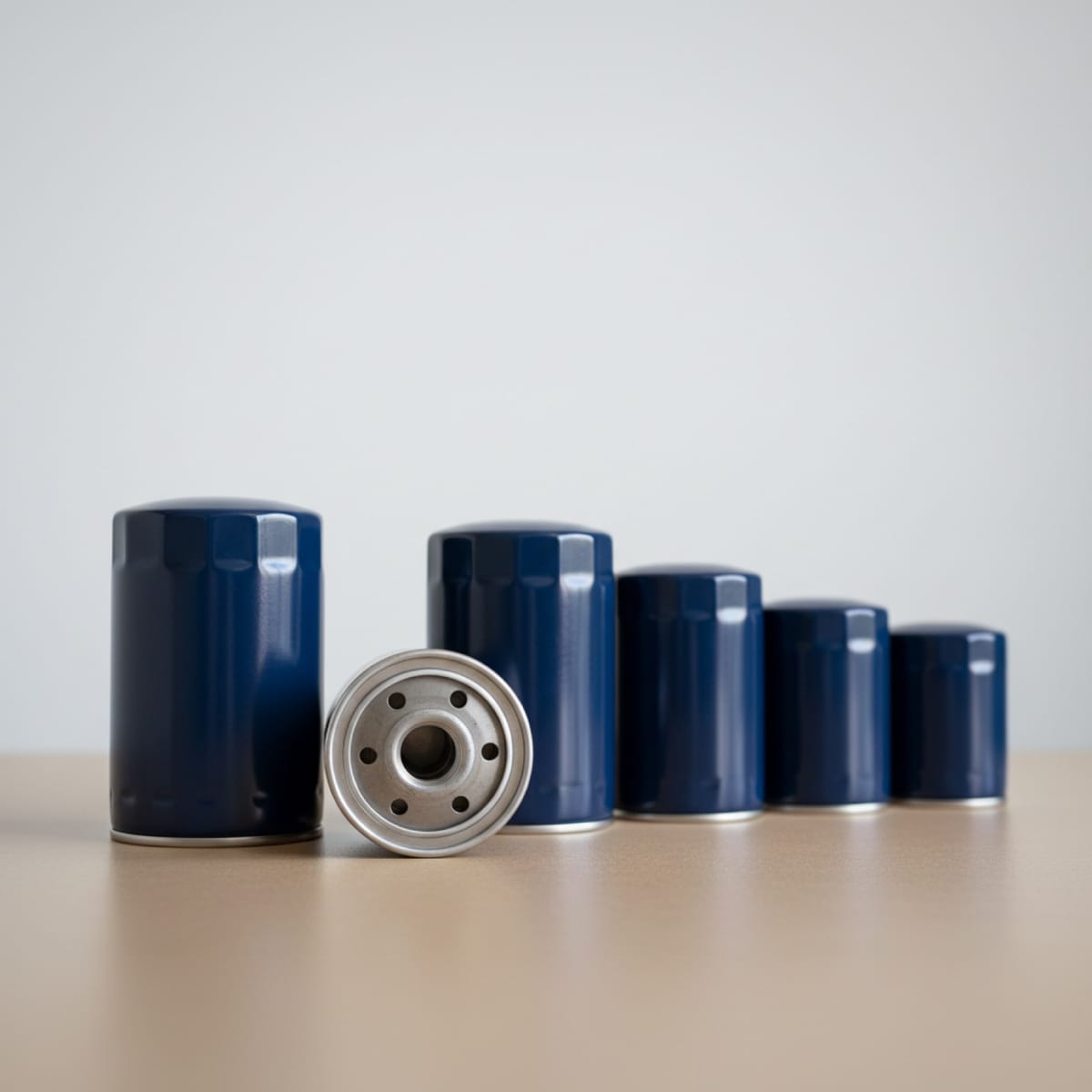


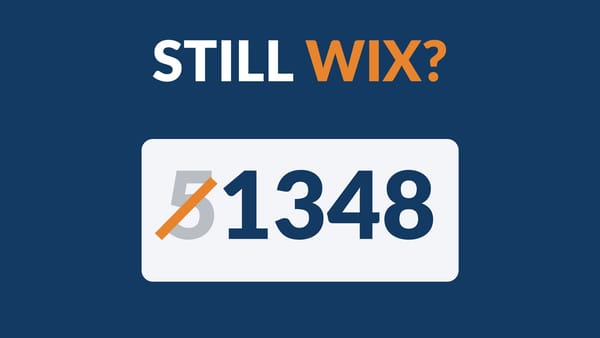
A FRAM oil filter part number is a prefix plus a number. The prefix names the product line and the number identifies the physical filter. PH3614, TG3614 and XG3614 are the same filter in three different media grades, and all three cross to WIX 51348 and Purolator L10241.
That one rule solves most FRAM cross reference problems. The rest of this guide covers what each prefix means, a verified chart across the major brands, the Carquest numbers nobody explains properly, and the trap that makes online cross reference tools return filters that will not fit your car.


As an Amazon Associate we earn from qualifying purchases.
What Do FRAM Oil Filter Part Numbers Mean?
Every FRAM oil filter number splits into two parts. Letters first, digits second.
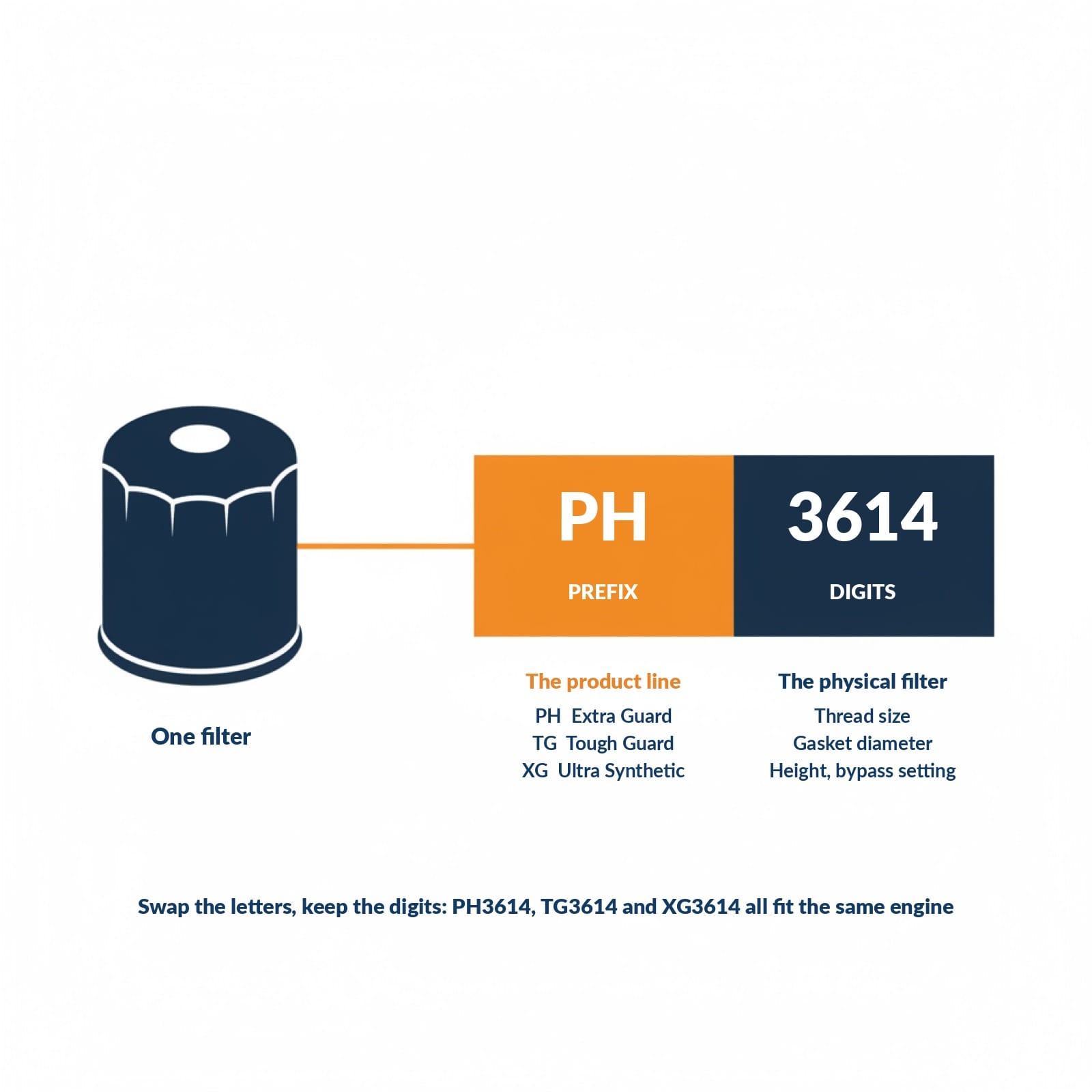
The letters tell you which product line the filter belongs to. The digits tell you which filter it physically is: the thread size, the gasket diameter, the canister height, the bypass valve setting.
FRAM does not publish a public key to its own prefixes. The mapping below is assembled from FRAM's product catalog and from interchange database records.
What does the PH prefix mean?
PH marks a spin-on filter in the Extra Guard line, FRAM's entry-level conventional filter.
The letters are not an abbreviation of anything current. A FRAM employee posting on BobIsTheOilGuy explained that the PH designation goes back to the WWII era and became so entrenched in the trade that FRAM's own marketing group would not replace it.
CH marks the cartridge version. In the older Guard lines, the prefix carries both the product tier and the body style, so a spin-on Extra Guard is PH and a cartridge Extra Guard is CH.
FRAM's newer lines dropped that split. In those, the prefix identifies the product family only, and the same letters appear on both spin-on and cartridge filters.
Does the number after the prefix identify the filter?
Yes, and this is the single most useful thing to know about FRAM numbering.
Interchange records for the Ford 5.0 Coyote filter list FRAM PH10575, TG10575, XG10575, HM10575 and FP10575 in the same group, all against WIX 57502 and Purolator L22500.
The same holds for the Toyota and Lexus filter, where PH3614, TG3614, XG3614, HM3614 and DG3614 all sit together.
If you know your FRAM number in one line, you know it in every line. Swap the letters, keep the digits.
The reverse is not true across brands. Do not assume another brand's number shares FRAM's digits. STP is the clearest example: the Ford Coyote filter is FRAM PH10575 but STP S10590, not S10575.
FRAM Oil Filter Series Explained
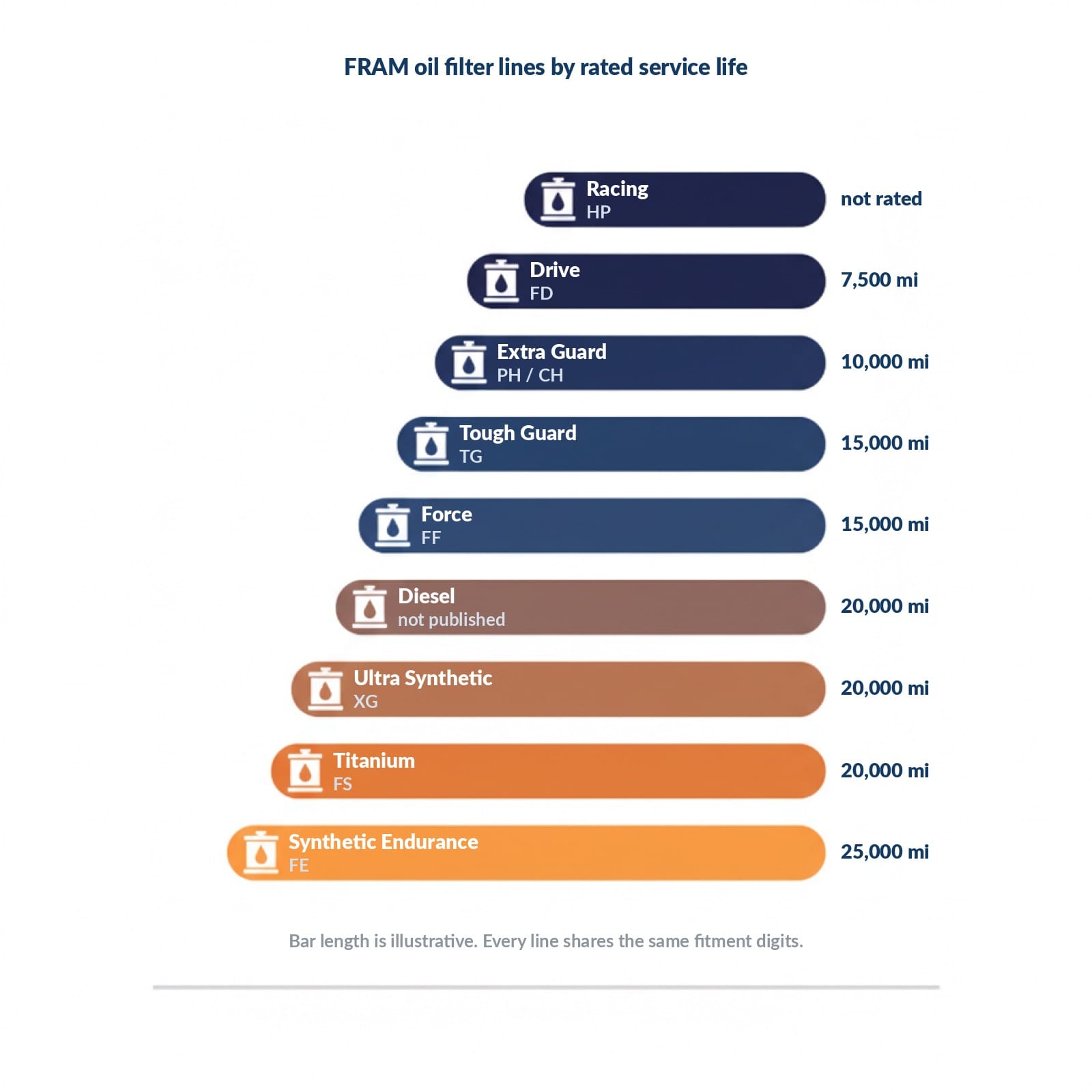
FRAM sells nine oil filter lines. The differences are media grade and rated service life, not fitment.
| Series | Prefix | Rated protection |
|---|---|---|
| Synthetic Endurance | FE | 25,000 miles |
| Titanium | FS | 20,000 miles |
| Ultra Synthetic | XG | 20,000 miles |
| Diesel | not published | 20,000 miles |
| Force | FF | 15,000 miles |
| Tough Guard | TG | 15,000 miles |
| Extra Guard | PH spin-on, CH cartridge | 10,000 miles |
| Drive | FD | 7,500 miles |
| Racing | HP | not rated in miles |
The mileage figures come from FRAM's own oil filter line-up page, which rates Synthetic Endurance at 25,000 miles, Titanium and Ultra Synthetic at 20,000 miles, Tough Guard and Force at 15,000 miles, Extra Guard at 10,000 miles and Drive at 7,500 miles.
HM appears on older High Mileage stock and still turns up in interchange databases. It follows the same digit rule.
What efficiency does FRAM publish?
Less than you would expect from a brand this size.
FRAM states 99% filtration efficiency for Synthetic Endurance and 99% dirt-trapping efficiency for Titanium. It does not put a micron figure next to either claim on that page, and it publishes no efficiency percentage at all for Extra Guard, Tough Guard or Ultra Synthetic there.
Efficiency percentages are meaningless without the micron size they are measured at. A filter that is 99% efficient at 30 microns and one that is 99% efficient at 20 microns are not close to equivalent, and the difference matters more than the brand on the can.
I could not find a published micron rating from FRAM for any consumer line. If you need that number, request the data sheet from FRAM directly rather than trusting a retail listing.


As an Amazon Associate we earn from qualifying purchases.
FRAM Oil Filter Cross Reference Chart
Each row below is one physical filter reached through five catalogs. Swap the FRAM prefix freely within a row.
| FRAM | WIX | Purolator | Typical application |
|---|---|---|---|
| PH3614 | 51348 | L10241 | Toyota, Lexus, Ford, Chrysler, 3/4-16 thread |
| PH10575 | 57502 | L22500 | Ford 5.0 Coyote V8 |
| PH6607 | 51356, 51365 | L14612, L14622 | Honda, Nissan, Mitsubishi, Mazda |
| PH4386 | 57145 | L14477 | Toyota 90915-YZZF1 applications |
| PH10060 | 57060 | L12222 | GM V8, ACDelco PF48 applications |
| PH2 | 51372 | L24651 | Ford, Lincoln, Mercury |
| CH9972 | 57047 | L25608 | Toyota 2.5L cartridge, 04152-YZZA1 |
| CH8530 | 57210 | L45308 | VW and Audi TDI cartridge |
Second half of the same rows, in the catalogs people forget to check:
| FRAM | NAPA Gold | ACDelco or Motorcraft | Carquest |
|---|---|---|---|
| PH3614 | 1348 | ACDelco PF53 | 85348 |
| PH10575 | 7502 | Motorcraft FL-500S | 84502 |
| PH6607 | 1365 | ACDelco PF1127 | not confirmed |
| PH2 | 1372 | not confirmed | not confirmed |
The PH3614 row is confirmed against the WIX 51348 interchange group, which returns FRAM PH3614, TG3614 and XG3614 alongside Purolator L10241, ACDelco PF53 and Carquest 85348.
The PH10575 row is confirmed against the PH10575 group, which returns WIX 57502, Purolator L22500, Motorcraft FL-500S, NAPA 7502, Carquest 84502, ACDelco PF63, Autolite AL10575 and Ford AA5Z6714A.
Note the Autolite number: AL10575. Autolite and FRAM sat under the same parent for years, and Autolite oil filter numbers mirror FRAM's digits exactly. That is the only other brand where the digit-swap trick works.
FRAM PH6607 Cross Reference
The PH6607 is the import filter that fits a very large share of Honda, Nissan, Mitsubishi and Mazda four-cylinder engines. It is also the best example of why cross reference tools need to be read carefully.
Its interchange group returns WIX 51356, 51365, 51334, 57002 and 57040, plus Purolator L14459, L14610, L14612, L14620 and L14622, along with NAPA 1365 and 7002, Bosch 3300, STP S6607, Baldwin B1400 and ACDelco PF1127, PF1230 and PF1237.
That is five WIX numbers and five Purolator numbers for one FRAM number. They are not all the same filter.
The same group also merges FRAM PH3593A, PH7317, PH9688, PH4998 and PH6811 into the PH6607 entry. Those are physically different canisters that happen to share a thread and a broad application overlap.
The Tough Guard and Ultra Synthetic versions, TG6607 and XG6607, sit in the same group, which confirms the prefix rule holds here too.
What to do with a result like that: treat the group as a shortlist, then pick the one number that matches your OEM part number. The OEM number is the tiebreaker, not the aftermarket number.
Carquest Oil Filter Cross Reference to FRAM
Carquest oil filter numbers look like they should decode cleanly. They mostly do, and then they trap you.
Carquest numbers run in an 84000 and an 85000 block, and the last three digits usually mirror the WIX number for the same filter. WIX 51348 becomes Carquest 85348. WIX 57502 becomes Carquest 84502. WIX 51356 becomes Carquest 84356.
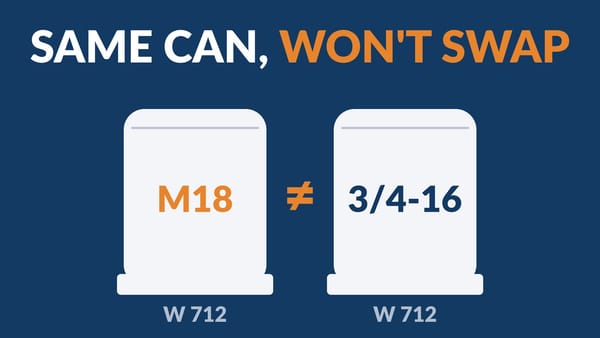
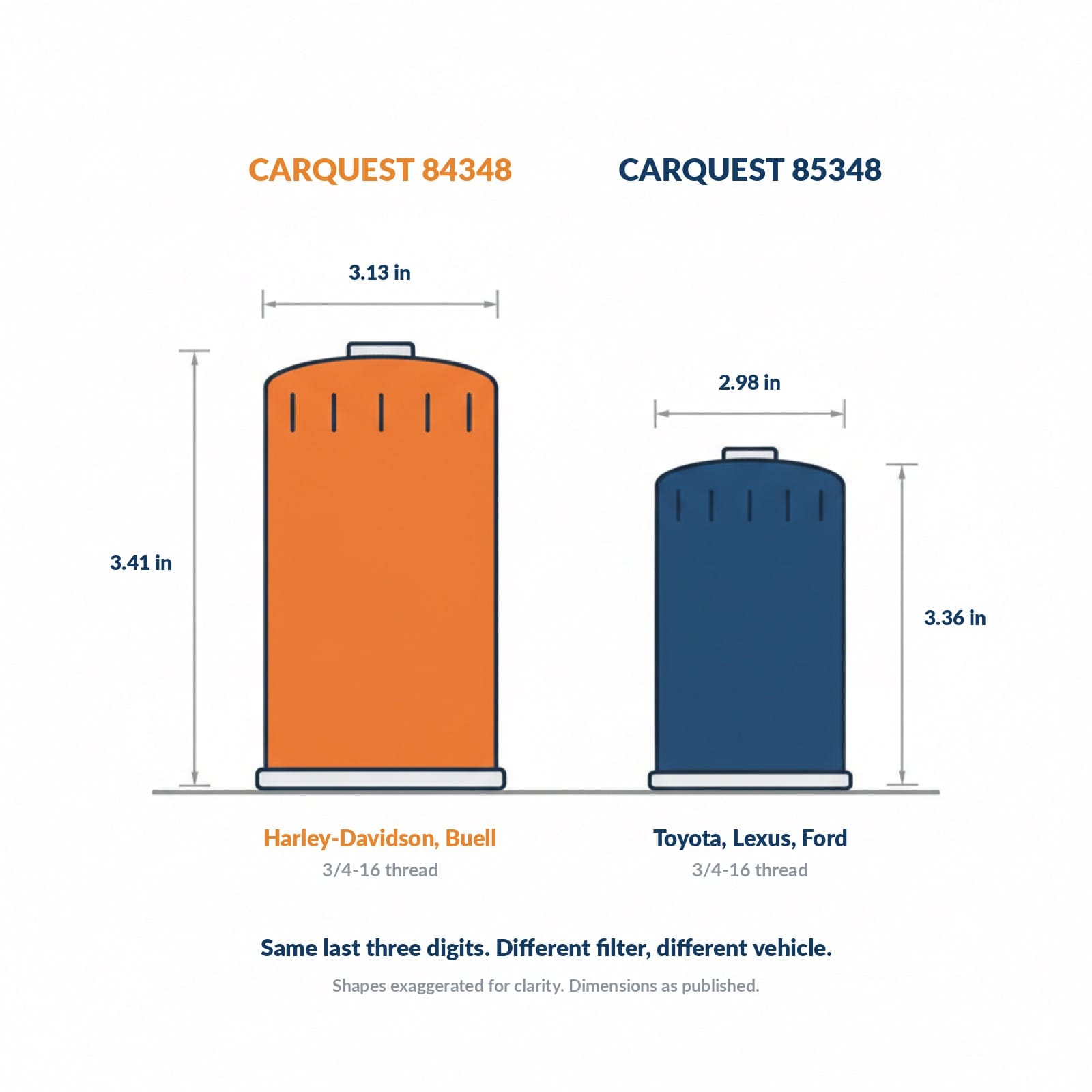
Two Carquest numbers can share the last three digits and be completely different filters.
Carquest 84348 is a 3.41 inch tall, 3.13 inch outside diameter, 3/4-16 filter whose entire application list is Harley-Davidson, Buell and American IronHorse motorcycles.
Carquest 85348 is a 3.36 inch tall, 2.98 inch outside diameter, 3/4-16 filter with a 12 to 15 PSI relief valve, covering Toyota, Lexus, Ford, Chrysler and dozens more.
Same three digits. Different filter, different diameter, different vehicle.
What is the difference between Carquest 84000 and 85000 filters?
Where both exist for one application, the 85000 number is the higher-specification filter.
Carquest's own catalog data lists 84356 at 99% filtration efficiency at 30 microns on OE synthetic blend media, with a 14 to 18 PSI relief valve and an M20x1.5 thread.
The matching 85356 is listed at 99.5% efficiency at 20 microns on cellulose and synthetic blended media, with a silicone anti-drainback valve Carquest describes as three times more durable than nitrile.
Both cover the same Mitsubishi, Mazda and Nissan applications, so in that case the numbers really are two grades of one filter. In the 348 case they are not. Look the number up rather than deriving it.
Who makes Carquest oil filters?
It has changed more than once, and it depends on the number.
Carquest filters have been sourced from WIX, from FRAM and from Baldwin at different points. Forum members have documented a Carquest filter identical to a FRAM PH30 in every way except colour, and a Carquest 85806 stamped as made by Baldwin.
The numbering follows the WIX catalog because WIX was the long-running supplier. The filter in the box may not be.


As an Amazon Associate we earn from qualifying purchases.
Why Cross Reference Charts Merge Filters That Are Not Identical
Every free cross reference tool builds interchange groups, not one-to-one equivalents.
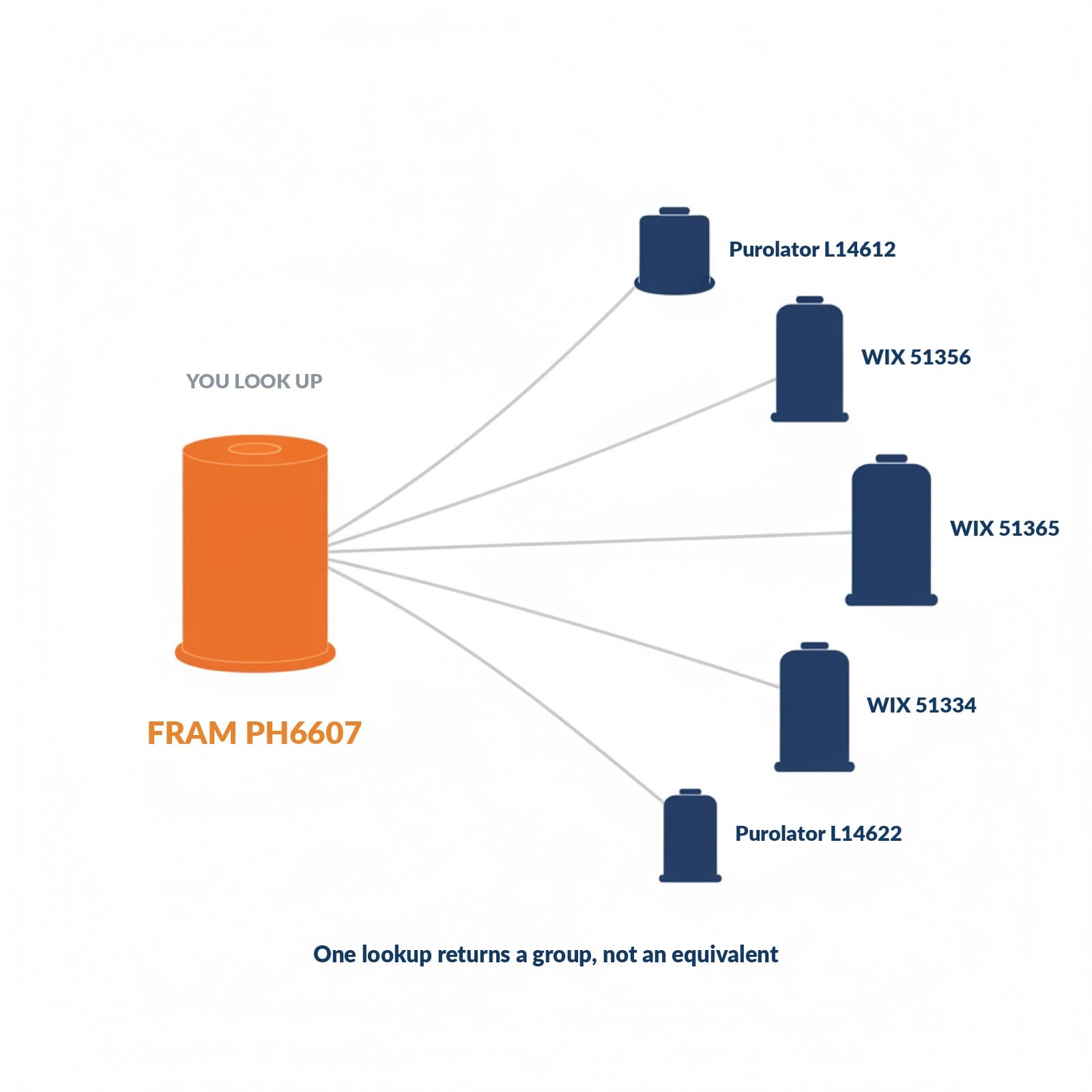
A group is a set of part numbers that some catalog somewhere has listed as substitutable for at least one shared application. Once brands are merged transitively, a group grows to include filters that are genuinely different sizes.
That is how PH6607 ends up returning five WIX numbers, and how a Harley filter and a Camry filter can share a three-digit tail.
Three rules keep you out of trouble:
- Anchor on the OEM number, not the aftermarket number. Your vehicle's factory part number is the only one that is unambiguous.
- Check thread size, gasket diameter and height before you buy. A filter that threads on but sits proud of the gasket seat will leak.
- Check the bypass valve pressure. A filter with the wrong relief setting either bypasses too early, sending unfiltered oil round, or too late, starving the engine on a cold start.
Physical fit and bypass pressure are the two specs that matter, and they are the two most likely to be silently different between members of the same interchange group.
How Do I Find the Right FRAM Filter for My Car?
Work from the vehicle, not from a chart.
- Find your OEM oil filter part number, from the owner's manual, the dealer parts counter or the number printed on the filter currently fitted.
- Look that OEM number up in FRAM's own catalog rather than a third-party chart.
- Note the FRAM digits that come back. That is your filter.
- Choose the prefix that matches how long you leave oil in the engine. Longer drain interval, higher line.
- Confirm thread size and height against the filter you removed before you fit the new one.
Step four is the only real decision. A 7,500-mile Drive filter fitted to a car running 15,000-mile synthetic intervals is the wrong filter even though it fits perfectly.


As an Amazon Associate we earn from qualifying purchases.
Who Makes FRAM Oil Filters Now?
The brand changed hands in 2026, and the answer most sites give is already out of date.
FRAM was founded in Providence, Rhode Island. Chemists T. Edward Aldham and Frederick Franklin were hired in 1932 to develop a replaceable oil filtering element, the company incorporated in 1934, and the name is a blend of Franklin and Aldham.
FRAM's parent through the late 2010s and early 2020s was First Brands Group. In September 2025 First Brands Group filed for Chapter 11 bankruptcy, listing assets of $5 billion to $10 billion against liabilities of $10 billion to $50 billion.
Premium Guard Inc, a Memphis-based filter manufacturer, signed an agreement in March 2026 to acquire key intellectual property and related assets from First Brands Group.
That deal closed on 16 April 2026 and covers the FRAM, Autolite, TRICO, ANCO, LuberFiner and StrongArm brands.
What this means for cross referencing: part numbers do not change when a brand is sold, so every chart on this page remains valid. What can change is who physically builds a given number, and therefore its internal construction. If you are choosing on media quality rather than fitment, buy recent stock and check the filter itself.
Frequently Asked Questions
Is TG3614 the same filter as PH3614?
Yes, physically. Both appear in the same interchange group with the same thread, gasket and dimensions, so they fit the same engines. TG is Tough Guard and PH is Extra Guard, so the Tough Guard carries better media and a 15,000-mile rating against the Extra Guard's 10,000.
What WIX filter replaces a FRAM PH6607?
The PH6607 group returns several WIX numbers, most commonly 51356 and 51365. Because the group merges more than one physical filter, match your OEM part number rather than picking either WIX number on the strength of the FRAM cross alone.
Do FRAM numbers and STP numbers share the same digits?
No, and assuming they do is a common error. The Ford Coyote filter is FRAM PH10575 but STP S10590. Some numbers happen to coincide because both catalogs have long histories, but the pattern is not a rule.
Is the Carquest number just the WIX number with a different prefix?
Usually the last three digits match, but the 84000 and 85000 blocks are separate part numbers rather than two grades of one filter. Carquest 84348 fits Harley-Davidson motorcycles while 85348 fits Toyota and Ford cars. Look the number up rather than calculating it.
Does FRAM publish a micron rating for its oil filters?
Not on its consumer product pages. FRAM publishes a 99% efficiency claim for Synthetic Endurance and Titanium with no micron size attached, and no efficiency figure at all for Extra Guard, Tough Guard or Ultra Synthetic. Ask FRAM for the data sheet if you need the number.


As an Amazon Associate we earn from qualifying purchases.
Next Step
Find the OEM part number for your engine before you open any cross reference tool. Every mistake in this guide, the merged groups, the Harley filter with the Camry number, the STP digits that do not line up, is caused by starting from an aftermarket number instead of the factory one.
With the OEM number in hand, the FRAM chart above becomes a two-second lookup, and the prefix is the only thing left to decide.