Carquest Oil Filter Cross Reference Chart & Lookup

A Carquest oil filter number tells you two things at once: which tier it is, and roughly which WIX number it matches. The tier is the first two digits, 84 or 85. The rest usually mirrors the last three digits of the equivalent WIX part, though "usually" is doing real work in that sentence, because two Carquest numbers can share a tail and fit completely different vehicles.
Carquest sells three oil filter lines: RFI Red Standard, CFI Blue Premium, and a Heavy Duty range built by Baldwin. This guide covers what the prefixes and blocks mean, a chart cross-referenced against WIX, FRAM and NAPA, the two efficiency figures Carquest actually publishes, and who builds the filters today.
What Do Carquest Oil Filter Numbers Mean?
Every current Carquest oil filter carries a five-digit number, and the catalog code behind it is CFI for the Premium (Blue) line and RFI for the Standard (Red) line, with an HD suffix marking the Baldwin-built Heavy Duty range.
Carquest's own parts lookup returns results by searching `mfgName=CFI` against a part number, which is the internal catalog name for the Premium line rather than a customer-facing label. Advance Auto Parts, Carquest's parent since 2014, sells the Standard, Premium and Heavy Duty lines side by side under the same physical dimensions in many sizes, so the tier is a media and gasket upgrade rather than a different filter shape.
What's the difference between Carquest Standard, Premium and Heavy Duty?
The Standard uses cellulose media with a nitrile gasket and nitrile anti-drain-back valve, rated for up to 5,000 miles. The Premium steps up to synthetic blend media, a silicone gasket and silicone anti-drain-back valve, rated for up to 10,000 miles, described on Carquest's own sell sheet as giving "2X capacity" over the Standard. The Heavy Duty line is a separate product built by Baldwin/Hastings, not a third grade of the same filter.
| Tier | Catalog code | Media | Gasket / ADBV | Rated interval |
|---|---|---|---|---|
| Standard | RFI (Red) | Cellulose | Nitrile / Nitrile | 5,000 miles |
| Premium | CFI (Blue) | Synthetic blend | Silicone / Silicone | 10,000 miles |
| Heavy Duty | HD suffix | Not published by Carquest | Not published by Carquest | Not published by Carquest |
What Efficiency Do Carquest Oil Filters Publish?
The current Carquest Standard is rated at 95.1% efficiency at 20 microns, and the current Premium is rated at 99.5% efficiency at 20 microns, both stated on Carquest's own sell sheets and repeated on the matching Advance Auto Parts product pages.
Those numbers replaced an older set. An earlier Carquest Standard sheet advertised 96% at 20 microns, and an earlier Premium sheet advertised 99% at 30 microns, both figures that predate the current media and gasket spec. Carquest's own filter database still returns the older Premium figure on some part numbers and the newer one on others, which means the two ratings coexist in the live catalog rather than one having fully replaced the other. Treat the 99.5% at 20 microns figure as the current spec and the 99% at 30 microns figure as legacy.
No efficiency figure has been published for the Heavy Duty line by Carquest. The Heavy Duty's Baldwin cross reference carries a nominal/absolute micron rating rather than a single efficiency percentage, which is a different measurement standard and does not convert cleanly to the Standard and Premium numbers.
Carquest Oil Filter Cross Reference Chart
Each row below is one physical filter, cross-referenced against its WIX, FRAM and NAPA Gold equivalents. The Carquest number is the Premium (CFI) part unless marked.
| Carquest | WIX | FRAM | NAPA Gold | Application |
|---|---|---|---|---|
| 84060 | 57060 | PH10060 | 7060 | GM V8, ACDelco PF48 applications |
| 84356 | 51334 family | PH3593A group | 1334 | Honda, Nissan, Subaru, Hyundai |
| 85348 | 51348 | PH3614 | 1348 | Toyota, Lexus, Ford, Chrysler, 3/4-16 thread |
| 84502 | 57502 | PH10575 | 7502 | Ford 5.0 Coyote V8 |
| 84348 | not a WIX 51348/57502 match | not a FRAM PH3614/PH10575 match | not confirmed | Harley-Davidson, Buell, American IronHorse motorcycles |
The 84502 and 85348 rows are confirmed against the PH10575 and WIX 51348 interchange groups already established on the FRAM cross reference guide, where Carquest's own catalog data independently returns the same tail-digit numbers. The 84060 row is confirmed against the WIX 57060 group, which lists Carquest 84060 among its FRAM, NAPA and K&N equivalents.
Why does 84348 not match the 85348 filter it looks like?
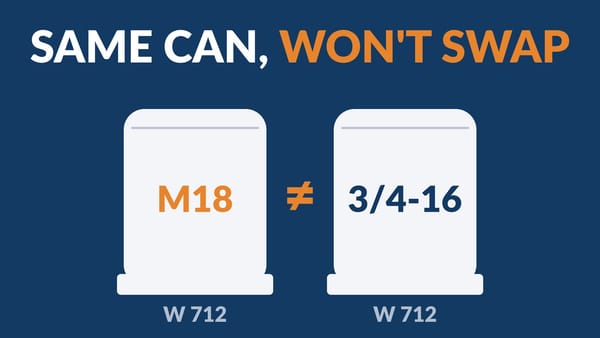
Because the 84000 and 85000 blocks are separate part number ranges, not two tiers of the same physical filter. Carquest 84348 is a 3.41 inch tall, 3.13 inch outside diameter, 3/4-16 filter whose entire application list is Harley-Davidson, Buell and American IronHorse motorcycles, confirmed on the FRAM cross reference article's own research into this exact pair. Carquest 85348 is a 3.36 inch tall, 2.98 inch outside diameter, 3/4-16 filter with a 12 to 15 PSI relief valve, covering Toyota, Lexus, Ford, Chrysler and dozens more.
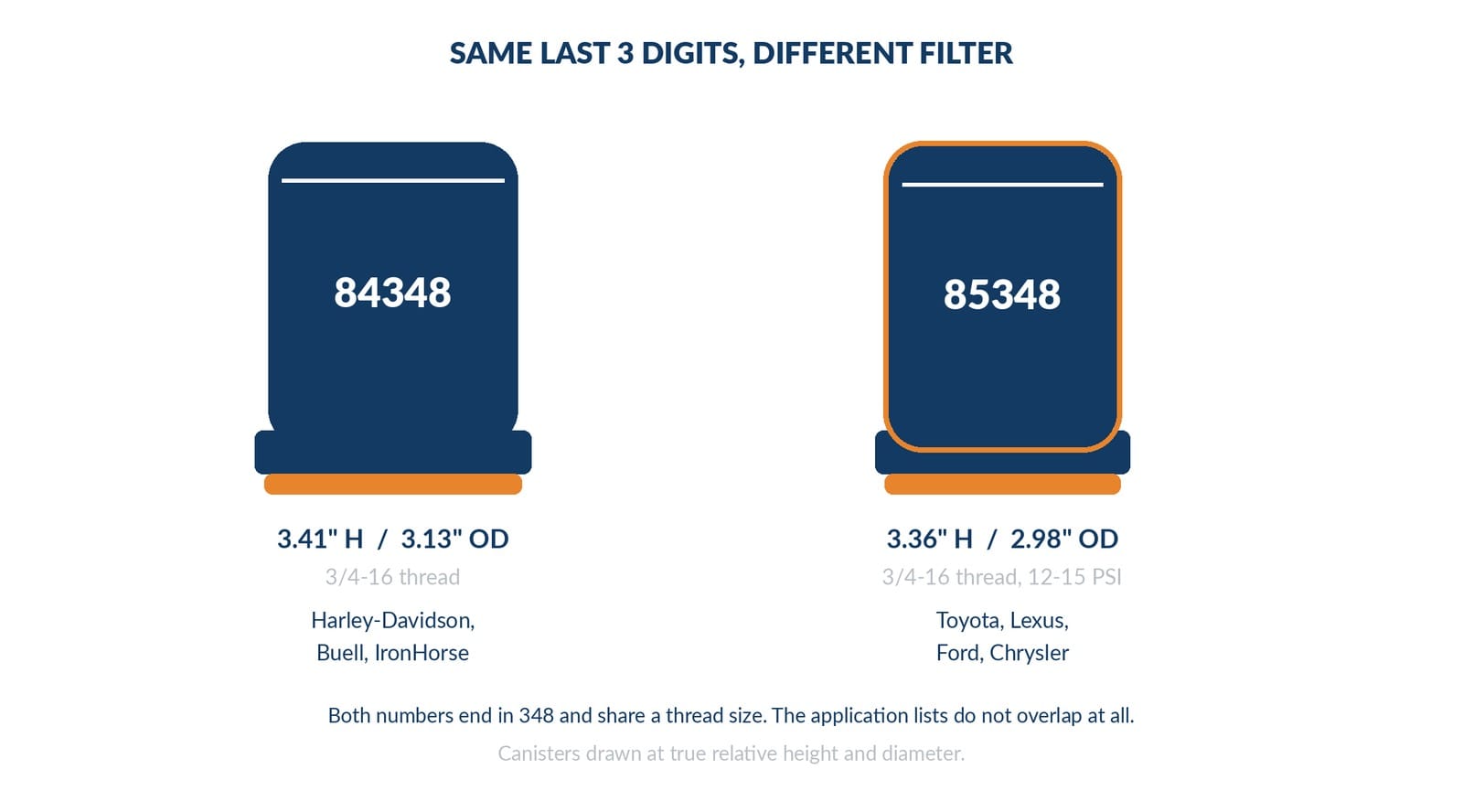
Same three trailing digits. Different height, different diameter, different vehicle entirely. Look the number up rather than assuming the 84 and 85 versions of a tail are interchangeable.
Where both blocks do exist for one true application, the relationship flips: they become two grades of the same filter rather than two different filters. Carquest 84356 carries a 99% at 30 microns rating on OE synthetic blend media with a 14 to 18 PSI relief valve, and its matching 85356 carries a 99.5% at 20 microns rating on cellulose and synthetic blended media with a silicone anti-drain-back valve, covering the same Mitsubishi, Mazda and Nissan applications. That pair really is a Standard-versus-Premium choice on one fitment. The 348 pair is not. There is no rule that predicts which case you are in without checking.
Who Makes Carquest Oil Filters Now?
Carquest oil filters have changed manufacturer multiple times, and the current answer traces to the same 2025 to 2026 filter industry shake-up already documented on this site.
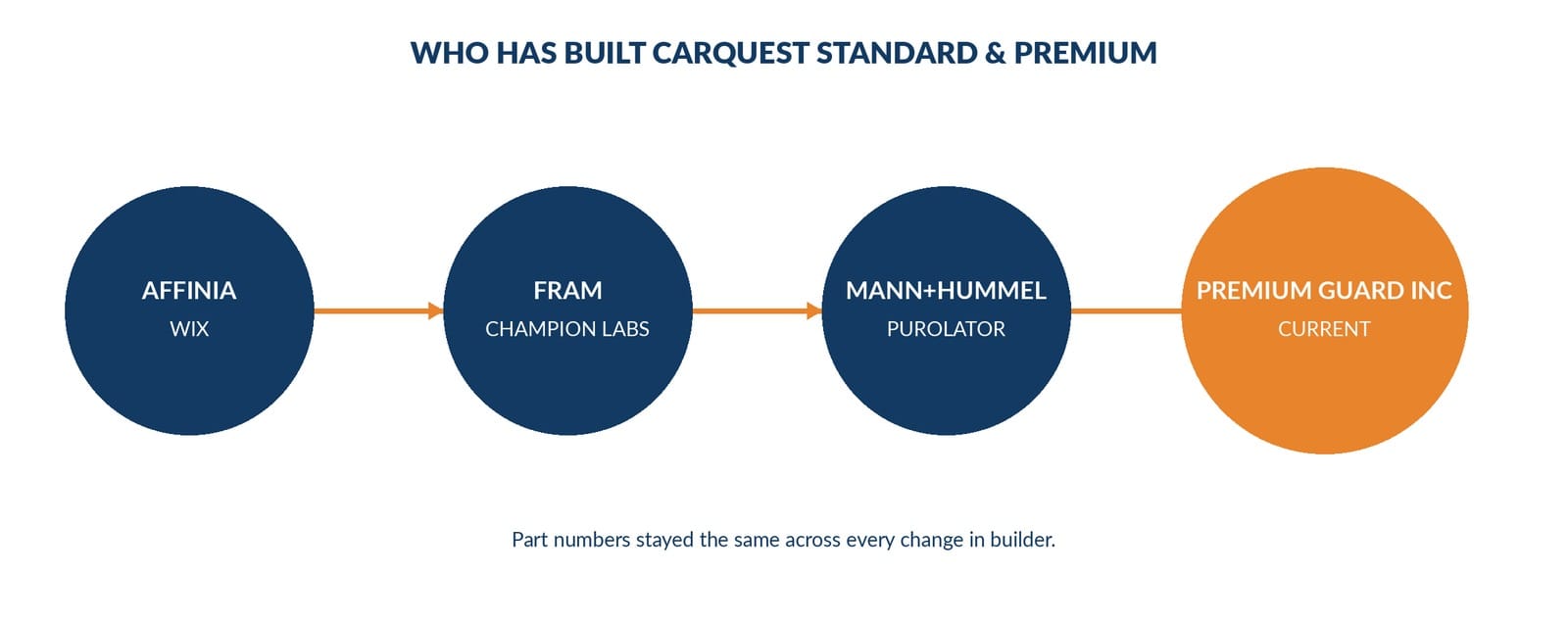
The Standard (Red) and Premium (Blue) lines were built first by Affinia/WIX, then by FRAM/Champion Laboratories, then by MANN+HUMMEL/Purolator. As of the current catalog, both lines are built by Premium Guard Inc, the Memphis-based private-label filter manufacturer that also supplies Carquest's own numbering neighbor NAPA Gold. Country of origin for Premium Guard-built Carquest filters is primarily China and Vietnam. That name should be familiar from the ownership shake-up already documented on the FRAM cross reference guide, though Carquest itself was not one of the brands that changed hands in the First Brands bankruptcy. It arrived at Premium Guard through a separate supply relationship.
The Heavy Duty line is built by Baldwin, under the Hastings/Baldwin lineage, and has historically been sourced in the USA more than the Standard and Premium lines, though recent Heavy Duty production in smaller sizes may have shifted to Mexico.
Part numbers do not change when a manufacturer changes, which is why the chart above stays valid regardless of who built the filter in your hand. What changes is internal construction. Carquest's own current sell sheets describe metal end caps and a coil spring bypass across all three lines, with the media and gasket material as the real point of difference.
Is a Carquest number the same as the matching WIX number with a different prefix?
Not reliably enough to skip checking. The last three digits usually match the WIX tail, and Carquest 84060 crossing to WIX 57060 or Carquest 84502 crossing to WIX 57502 both hold up. But the 84348/85348 pair above proves the tail-digit shortcut fails exactly when you need it most, on two numbers that look like a matched set. Confirm the OEM application before buying, not just the number pattern.
How Carquest's Own Catalog Is Structured
Carquest's parts data lives at weblink.carquest.com, a static lookup that returns dimensions, relief valve pressure, media type and application list per part number when queried by manufacturer code (CFI for Premium, RFI for Standard) and part number. It requires a Carquest account login to browse, but individual part pages load directly when linked, and it is the most detailed public source available for a given Carquest number, more detailed than most retailer listings.
K&N publishes its own manufacturer cross reference index for Carquest numbers, which independently returns a K&N equivalent for a given Carquest part. Carquest 84356, for example, crosses to K&N SO-1010 in that same catalog, a second manufacturer source corroborating the fitment rather than an aggregator's guess.
Frequently Asked Questions
What does CFI mean on a Carquest oil filter?
CFI is the internal catalog code Carquest's parts lookup uses for the Premium (Blue) line, visible in the `mfgName=CFI` parameter on weblink.carquest.com part pages. It is not printed on the filter box and is not a widely explained abbreviation anywhere in Carquest's consumer marketing.
Does the Carquest 84000 or 85000 number mean a specific filter type?
No. Both blocks contain spin-on filters for a wide range of applications, and neither number range is reserved for a single vehicle brand, engine type or filter style. The block only tells you it's a Carquest Premium-line part; the specific application still has to be looked up.
Are Carquest filters made by WIX?
Not currently, despite the numbering pattern that still echoes WIX's system. Carquest's Standard and Premium lines have moved through several manufacturers since the WIX era, and are currently built primarily by Premium Guard Inc, per BobIsTheOilGuy's manufacturer thread, which reflects owner-reported findings and phone confirmation with Carquest/Advance Auto Parts customer service rather than a manufacturer press release.
Which Carquest oil filter line should I use?
Match the line to your oil change interval, the same rule that applies across every brand on this site: the Standard fits a 5,000-mile conventional oil interval, and the Premium fits a 10,000-mile synthetic or synthetic blend interval. Buying a longer-rated filter never hurts fitment; buying a shorter-rated one for a long interval leaves the filter working past its designed capacity.
Finding the Right Carquest Filter for Your Car
Work from your vehicle's OEM number, not from a Carquest number you already have in hand.
- Find your factory oil filter part number from the owner's manual or the filter currently on the engine.
- Cross that OEM number against the WIX or FRAM catalog, where the interchange data is more thoroughly documented publicly than Carquest's own login-gated catalog.
- Take the resulting WIX or FRAM number and match its last three digits against a Carquest 84000 or 85000 number, then verify that match against weblink.carquest.com or K&N's cross reference rather than assuming the pattern holds.
- Choose Standard or Premium based on how long you plan to run the oil before the next change, not on price alone.
Skipping step 3's verification is exactly how a Harley filter and a Camry filter end up looking interchangeable on a spreadsheet. They share three digits and nothing else.