How Often Should You Change Your Oil Filter?

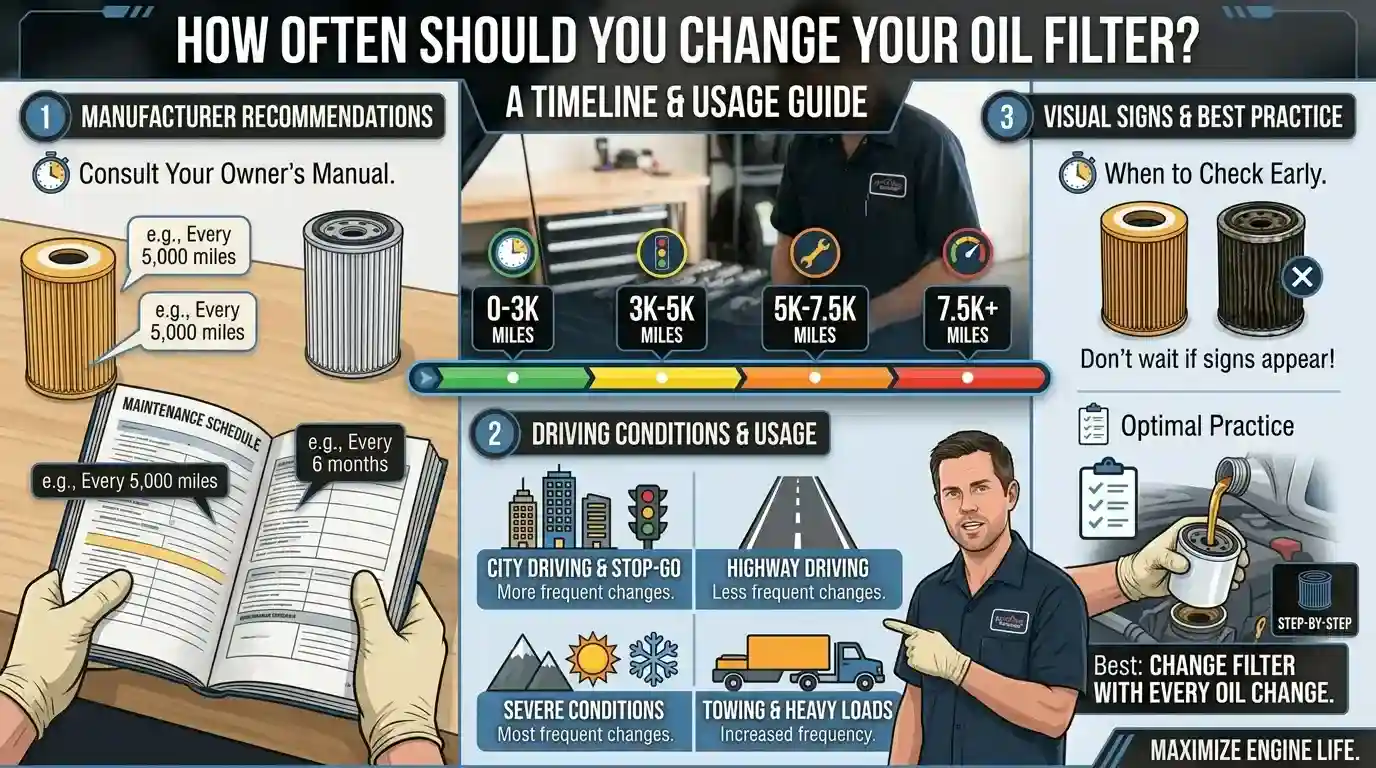


Change your oil filter every time you change your oil. That's the standard recommendation from virtually every major automaker and oil filter manufacturer. Whether your interval is 3,000 miles on conventional oil or 10,000 miles on full synthetic, the filter gets replaced at the same time the oil does. It's not a separate schedule. It's the same service.


As an Amazon Associate we earn from qualifying purchases.
How Often Should You Change Your Oil Filter?
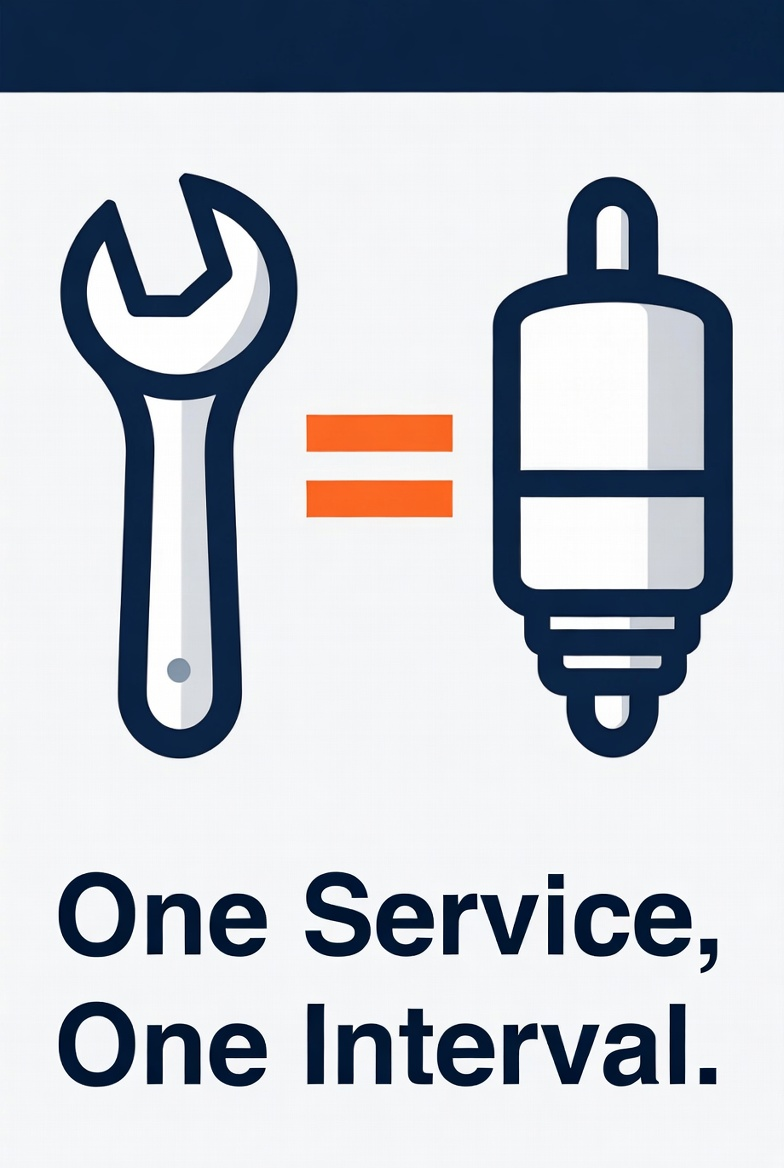
The answer is simple: at every oil change, without exception.
Here's the reasoning. An oil filter's job is to trap contaminants. As it does its job, it fills up. A filter that's been running for 5,000 miles has already captured a significant load of metal particles, combustion byproducts, and sludge.
When you install fresh oil into an engine with a saturated filter, the new oil immediately flows through a clogged medium. The fresh oil degrades faster because it has to carry the burden the old filter was already struggling with.
The cost difference between replacing the filter at every oil change versus skipping it is less than $10. The cost of engine damage from inadequate filtration is measured in thousands.
Do You Have to Change the Oil Filter Every Time You Change the Oil?
Yes. This is not a controversial position among engineers or mechanics.
The filter and oil are a system. They wear out together. Separating their replacement schedules creates a situation where one half of the system is new and the other half is degraded. That asymmetry is exactly what accelerates engine wear.
Some older advice suggested changing the filter every other oil change. That guidance came from an era when filter media was less sophisticated and oil changes were every 3,000 miles. At 3,000-mile intervals, a filter running two full cycles was only accumulating 6,000 miles of contamination load.
Today's extended drain intervals mean skipping the filter replacement at a 7,500-mile change results in a filter with 15,000 miles of accumulated debris. That's a completely different situation.
Modern engines are built to tighter tolerances. The clearances between moving parts are smaller. That means smaller particles cause more wear. A filter that's past its capacity doesn't trap those particles. It passes them through.


As an Amazon Associate we earn from qualifying purchases.
Can You Change Oil Without Changing the Filter?
Technically, yes. Practically, you shouldn't.
The arguments for skipping the filter are usually about cost and convenience. Neither holds up under scrutiny.
A quality oil filter costs between $6 and $20 for most vehicles. Premium filters from Mobil 1, Royal Purple, or K&N run higher, but even those stay under $30. On an oil change that might cost $40 to $80 in materials, skipping a $10 filter to save money is a false economy.
The convenience argument also collapses quickly. Replacing an oil filter adds less than five minutes to a DIY oil change. It's a single step in the same process. The filter comes off at the same time the drain plug does. There's no extra trip, no extra tools, no extra complexity.
The only scenario where skipping the filter is defensible is an emergency top-up situation where fresh oil must be added but filter access is genuinely impractical. Even then, the filter should be replaced at the earliest opportunity.
What Happens If You Don't Change Your Oil Filter?
A neglected oil filter fails in predictable ways, and all of them hurt your engine.
The bypass valve opens
Every oil filter contains a bypass valve. This valve is a pressure-relief mechanism designed to open when the filter medium becomes so restricted that oil can no longer flow through it normally. When the bypass opens, unfiltered oil flows directly to the engine's bearings and other critical surfaces.
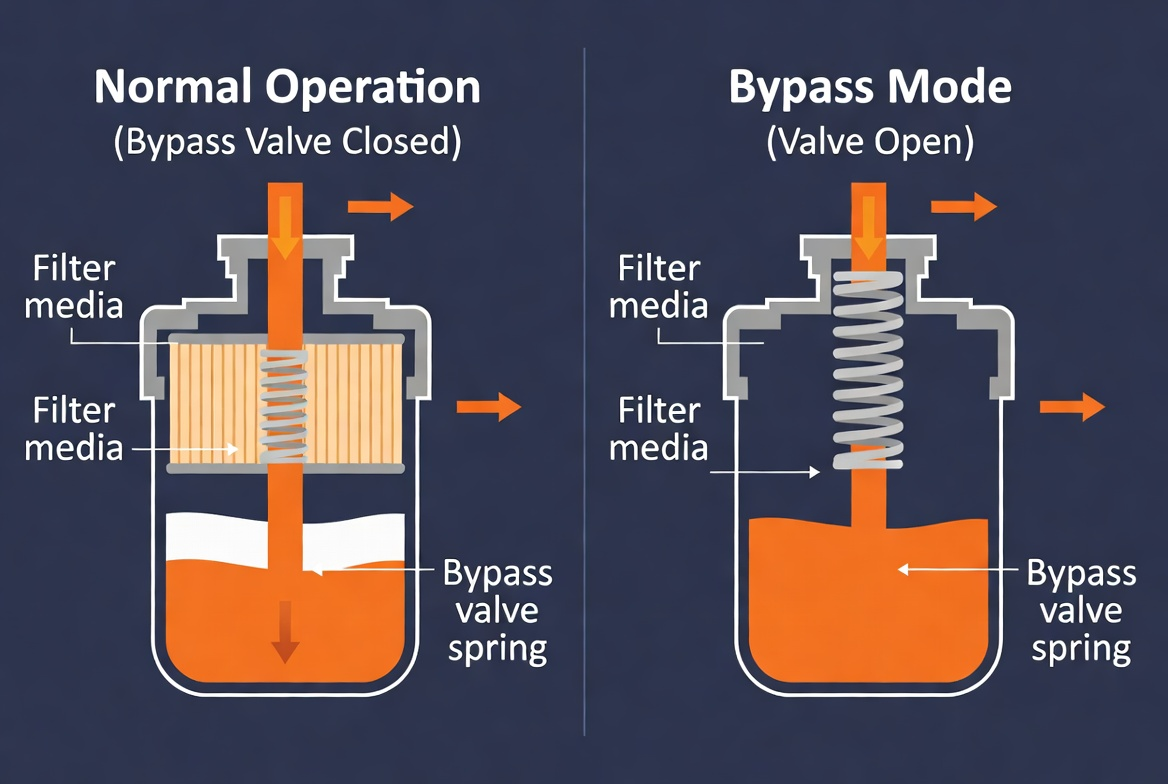
This is the filter's fail-safe. It prevents oil starvation, which would destroy the engine instantly. But it trades one problem for another. Unfiltered oil carries every particle the filter was supposed to trap. Bearings, camshaft journals, and piston rings all receive contaminated oil at normal operating pressure.
The bypass doesn't announce itself. There's no warning light for "bypass valve open." The engine continues to run. Wear accelerates silently. There are, however, other symptoms of a clogged filter that appear before catastrophic damage sets in.
Sludge accumulates faster
Motor oil degrades through a combination of heat, oxidation, and contamination. A saturated filter means the oil carries more contaminants back into circulation with every pump cycle. Those contaminants accelerate oxidation. Oxidized oil forms sludge. Sludge clogs oil passages, restricts flow to the valvetrain, and bakes onto internal surfaces.
Sludge damage is cumulative and largely irreversible without a full engine teardown.
Particle-related wear compounds
Metal-to-metal contact is normal in an engine. The oil film between moving parts prevents direct contact, but particles suspended in oil act like fine sandpaper. The longer those particles remain in circulation, the more material they abrade from bearing surfaces, cylinder walls, and camshaft lobes. That wear produces more particles. More particles produce more wear. It's a cycle that shortens engine life by tens of thousands of miles.
Does Oil Type Affect How Often to Change the Oil Filter?
The oil type determines your change interval. The filter follows that interval.
With conventional oil, most manufacturers recommend changes every 3,000 to 5,000 miles. If you're on a 3,000-mile schedule, the filter gets replaced every 3,000 miles.
With full synthetic oil, drain intervals extend to 7,500 to 10,000 miles in typical driving, with some manufacturers and oils supporting intervals up to 15,000 miles. The filter still gets replaced at that same interval.
Here's where filter quality becomes relevant. A budget filter running a 5,000-mile conventional oil interval is a different load condition than that same filter running a 10,000-mile full synthetic interval. If you're on an extended drain schedule with synthetic oil, using a premium filter designed for high-mileage or extended service intervals is worth considering. Brands like Mobil 1, Wix, and Purolator Gold publish capacity ratings for exactly this reason.
The filter must be rated for the interval. A conventional-grade filter on a 10,000-mile synthetic schedule is a mismatch.


As an Amazon Associate we earn from qualifying purchases.
Does Driving Style Affect Oil Filter Life?
Yes. Driving conditions are probably the most underappreciated factor in filter service life.
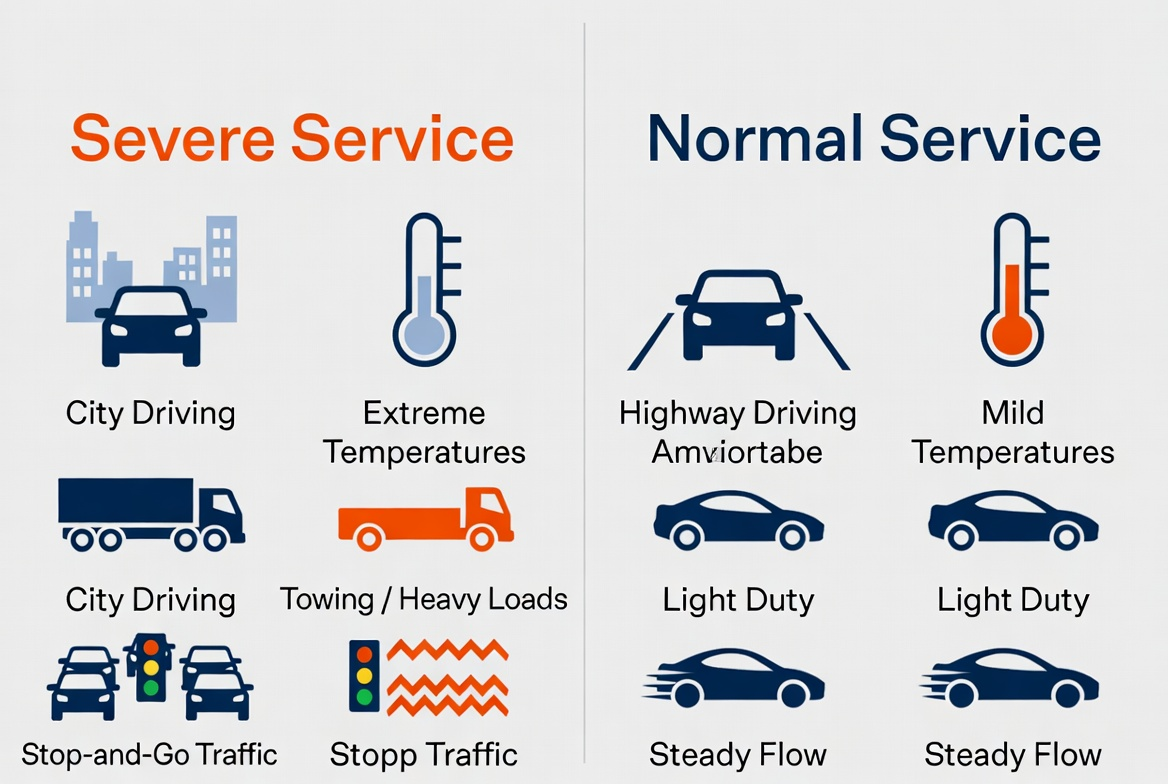
Severe service conditions
Most manufacturers define "severe service" in their owner's manuals. Common triggers include:
- Frequent short trips under 5 miles (the engine never fully warms up, oil doesn't reach operating temperature, condensation and fuel dilution accumulate faster)
- Towing or hauling heavy loads regularly
- Driving in extreme heat or extreme cold
- Lots of stop-and-go city driving
- Dusty or off-road environments
Under severe service conditions, oil and filter degradation happens faster. Many manufacturers recommend shortening the change interval by 30 to 50 percent under these conditions. If your standard interval is 7,500 miles, severe service conditions might push that to 4,000 to 5,000 miles, with the filter replaced every time.
Highway driving
Sustained highway driving is actually easier on oil and filters than city driving. The engine runs at consistent temperature and load. There's less stop-and-go combustion blow-by. Oil circulates continuously rather than sitting and cooking during repeated cold starts.
If your driving is predominantly highway miles, you're closer to the "normal" service end of the spectrum. If it's predominantly short urban trips, assume severe service and shorten your interval accordingly.
How Do You Know If Your Oil Filter Needs Changing?
The direct answer is: you don't, without pulling it and inspecting it or cutting it open. Oil filters don't have external indicators of internal condition.
What you can watch for:
Oil pressure fluctuation: A partially restricted filter can cause oil pressure to vary, particularly at idle. If your oil pressure gauge dips and recovers, especially when the engine is warm, the filter is a candidate worth investigating alongside other possibilities.
Oil dark quickly after a change: If fresh oil turns dark within the first 1,000 miles after a change, the filter may be recirculating contamination it couldn't hold. This can also indicate engine wear or blow-by issues, but a saturated filter from a previous long interval is a common cause.
Obvious mileage overage: If your sticker says 5,000 miles and you're at 8,500 miles, you already know the filter needs changing. The interval exists for a reason.
Manufacturer monitoring systems: Many modern vehicles have oil life monitoring systems that calculate change intervals based on actual engine conditions, not just mileage. These systems factor in temperature cycles, RPM patterns, and load. When the system signals a change, it means both oil and filter need replacement.
The cleanest approach is to simply not let the interval become a question. Set a schedule, stick to it, and replace the filter every single time.


As an Amazon Associate we earn from qualifying purchases.
Does Filter Brand or Quality Affect Replacement Interval?
Yes, but within limits.
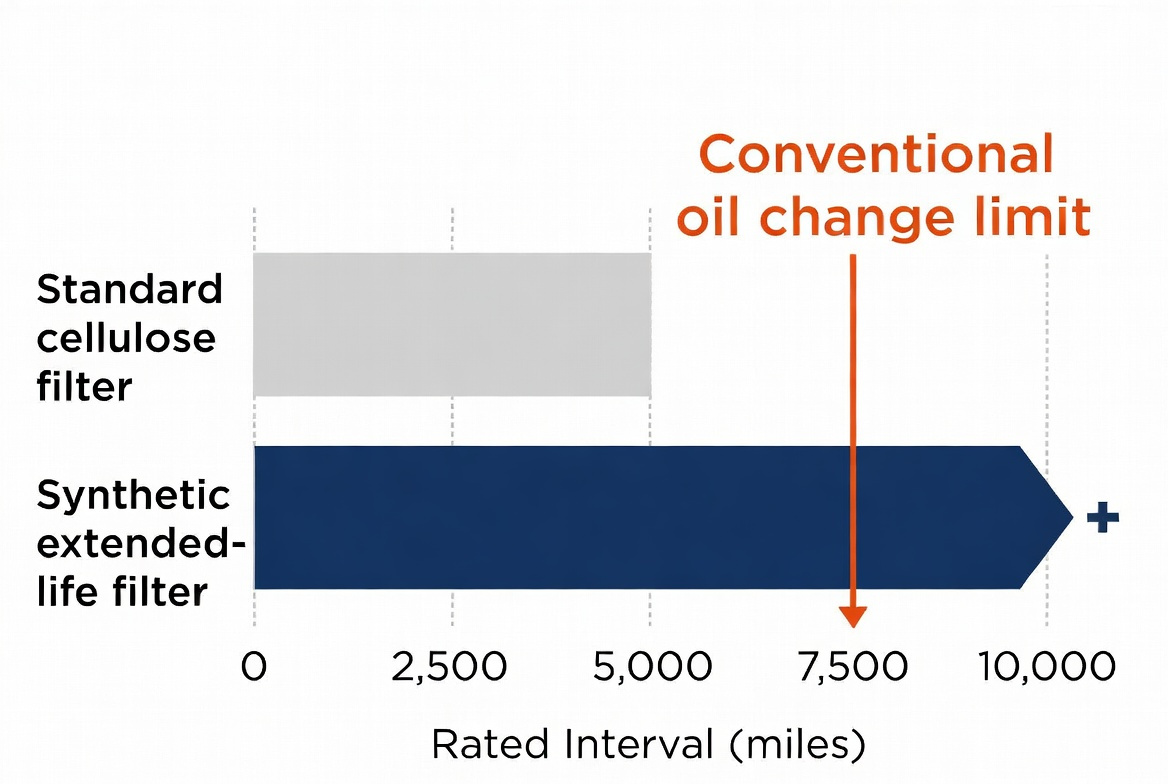
A premium extended-life filter uses a higher-capacity filter medium, usually a synthetic or synthetic-blend media with greater surface area. It can hold more contamination before reaching bypass pressure. This matters at longer drain intervals.
A budget filter uses cellulose media with lower capacity and shorter effective life. At 3,000 to 5,000-mile conventional oil intervals, the difference is marginal. At 10,000-mile full-synthetic intervals, the difference is significant.
The practical guidance: match your filter to your interval. If you're running extended synthetic oil changes, use a filter explicitly rated for that interval. If you're running conventional oil on a short interval, a quality standard filter is completely adequate.
What you should never do is use an extended-life filter as justification to push beyond your oil change interval. The filter may have capacity remaining, but the oil doesn't. The two are not independently interchangeable. When the oil hits its limit, both get replaced. The filter's remaining capacity is irrelevant.
FAQ
How often should I change my oil filter?
Change it every time you change your oil. If you change oil every 5,000 miles, the filter gets replaced at every 5,000-mile interval. There is no separate filter-only schedule.
Can you just add oil and skip the filter?
You can top off oil between changes without replacing the filter. But at a full oil change, the filter must be replaced. Running fresh oil through a saturated filter defeats the purpose of the oil change.
What happens if you go 10,000 miles without changing the oil filter?
The filter will almost certainly have reached its capacity and begun operating in bypass mode, sending unfiltered oil to your engine's bearing surfaces. Wear accelerates. Sludge builds up faster. Engine life shortens. Whether damage is immediate or cumulative depends on your specific engine, oil, and driving conditions. The risk is not worth the savings.
Do I need to change the oil filter if I only change one quart of oil?
No. Partial oil additions between changes don't require a filter replacement. The filter is replaced at the full drain-and-refill oil change interval.
Is there a mileage limit on oil filters?
Standard filters are typically rated for intervals matching conventional oil changes, around 3,000 to 7,500 miles. Extended-life or synthetic-grade filters are rated for 10,000 to 15,000-mile intervals. Check the filter's packaging for its rated interval and don't exceed it.
Can I use a higher-quality filter and extend my oil change interval?
No. The filter's capacity is only one factor. Oil itself degrades through heat and oxidation regardless of filtration quality. A premium filter doesn't extend your oil change interval. It ensures proper filtration throughout whatever interval the oil itself dictates.


As an Amazon Associate we earn from qualifying purchases.
The Simple Rule That Protects Your Engine
Change the oil filter at every oil change. Don't separate the schedules. Don't skip it to save a few dollars. Don't assume the filter has capacity left because you're using a premium brand.
The filter and oil are one system. They go in together. They come out together.
If you're not sure what interval your vehicle requires, your owner's manual is the definitive source. The manufacturer's engineering team calculated that interval based on your specific engine's tolerances, oil pump flow rates, and contamination load expectations. It's the best guidance available and it costs nothing to follow.