Purolator Oil Filter Cross Reference Chart (All Models)

Purolator makes three filter lines: Classic (L prefix), PureONE (PL prefix), and Boss (also PL prefix, upgraded version). Each line covers the same vehicle applications as FRAM, WIX, and OEM filters. This guide maps the most common Purolator numbers to their FRAM, WIX, and OEM equivalents, and explains how to find the right cross reference for your specific vehicle.
What Are Purolator's Filter Lines?
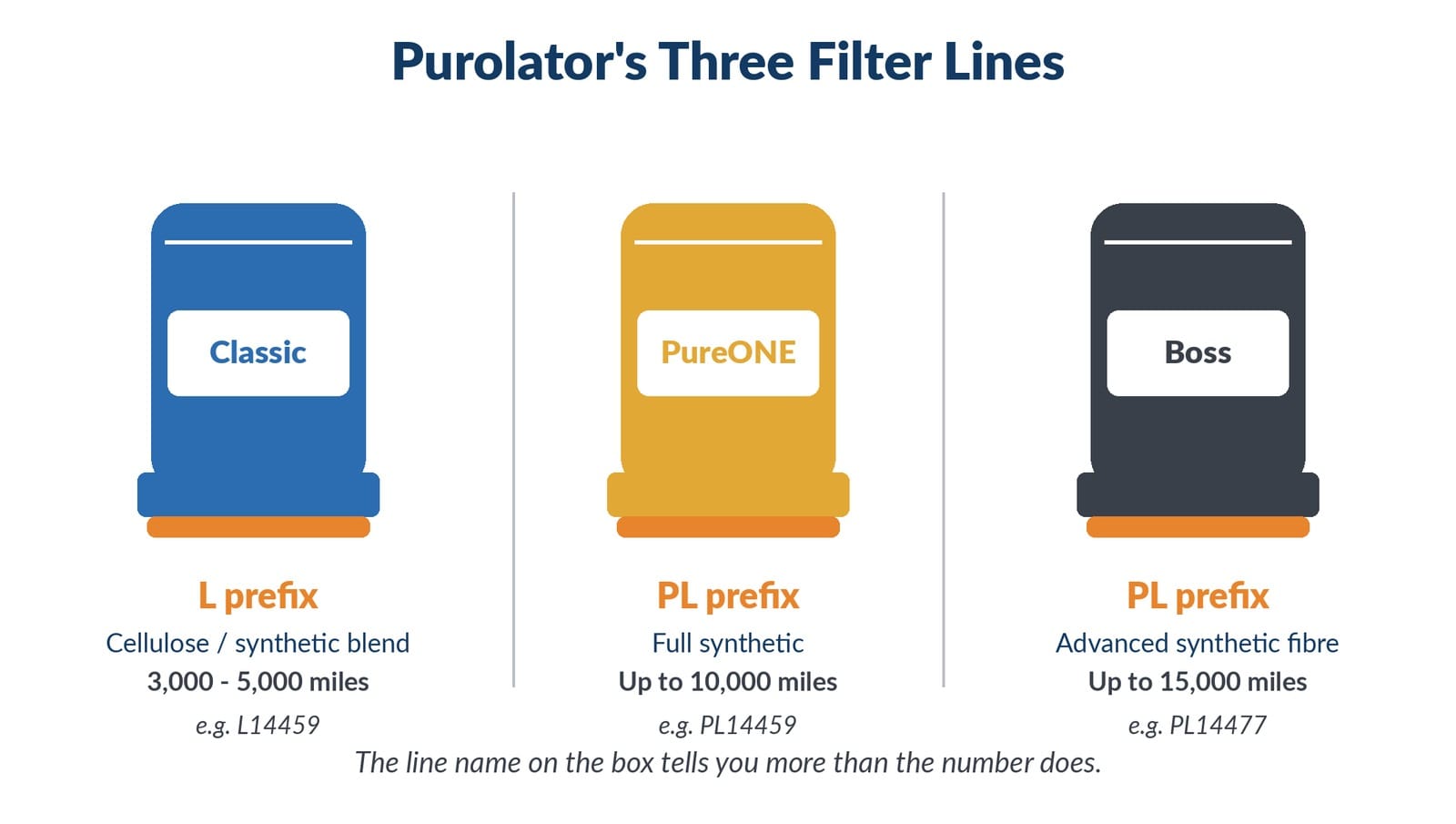
Purolator organizes its oil filter catalog into three performance tiers. Understanding the difference helps you cross reference correctly, because a Classic L-series and a PureONE PL-series with the same number suffix are designed for the same engine but use different filter media.
Purolator Classic (L Prefix)
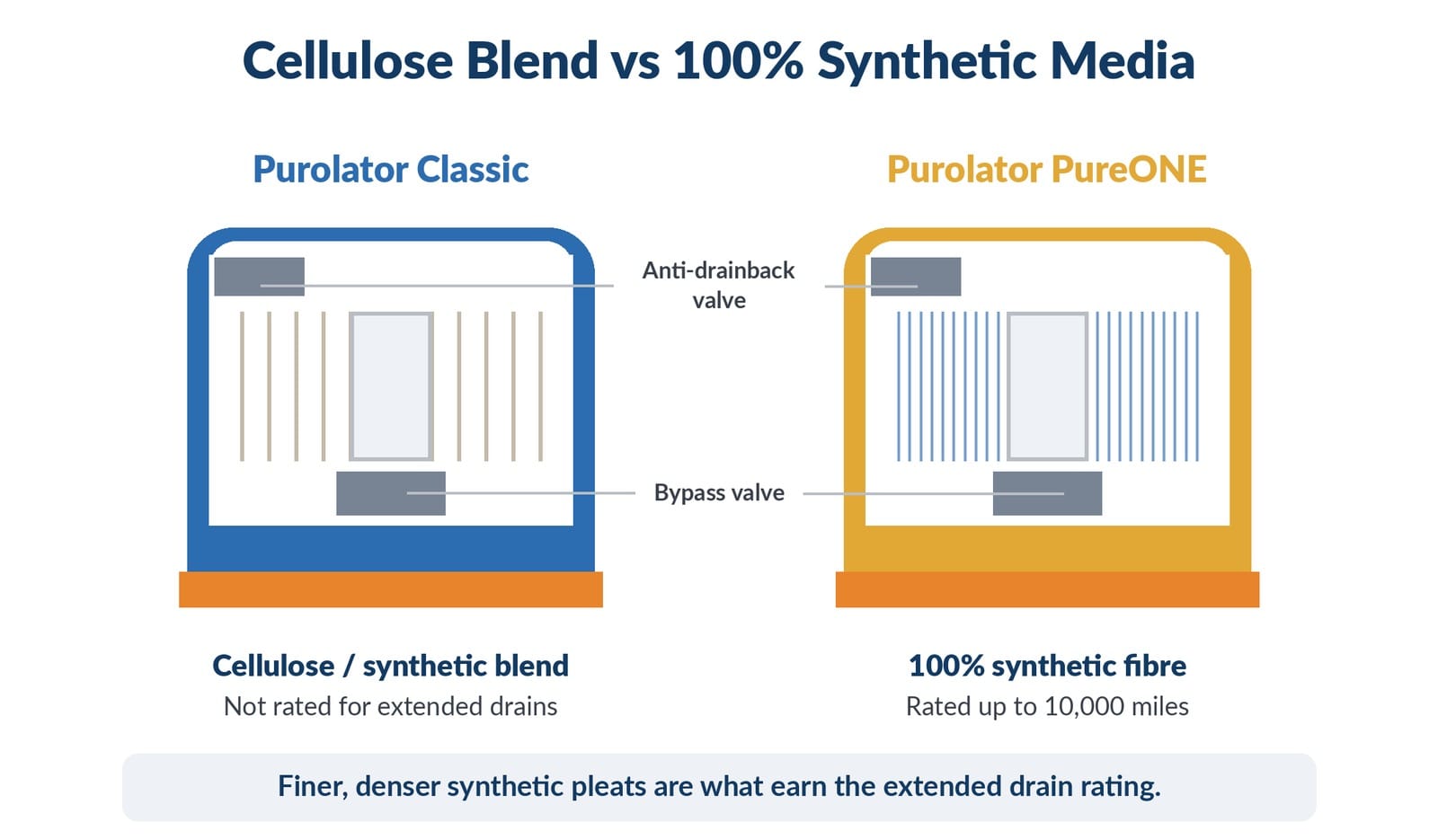
The Classic line is Purolator's entry-tier filter. It uses a cellulose and synthetic blend media. The Classic is engineered for conventional oil service intervals and is rated to capture particles in the 20 to 25 micron range at nominal efficiency. It is the baseline replacement filter for standard oil change schedules.
Part numbers use an L prefix: L14610, L20195, L24651.
Purolator PureONE (PL Prefix)
The PureONE is Purolator's premium filter, using a 100 percent synthetic media. Purolator rates PureONE filters at 99.9% efficiency at the target micron level for each application. The PL prefix part numbers are direct mechanical equivalents of the L prefix Classic numbers, but with upgraded internal construction for extended synthetic oil intervals.
Part numbers use a PL prefix: PL14610, PL20195, PL24651.
Purolator Boss (PL Prefix)
The Boss is Purolator's extended-performance tier, positioned for high-mileage engines and long-drain synthetic service. It uses an advanced synthetic fiber matrix and a silicone anti-drainback valve rated for extreme temperature cycles. Boss filters are sized identically to PureONE filters with the same part number suffix. They are available as a standalone Boss line in some markets, and in others the PL number simply designates the premium synthetic option.
The key takeaway: L and PL numbers with the same suffix fit the same engine. The difference is media quality and service interval, not physical fitment.
How Purolator Part Numbers Work
The letter prefix encodes the product tier, and the number encodes the filter size and fitment group.
| Prefix | Line | Media | Interval |
|---|---|---|---|
| L | Classic | Cellulose/synthetic blend | Conventional (3,000–5,000 miles) |
| PL | PureONE | Full synthetic | Extended (up to 10,000 miles) |
| PL | Boss | Advanced synthetic fiber | Extended (up to 15,000 miles) |
The suffix number does not encode vehicle information directly. It is a catalog designation. Purolator L14610 and PL14610 are both engineered for the same set of applications. The prefix is the only indicator of media tier.
This is different from FRAM's system, where the prefix letters indicate the product line (PH for standard, TG for Tough Guard, XG for Ultra Synthetic). With Purolator, only two prefixes cover the entire consumer catalog.
Purolator Cross Reference Chart
The chart below is organised by Purolator part number rather than by vehicle, because that is how the catalog actually works. One Purolator number covers a group of applications, and the FRAM, WIX and OEM numbers beside it are the equivalents within that group.
Always confirm your exact year, make, model and engine in a fitment lookup before buying. A cross reference chart tells you which filters are equivalent. It does not tell you which one your engine takes.
| Purolator Classic | PureONE | FRAM | WIX | OEM number | Typical coverage |
|---|---|---|---|---|---|
| L14459 | PL14459 | PH3593A | 51334 | Honda 15400-PLM-A02 | Honda, Acura, Subaru, Hyundai, Kia, Mitsubishi |
| L14477 | PL14477 | PH4386 | 57145 | Toyota 90915-YZZF1 | Toyota, Lexus, Scion 4-cylinder |
| L10241 | PL10241 | PH3614 | 51348 | Toyota 90915-YZZD1 | Toyota, Ford, Chrysler, Mazda multi-make |
| L25608 | PL25608 | CH9972 | 57047 | Toyota 04152-YZZA1 | Toyota, Lexus cartridge applications |
| L25702 | not listed | CH10295 | 57041 | Toyota 04152-YZZA4 | Tundra, Sequoia, Land Cruiser 4.6L and 5.7L cartridge |
| L22500 | PL22500 | PH10575 | 57502 | Motorcraft FL500S | Ford 5.0L Coyote and EcoBoost; GM EcoTec3 V8 (ACDelco PF63) |
| L24651 | PL24651 | PH2 | 51372 | Motorcraft FL820S | Ford, Lincoln, Mercury V6, V8 and V10 (1991 to 2014) |
| L12222 | PL12222 | PH10060 | 57060 | ACDelco PF48 | GM V8; Chrysler, Dodge, Jeep (2007 to 2018) |
| L45515 | PL45515 | CH9549 | 57311 | Ford 3C3Z-6731AA | Ford 6.0L and 6.4L Power Stroke cartridge |
| L45308 | not listed | CH8530 | 57210 | VW 074 115 562 | VW, Audi TDI cartridge (1998 to 2006) |
| L28209 | not listed | CH11885 | not listed | BMW 11428570590 | MINI Cooper 1.5L and 2.0L (2015 to 2018) |
| L36289 | not listed | CH11246 | not listed | Mercedes 2711800309 | Mercedes C250 1.8L turbo (2012 to 2015) |
Two things worth reading carefully in that chart.
First, the L and PL numbers always pair. Where a PureONE number exists it is the Classic number with a PL in front, and it fits the same engines. Where the chart says "not listed", Purolator does not publish a PureONE version of that filter.
Second, several of these numbers sit in wide interchange groups. Purolator L14459 shares its group with L14460, L14610, L14612, L14620 and L14622, and those cover different body sizes within the same family. The OEM number column is the tiebreaker, because it points at one specific filter rather than a group.
Purolator Classic vs PureONE vs Boss: Which Should You Choose?
The right Purolator tier depends on your oil type and drain interval, not the vehicle itself.
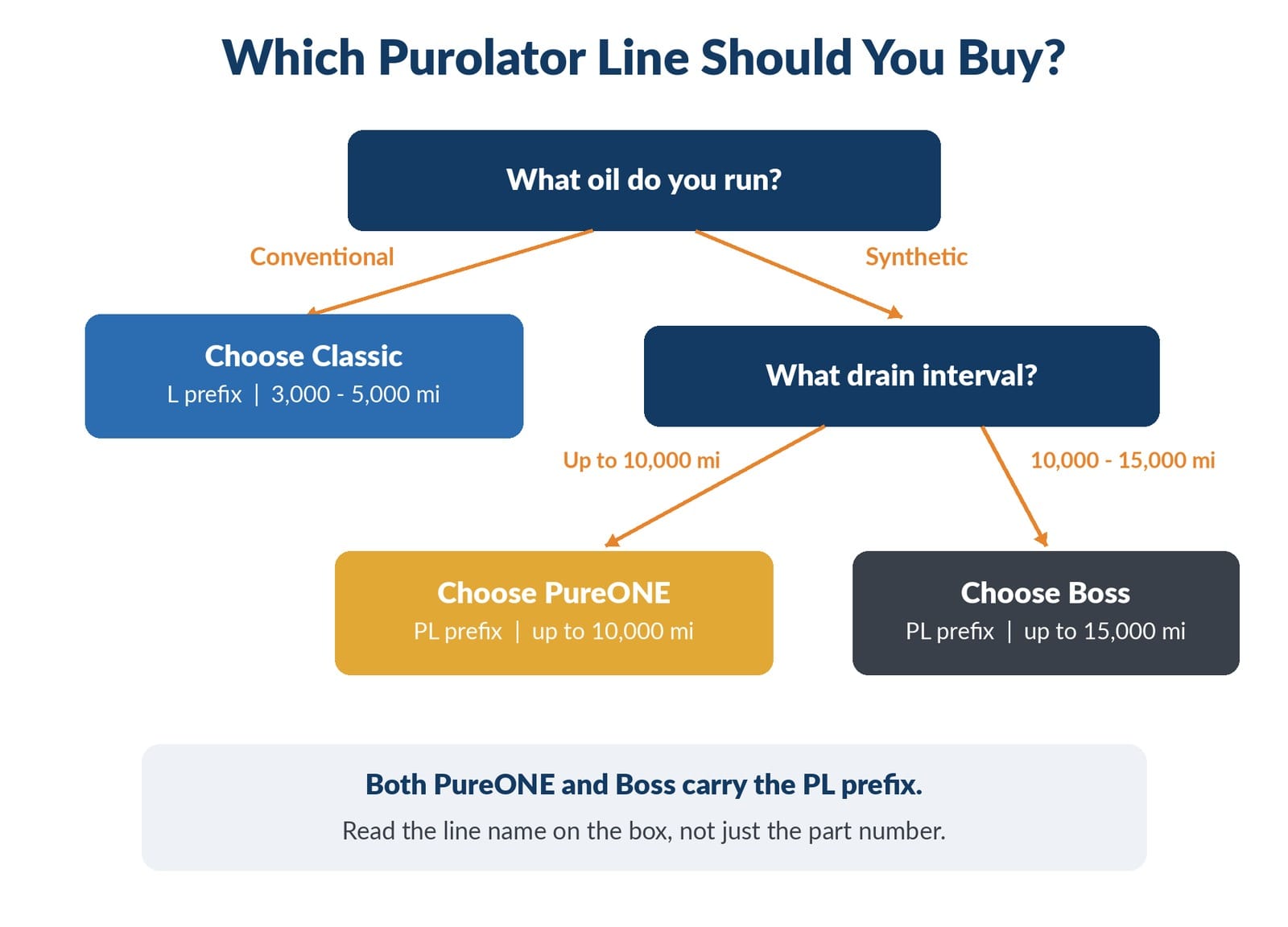
Choose Classic (L prefix) if:
- You use conventional oil
- You change oil every 3,000 to 5,000 miles
- You want the lowest-cost option from a reliable brand
Choose PureONE (PL prefix) if:
- You use full synthetic oil
- Your drain interval is 7,500 to 10,000 miles
- You want improved filtration efficiency on the same engine
Choose Boss (PL prefix, Boss-labeled) if:
- You have a high-mileage engine with more wear particles
- You use full synthetic on an extended drain (10,000 to 15,000 miles)
- You want the highest filter capacity before bypass
For any vehicle under normal driving conditions on synthetic oil, the PureONE PL-series is the most cost-effective choice. The Boss tier makes the most sense for engines past 100,000 miles or severe service use.
Is Purolator a Good Oil Filter Brand?
Purolator invented the automotive oil filter in 1923. Their PureONE line consistently performs well in independent cut-open tests that examine media density, bypass valve quality, and anti-drainback valve construction.
In community evaluations on forums like BobIsTheOilGuy, the PureONE routinely ranks among the top-tier aftermarket filters. The Classic line is solid for conventional oil service. The Boss adds meaningful capacity for worn engines.
The main criticism is that Purolator's silicone anti-drainback valves in the Classic line can be less consistent at very low temperatures compared to the nitrile valves in some competitors. The PureONE and Boss use a superior silicone formulation that addresses this.
How Does Purolator Compare to FRAM and WIX?
| Attribute | Purolator Classic | Purolator PureONE | FRAM Extra Guard | WIX Standard |
|---|---|---|---|---|
| Media | Cellulose/synthetic blend | 100% synthetic | Cellulose | Cellulose/glass blend |
| Anti-drainback | Silicone | Silicone | Silicone | Silicone |
| Bypass valve quality | Consistent | Consistent | Consistent | Consistent |
| Extended interval rated | No | Yes | No | No |
| Community reputation | Good | Excellent | Mixed | Good |
The PureONE is generally considered equal to or better than FRAM's Tough Guard (TG series) and WIX's standard line. It competes directly with FRAM Ultra Synthetic (XG series) and WIX XP in the extended synthetic category.
Where to Look Up Purolator Cross References
Three sources give the most reliable Purolator cross reference results:
Purolator's own lookup tool at purolatorauto.com lets you enter your year, make, model, and engine and returns the correct Classic and PureONE part numbers. This is the primary source for confirming fitment.
WIX Filters cross reference at wixfilters.com cross-references WIX numbers to Purolator equivalents because both are under the same parent, MANN+HUMMEL. The WIX tool is particularly reliable for confirming that a Purolator PL number shares the same physical spec as the WIX equivalent.
NAPA cross reference is reliable because NAPA Gold numbers are WIX numbers with the first digit dropped, and the NAPA lookup tool confirms Purolator equivalents alongside WIX and FRAM results.
For a broader overview of how oil filter cross references work and how to use these tools effectively, see our main cross reference guide.
Does Crossing to Purolator Void Your Warranty?
No. The Magnuson-Moss Warranty Act prevents manufacturers from voiding your warranty simply because you used an equivalent aftermarket oil filter. A Purolator PL14477 in a Toyota Camry does not void the Toyota warranty. The manufacturer would need to prove the Purolator filter specifically caused the damage to deny a warranty claim, which is not possible for a compliant filter meeting the same physical specifications.
This is the same protection that applies to any aftermarket oil filter used as a direct replacement.
FAQ
What is the Purolator equivalent of FRAM PH4386? The Purolator Classic equivalent is L14477 and the PureONE equivalent is PL14477. Both sit in the same group as the PH4386 against Toyota OE number 90915-YZZF1, alongside WIX 57145.
What is the Purolator equivalent of WIX 51516? The Purolator Classic equivalent is L20195 and the PureONE is PL20195. That group covers Ford, Dodge, Jeep, Mazda, Lincoln and Chrysler applications, not Honda. The Honda equivalent of a WIX filter in that size range is L14459.
Is Purolator PureONE better than FRAM Ultra Synthetic? Both use 100 percent synthetic media and are rated for extended drain intervals. Independent cut-open tests show both perform well. The PureONE has a slight edge in media density in some comparisons, but the difference is marginal in real-world use. Either is a valid choice for synthetic oil service.
Can I use Purolator on a BMW? Yes, but not with the PL24651, which is the Ford FL820S filter. BMW and MINI applications use cartridge elements: the L28209 covers MINI Cooper 1.5L and 2.0L engines from 2015 to 2018. Confirm your exact engine variant in Purolator's lookup tool before buying.
What is the difference between Purolator L14610 and PL14610? The L prefix is the Classic cellulose/synthetic blend. The PL prefix is the PureONE full synthetic. Both fit the same engines. The PL14610 is rated for longer intervals and higher filtration efficiency than the L14610.
Where is Purolator manufactured? Purolator filters are manufactured in the United States. The company has been wholly owned by MANN+HUMMEL since 2013, when it bought out Bosch's half of the joint venture that had held the business since 2006. MANN+HUMMEL also owns WIX, which it picked up with the Affinia filter business in 2016.
For a complete breakdown of how cross references work across all filter brands and how to use the major lookup tools, see the full oil filter cross reference guide.