Oil Filter Cross Reference: How to Find Compatible Replacements

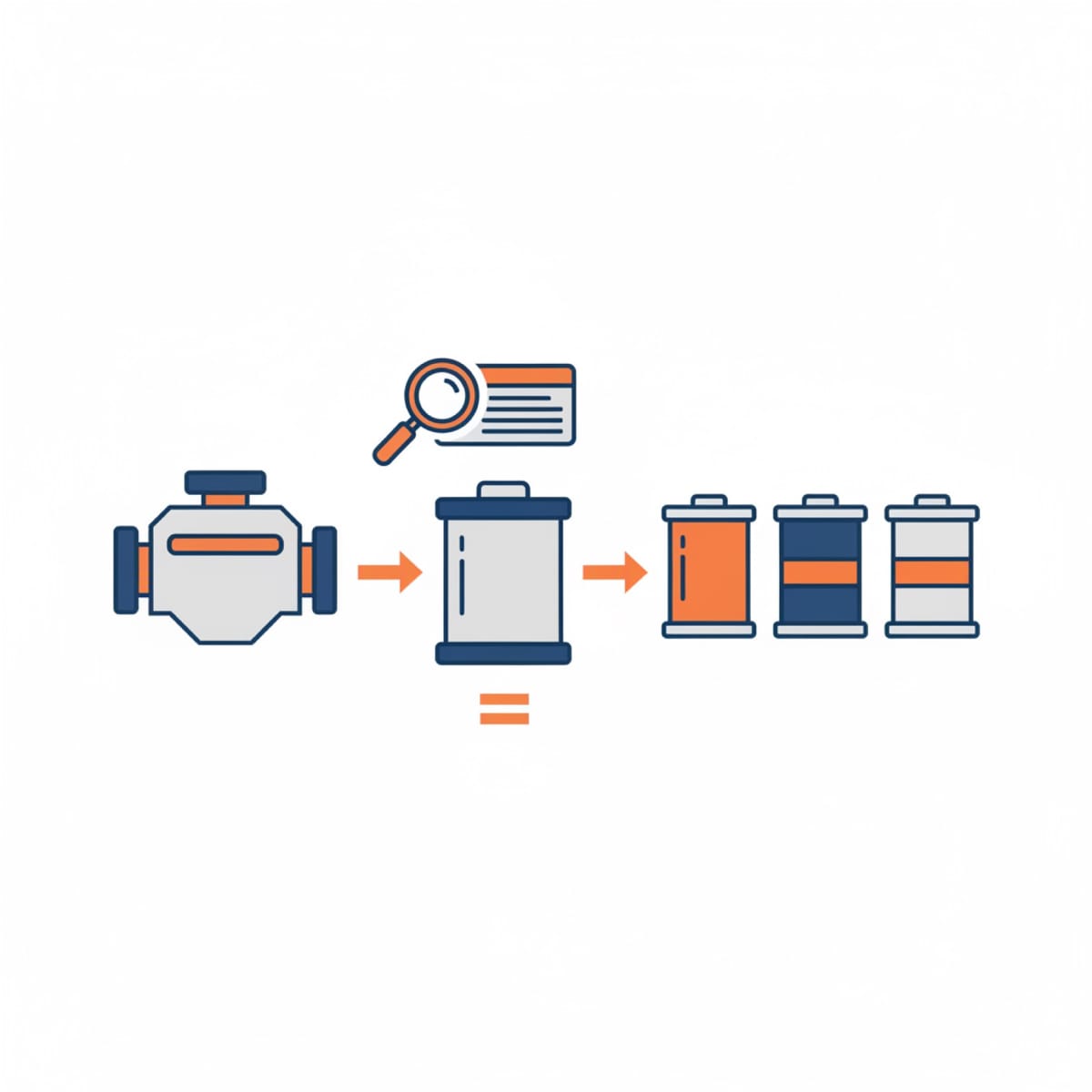


An oil filter cross reference tells you which filters from different brands are compatible with your engine. You look up your current part number, and the cross reference returns equivalent part numbers from FRAM, WIX, Purolator, Mobil 1, and other brands. This lets you shop by price, quality, or availability without being locked into one brand.


As an Amazon Associate we earn from qualifying purchases.
What Does "Oil Filter Cross Reference" Mean?
A cross reference is a compatibility lookup. It connects one part number to all equivalent part numbers across different brands.
If your car uses a FRAM PH3600, a cross reference tells you that the WIX 51516, the Purolator L20195, and the Mobil 1 M1-209 are all compatible replacements. The filters are not identical internally. But they share the same thread size, gasket diameter, bypass valve pressure, and outer dimensions needed to fit your specific engine.
The term comes from the practice of "crossing" one manufacturer's number to another. Mechanics and parts stores have used cross reference charts for decades to find in-stock alternatives when a specific brand is unavailable.
Why Cross References Exist
Oil filter manufacturers do not each make a unique filter for every vehicle. They produce a catalog of filters in standard sizes, then publish fitment guides showing which vehicles each filter fits.
Because multiple manufacturers produce filters in the same standard dimensions, their products end up being interchangeable for the same application. Cross reference charts simply map these overlaps in a searchable way.
How Oil Filter Part Numbers Work
Understanding the part number system helps you interpret cross reference results correctly.
FRAM Part Numbers
FRAM uses a letter prefix followed by numbers. The most common prefixes are:
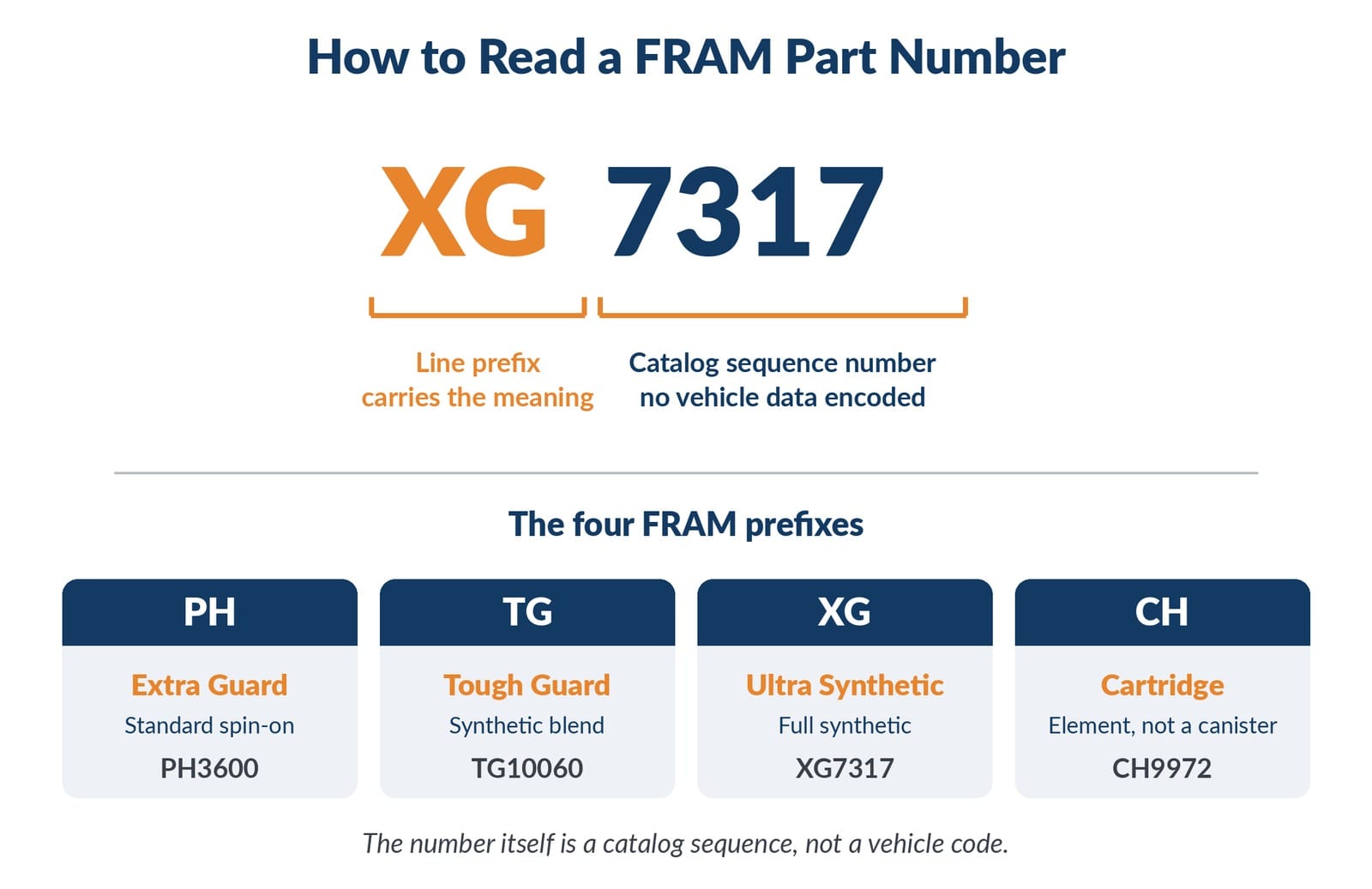
- PH: Extra Guard, the standard spin-on line (PH3600, PH4386, PH6607)
- TG: Tough Guard, the synthetic blend upgrade
- XG: Ultra Synthetic, the full synthetic line
- CH: cartridge element rather than a spin-on canister
The number itself does not encode vehicle information directly. It is simply a catalog sequence number assigned when FRAM added that filter to their line.
WIX Part Numbers
WIX uses a 5-digit number system (51516, 57356, 57060). Oil filters run in the 51000 and 57000 blocks, and the split between them is baseplate geometry rather than a quality tier or a filter type. The 57000 block contains cartridges as well as spin-ons. WIX's extended performance filters carry an XP suffix on the part number (e.g., 57356XP).
Purolator Part Numbers
Purolator uses alphanumeric codes. The L prefix indicates their Classic line (L14610). The PL prefix is their PureONE synthetic line (PL14610). The Boss line uses a Boss prefix.
OEM Part Numbers
OEM filters (Toyota, Honda, BMW) carry manufacturer-specific numbers like 15400-PLM-A02 (Honda) or 15208-65F0E (Nissan). These numbers encode fitment data specific to that manufacturer's system, which is why a cross reference is necessary to find aftermarket equivalents.


As an Amazon Associate we earn from qualifying purchases.
How to Read an Oil Filter Cross Reference Chart
A cross reference chart typically has three columns: the source brand, the source part number, and the compatible part number from the target brand.
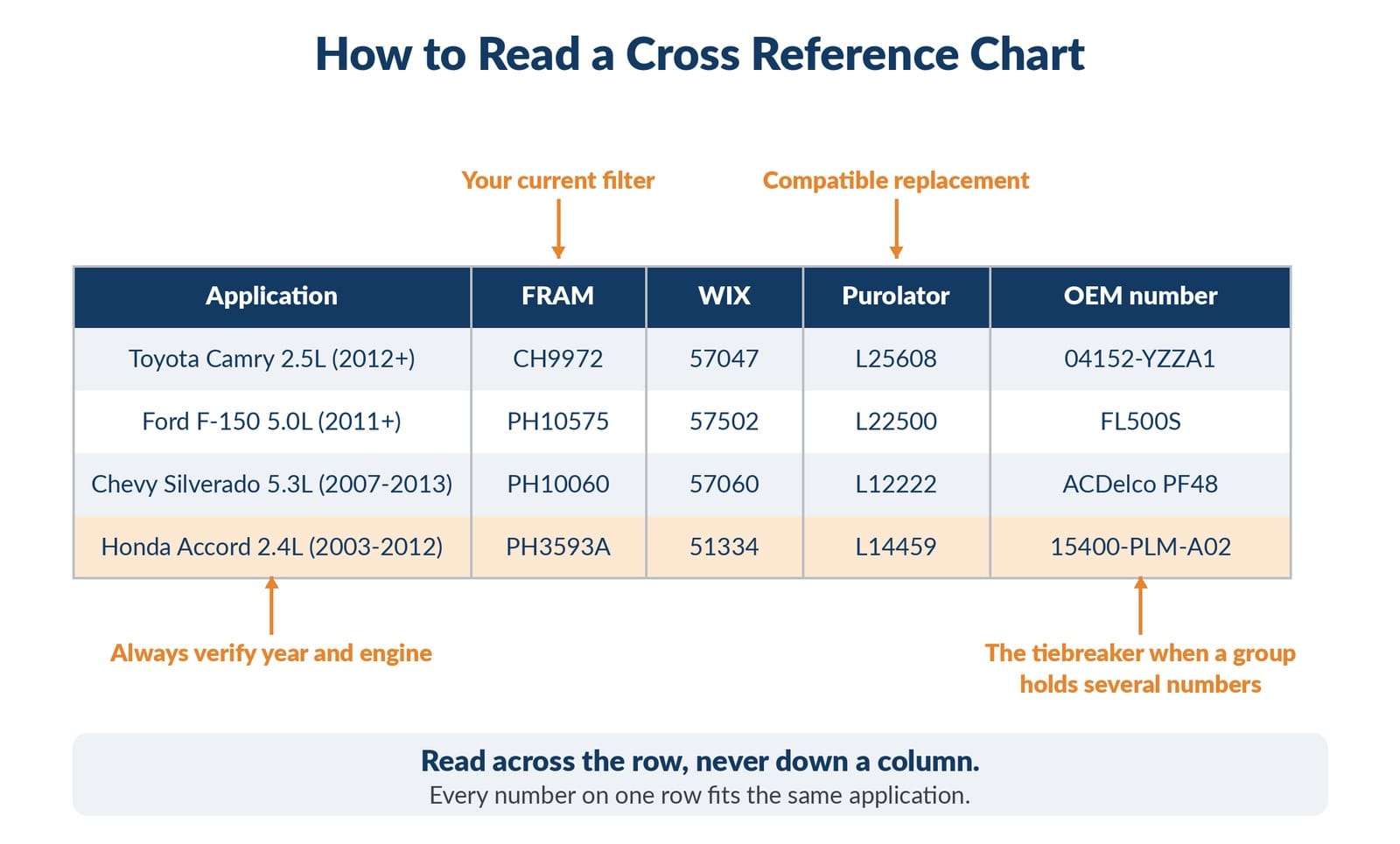
Here is a simplified example showing how the same application maps across brands:
| Application | FRAM | WIX | Purolator | OEM number |
|---|---|---|---|---|
| Toyota Camry 2.5L (2012+), cartridge | CH9972 | 57047 | L25608 | Toyota 04152-YZZA1 |
| Honda Accord 2.4L (2003–2012) | PH3593A | 51334 | L14459 | Honda 15400-PLM-A02 |
| Ford F-150 5.0L (2011+) | PH10575 | 57502 | L22500 | Motorcraft FL500S |
| Chevy Silverado 5.3L (2007–2013) | PH10060 | 57060 | L12222 | ACDelco PF48 |
| VW Golf, Jetta, Passat TDI (1998–2006), cartridge | CH8530 | 57210 | L45308 | VW 074 115 562 |
How to use this table:
- Find your current filter brand and part number
- Read across the row to find the equivalent from your preferred brand
- Confirm the result against the fitment guide for your vehicle year, make, and model
The table confirms size compatibility. It does not confirm filtration performance equivalence. A WIX XP and a FRAM Extra Guard both fit the same application, but their micron rating and media construction differ.
Are Cross-Referenced Filters Actually Compatible?
A cross-referenced filter is confirmed to be a physical fit. It threads onto the same drain boss, seats against the same surface, and uses the same bypass valve pressure rating for your engine.
Physical compatibility does not mean performance equivalence.
Two filters that cross reference to the same application can differ on:
- Media type: cellulose vs. synthetic blend vs. full synthetic
- Filtration efficiency: 20 microns at 95% vs. 20 microns at 99.5%
- Capacity: how many grams of contaminant the filter holds before bypass opens
- Anti-drainback valve: quality of the rubber membrane
Cross references are maintained by the filter manufacturers themselves and by third-party data providers like FiltersDB. When a manufacturer publishes a cross reference, they are confirming physical fitment, not claiming their filter is identical to the competitor's filter.
Direct Fit vs. Compatible Fit
Some cross reference databases distinguish between "direct fit" and "compatible fit":
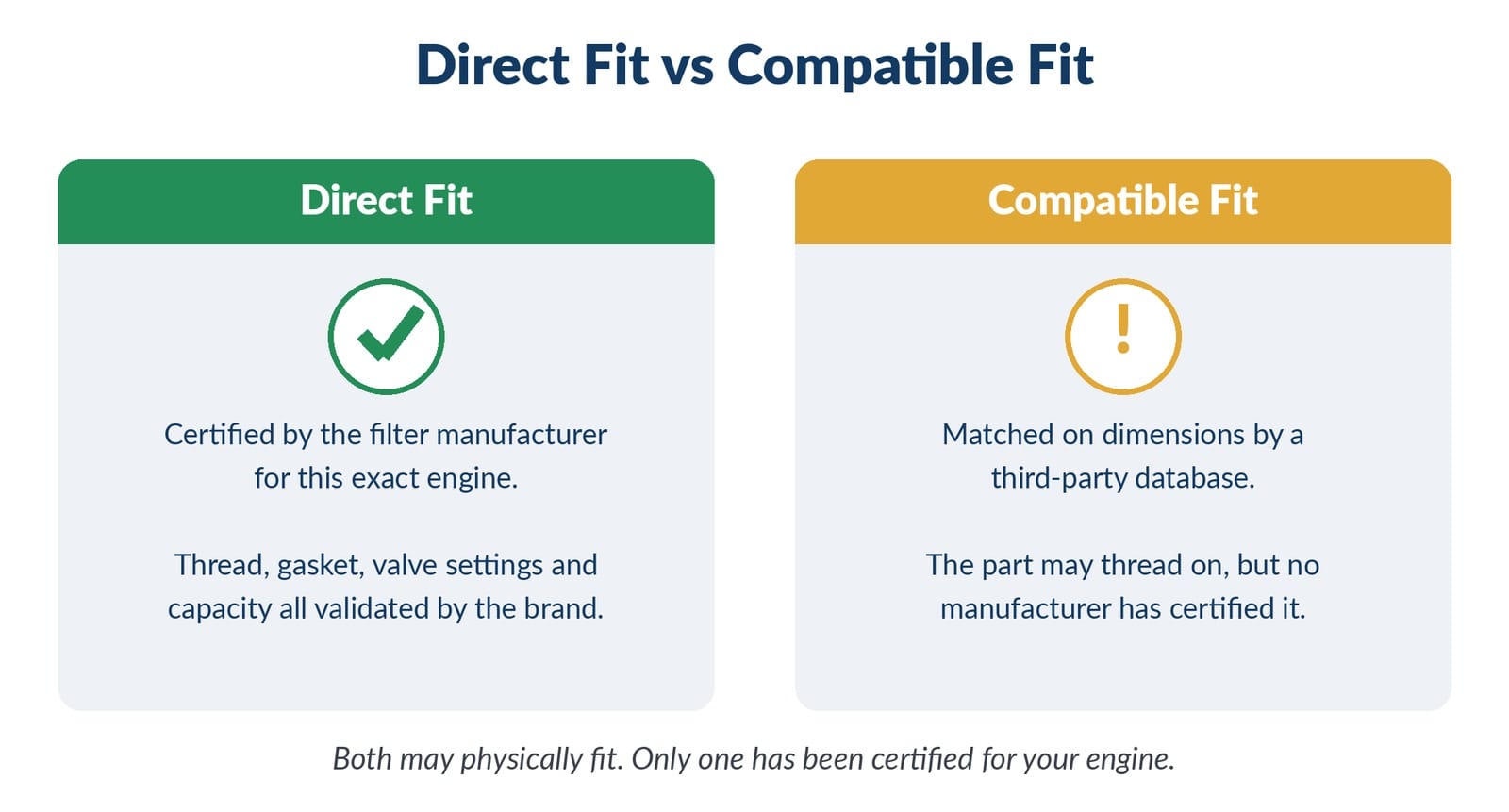
Direct fit means the filter was engineered and certified for that exact vehicle application by the manufacturer. It appears in their official fitment guide.
Compatible fit means a third party determined the filter shares the necessary dimensions and is likely to work, but the manufacturer has not specifically certified it for that application.
For most passenger vehicles, the distinction does not matter in practice. For modified engines, turbocharged applications, or vehicles with tight filter clearances, stick to direct fit results only.


As an Amazon Associate we earn from qualifying purchases.
How to Find Your Oil Filter Cross Reference
There are three reliable methods.
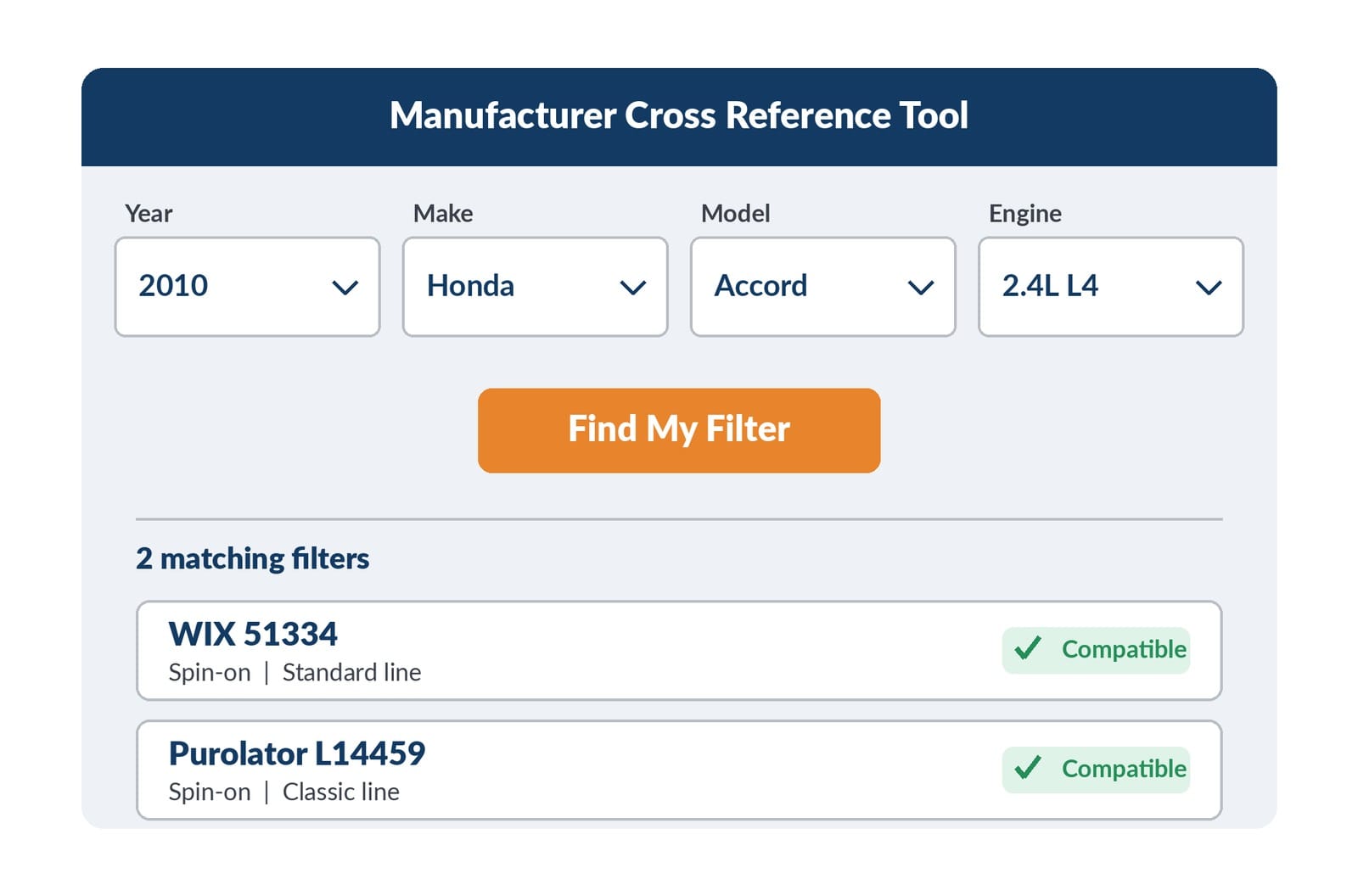
Method 1: Use the Manufacturer's Cross Reference Tool
Every major filter brand maintains a free cross reference tool on their website. You enter either your vehicle details (year, make, model, engine) or a competitor's part number, and the tool returns their compatible product.
The most useful tools are:
- WIX Filters: wixfilters.com/filterlookup, accepts vehicle lookup and competitor part number lookup
- FRAM Filters: framfilters.com, vehicle lookup with direct competitor cross reference
- Purolator: purolatorfilters.com, vehicle and part number lookup
- K&N: knfilters.com, vehicle and competitor lookup
- Mobil 1: mobil.com/filter-products, vehicle lookup
Each tool returns their own brand's equivalent. To compare across multiple brands, you need to check each tool separately, or use a third-party aggregator.
Method 2: Use a Third-Party Cross Reference Aggregator
Third-party sites aggregate cross reference data from multiple manufacturers and return results across all brands at once. The most commonly referenced aggregator is FiltersDB at filtersdb.com. You enter any part number and receive the full cross reference list across brands.
AutoZone, O'Reilly, and Advance Auto also run vehicle fitment lookups that show multiple compatible brands in one search. These are practical for seeing price comparisons alongside compatibility data.
Method 3: Match by Physical Specifications
If a part number lookup returns no results or you are cross-referencing an obscure OEM filter, you can match by physical specs:
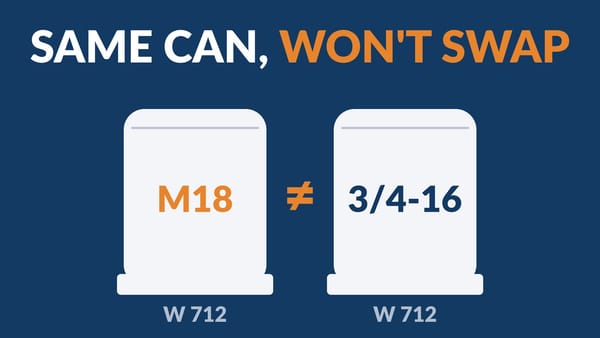
- Thread size and pitch: most passenger vehicles use M20×1.5, M22×1.5, or 3/4-16 UNF
- Gasket OD: measured in millimeters; must seat flush on the mounting boss
- Bypass valve pressure: typically 8 to 17 PSI depending on the engine
- Overall length and diameter: for clearance in the engine bay
This method is used by mechanics when a part is backordered or when sourcing filters for older vehicles with discontinued part numbers.
Common Cross Reference Scenarios
Replacing an OEM Filter With Aftermarket
OEM filters are made by suppliers to the same specifications the vehicle manufacturer requires. They are not always superior to aftermarket options. Many OEM filters are actually manufactured by WIX, MANN-Filter, or Toyo Roki and relabeled.
To find the aftermarket equivalent:
- Locate the OEM part number (in your owner's manual or on the current filter)
- Enter it into any manufacturer's cross reference tool
- Compare the aftermarket option against your oil change interval
For standard intervals up to 5,000 miles, a quality cellulose filter from any major brand is adequate. For extended intervals of 7,500 miles or more, a synthetic media filter is worth selecting even when the cross reference shows a cheaper alternative available.
FRAM to WIX Cross Reference
FRAM and WIX are the two most commonly swapped brands. The cross reference is reliable and well-documented. FRAM's database specifically includes WIX numbers, and WIX's tool returns FRAM equivalents.
A few application-specific notes from the cross reference data:
| FRAM | WIX Equivalent | Common Applications |
|---|---|---|
| PH4386 | 57145 | Toyota, Lexus 4-cyl |
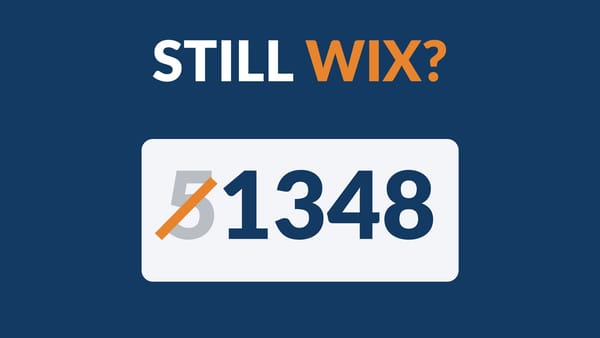
| PH3614 | 51348 | Toyota, Ford, Chrysler, Mazda multi-make |
| PH3600 | 51516 | Ford, Dodge, Jeep, Mazda, Lincoln, Chrysler |
| PH2 | 51372 | Ford/Lincoln V6, V8, V10 (91–14); replaces Motorcraft FL820S |
| PH10575 | 57502 | Ford 5.0 Coyote V8; GM EcoTec3 V8 (ACDelco PF63) |
| PH10060 | 57060 | GM V8 (ACDelco PF48); Chrysler, Dodge, Jeep (2007–2018) |
| PH3593A | 51334 | Honda, Nissan, Subaru, Hyundai, Mitsubishi |
These are illustrative of how the cross reference works. Always verify against your specific vehicle year and engine before purchasing.
Kawasaki, Kohler, and Small Engine Cross References
Cross reference lookups for powersports and small engines follow the same logic but use different databases. Kawasaki, Kohler, Briggs & Stratton, and Honda power equipment filters have their own OEM numbers that cross to standard brands.
For example, the Kawasaki 49065-0721 is a commonly searched small engine filter. The cross reference connects it to aftermarket equivalents from FRAM, WIX, and Champion.
The same tools work for these applications. Searching the OEM part number in FRAM's or WIX's tool returns compatible replacements.


As an Amazon Associate we earn from qualifying purchases.
What to Check After Finding a Cross Reference
A cross reference result gives you a starting point, not a final answer. Before purchasing, confirm:
1. The year, make, model, and engine match. Part number lookups can return results for a range of vehicles. If the tool shows the cross reference applies to a 2009–2014 application and your vehicle is a 2015, verify separately.
2. The filter is in stock in the media grade you want. A cross reference shows you a compatible part number. It does not tell you whether that part number is in the economy, mid-grade, or premium tier. Check the product page to confirm what media the filter uses.
3. Clearance for your specific vehicle. Some vehicles have tight engine bay clearances. A cross-referenced filter with the correct thread size but a different overall length can physically contact other components. Check the dimensions against the original if your engine bay is tight.
4. No TSB or recall affecting the cross reference. Some vehicles have technical service bulletins specifying a particular filter design (anti-drainback valve type, bypass pressure). If your vehicle has a known oil pressure or consumption concern, check whether the OEM specifies a filter requirement before substituting.
FAQ
What is a cross reference oil filter? A cross reference oil filter is an aftermarket or alternative-brand filter confirmed to be physically compatible with the same application as the original part number. It shares the same thread size, gasket dimensions, and bypass valve pressure as the filter it replaces. "Cross reference" refers to the chart or lookup tool that maps one part number to its equivalents across brands.
Can I use any cross-referenced oil filter? Any filter that appears in a manufacturer's direct fitment cross reference will physically fit your engine. Whether it is the right choice depends on your oil change interval and performance needs. A cross reference confirms fit, not performance equivalence. For extended drain intervals, choose a filter with synthetic media regardless of what the cross reference suggests as the baseline compatible option.
How accurate are online oil filter cross reference tools? Manufacturer-published cross reference tools are highly accurate for current vehicles. Third-party aggregators like FiltersDB are also reliable for mainstream applications. Errors occur most often with older vehicles, discontinued part numbers, and non-US market vehicles. When in doubt, verify the physical specifications against the original filter.
Does a cross-referenced filter void my warranty? No. The Magnuson-Moss Warranty Act protects your right to use any compatible aftermarket filter without voiding your vehicle warranty, as long as it meets the manufacturer's specifications. Using a cross-referenced filter from any reputable brand does not affect your warranty coverage.
What if no cross reference comes up for my filter? Try searching by your vehicle (year, make, model, engine) instead of by part number. If that also returns nothing, the filter may be application-specific or produced for a non-standard engine. In that case, match by physical specifications: thread size, gasket OD, filter length, and bypass valve pressure. An auto parts counter can measure an OEM filter and find a match.


As an Amazon Associate we earn from qualifying purchases.
Final Thoughts
A cross reference is the fastest way to find a compatible oil filter when you want to switch brands, shop for better pricing, or replace a discontinued part number.
The lookup is straightforward: enter your current part number or your vehicle details into any manufacturer's tool, and you get the equivalent from their catalog. For a broader view across all brands at once, a third-party aggregator saves time.
Use the cross reference result as a starting point. Confirm the fitment against your specific year and engine, then choose the media grade that matches your oil change interval.