Best Oil Filters: Top Picks Ranked by Published Specs

Royal Purple's extended life filter publishes the most complete filtration data of any consumer oil filter sold in the US: efficiency at three separate particle sizes, tested to ISO 4548-12. FRAM states 99%+ above 20 microns, Mobil 1 99% at 30 microns, and Purolator publishes no micron figure at all.
Nobody tested these filters, including me. What I did instead was read every spec sheet, technical brochure and footnote each manufacturer publishes for its own product, then rank them by how much they are willing to tell you.
That sounds like a lesser exercise than cutting filters open. It is not, and here is why: while reading those footnotes I found that the efficiency number on the box is almost never measured on the filter you are buying. It is measured on one or two part numbers in the line, then printed across the whole range.
Once you see that, most of the internet's oil filter advice stops making sense. So this list starts with that problem, and then works through the five filters worth considering.
The number on the box was measured on a different filter
Every premium brand advertises a single headline efficiency figure. Read the footnote and you find it came from testing a small sample of specific part numbers.
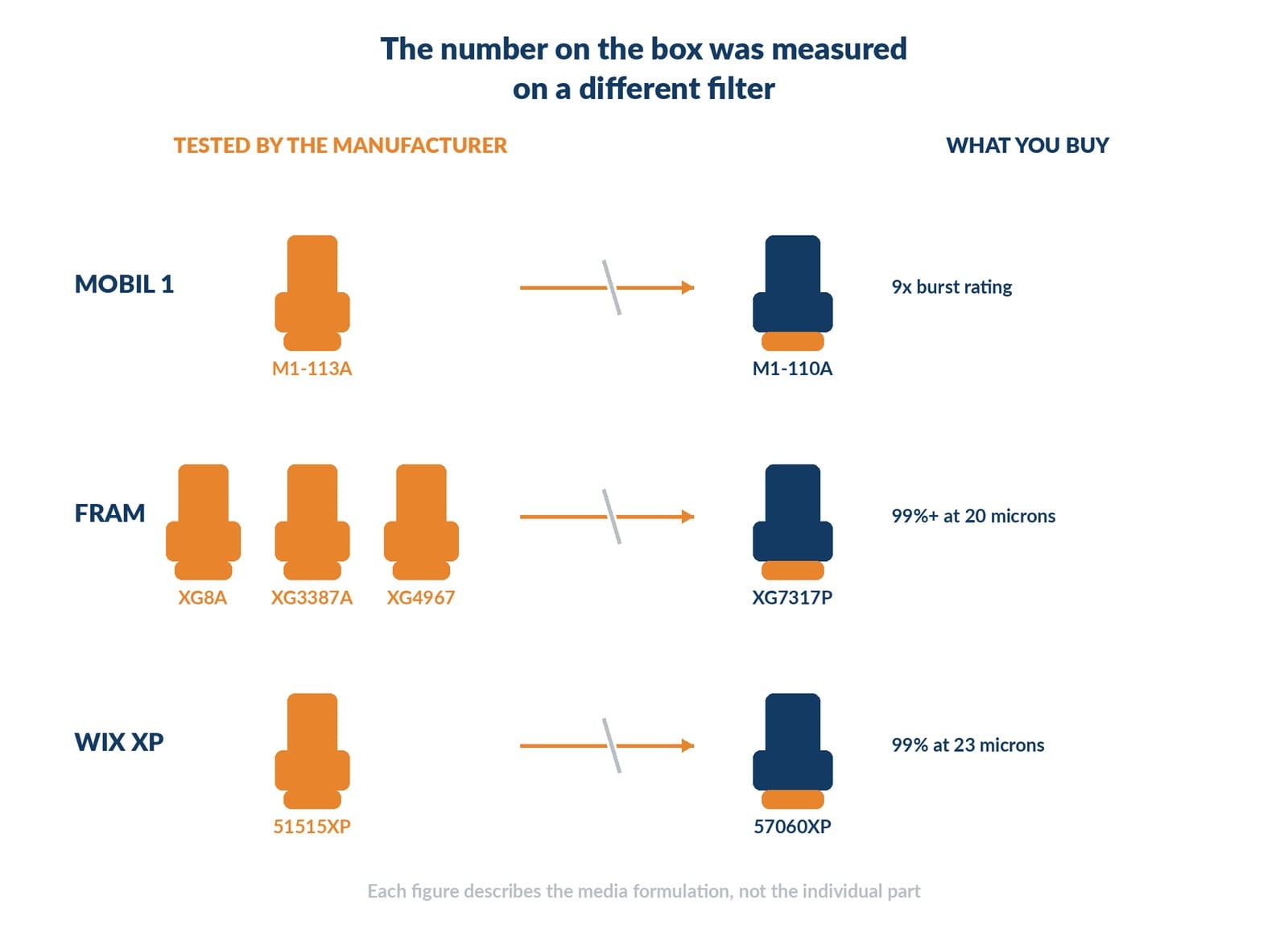
FRAM is the most explicit about it. The 99%+ efficiency claim for Ultra Synthetic comes from testing XG8A, XG3387A and XG4967 under ISO 4548-12, and the same page adds a separate footnote stating that not all features are available on every part number in the line, so you should check the package for the specific filter you buy.
WIX does the same thing with less warning. The XP page claims over 99% at 23 microns, then adds three words in brackets: based on 51515XP. The XP filter most commonly sold for GM applications is 57060XP, a different part, and its retail listing repeats the 23-micron figure anyway.
Mobil 1 splits it across metrics. The M1-110A page states 99% at 30 microns for that filter, but the 9x burst pressure rating carries a footnote saying the burst test was run on M1-113A, a different filter again.
None of this is fraud. Testing every part number in a 200-part line under a multi-pass standard would be enormously expensive, and sampling is normal engineering practice. But it means a published efficiency figure describes a media formulation, not the specific can you are holding, and no brand says that plainly.
The practical takeaway: treat a published efficiency number as a statement about the brand's media, not a measurement of your part number. It is still the best signal available. It is just weaker than it looks.
Royal Purple Extended Life: the most complete published data

Royal Purple is the only brand here that publishes a filtration curve rather than a single number. Its extended life filter brochure gives average beta ratings from ISO 4548-12 multi-pass testing at three particle sizes.
| Particle size | Beta ratio | Efficiency |
|---|---|---|
| 25 microns and larger | ß25 = 100 | 99% |
| 20 microns and larger | ß20 = 75 | 98.7% |
| 10 microns and larger | ß10 = 5 | 80% |
That third row is the one no competitor will print. Every brand's efficiency collapses at small particle sizes, and Royal Purple is alone in showing you where its own curve falls off.
The filter is 100% synthetic micro-glass media over a steel screen backing, with a silicone anti-drainback valve and a heavy gauge steel backplate the brochure rates at twice the burst strength of an ordinary filter.
The part I checked was 10-2867, which the brochure lists for Acura and Honda 2001-2017, Infiniti and Nissan 1995-2017, Mitsubishi 1992-2018, and Mazda 1983-2002 and 2009-2011. Its retail listing extends several of those ranges to 2019 and adds Chrysler, Dodge, Ford and Mercury applications, which the brochure does not cover.
One caveat: the brochure states no service interval at all. The 15,000-mile figure attached to this filter appears on retail listings, not in Royal Purple's own document.
FRAM Ultra Synthetic: strong data, explicit about its own limits

FRAM publishes 99%+ filtration efficiency for particles greater than 20 microns under ISO 4548-12, on dual-layer synthetic media, with up to 20,000 miles of protection when paired with synthetic oil.
The construction details are unusually specific. The silicone anti-drainback valve is rated at more than three times the functional life of a nitrile valve under SAE HS806 hot oil testing, and the high-temperature nitrile gasket is qualified under a USCAR-36 low-temperature leakage test.
FRAM also earns credit for the footnote that undermines its own headline. Naming the three part numbers it tested, and warning that features vary across the line, is more disclosure than any competitor offers.
The part I checked was XG7317P. Its retail listing describes fitment only as "select vehicle model years" and names no vehicles, which is the vaguest fitment statement of any filter here. Royal Purple's cross-reference lists XG7317 as an interchange for the same applications as its own 10-2867, so it covers broadly the same Honda, Acura, Nissan, Infiniti and Mitsubishi family. That is a cross-referenced inference from a competitor's document, not a fitment confirmed by FRAM, so verify it against your engine before buying.
Ownership changed during the 2025-26 First Brands Group bankruptcy. Premium Guard acquired the FRAM intellectual property in 2026 and announced it would reopen the Albion, Illinois plant. Published specs and part numbers have not changed, but who physically builds a given FRAM filter is a more open question than most "who makes FRAM" articles acknowledge.
Mobil 1 Extended Performance: three different intervals on one page

Mobil 1 states up to 99% efficiency at 30 microns on synthetic blend media, with a canister rated to 9x normal system operating pressure.
Then the same page gives three different service intervals. The banner promises up to one year or 25,000 miles. The spec block underneath says 20,000 miles. The FAQ further down says up to one year or 20,000 miles. The retail listing repeats the 25,000-mile version.
I could not resolve which figure governs, and Mobil does not flag the discrepancy anywhere. Treating 20,000 miles as the real number is the conservative read, since it appears twice on the manufacturer's own page and the 25,000 figure appears only in marketing positions.
The 30-micron threshold is also the coarsest cut on this list. A 99% figure at 30 microns is a weaker claim than 99% at 20 microns, and the two are frequently compared as though they were equivalent.
The part I checked was M1-110A, which Mobil lists for various Honda, Mitsubishi and Nissan vehicles, most commonly the 2018 Honda CR-V. Note that the linked listing is a two-pack, so any price comparison against a single filter is misleading.
WIX XP: a capacity figure where an efficiency figure should be

WIX claims over 99% dirt-holding capacity at 23 microns for the XP line, based on 51515XP, with up to 20,000-mile intervals.
Dirt-holding capacity and filtration efficiency are not the same property. Capacity is how much contaminant a filter can retain before it restricts flow, normally measured in grams. Efficiency is the percentage of particles removed at a given size. A percentage at a micron threshold is an efficiency statement, so the phrase on WIX's own page mixes two different metrics.
The retail listing for 57060XP resolves it in WIX's favour by simply saying "99% efficient at 23 microns," which is the claim the manufacturer page stops short of making for that part. I could not find a WIX document stating a filtration efficiency for 57060XP specifically.
The rest of the specification is strong and unusually targeted. WIX names the XP line for towing, hauling, extreme temperatures, high dust and mountainous terrain, which is a narrower and more falsifiable claim than most competitors make. Construction is a cellulose and micro-glass blend with a silicone anti-drainback valve, ethylene acrylic gasket and solid metal end caps.
The part I checked was 57060XP, listed for various Buick, Chevrolet, GM, Hummer, Saturn, Saab, Dodge, Chrysler and Jeep applications from 2007 to 2015.
Purolator BOSS: no micron figure and no testing standard

Purolator BOSS is the weakest disclosure of any premium filter here. The product page claims over 99% Dirt Removal Power for up to 20,000 miles, and that is the entire filtration specification.
There is no micron threshold. There is no ISO 4548-12 reference, or any testing standard at all. "Dirt Removal Power" is a trademarked phrase rather than a measured quantity, and a percentage with no particle size attached cannot be compared against any other filter on this list.
The hardware specification is genuinely good: SmartFUSION full synthetic media, a double-helix metal center tube, silicone anti-drainback valve, ethylene acrylic PuroSEAL gasket and a heavy steel casing. Purolator simply declines to say what any of it filters.
There is also a long-running owner complaint worth knowing about. Across BobIsTheOilGuy threads going back years, owners report split or non-sealing anti-drainback valves on Purolator filters, with startup rattle as the symptom, in some cases within a few hundred miles. That is forum anecdote, not data, and no manufacturer bulletin covers it. It is a pattern rather than a proven defect rate, but it recurs often enough on a filter whose maker publishes no filtration standard that it belongs in the decision.
The part I checked was PBL14610, listed for Honda CR-V, Accord, Civic, Pilot, Odyssey, HR-V and Fit, Nissan Frontier, Titan and Xterra, and Acura MDX and RDX.
Four of these filters fit the same engines
This is the part that makes the comparison usable. The Royal Purple 10-2867 interchange list names Mobil 1 M1-110A and FRAM XG7317 as direct equivalents, and the Purolator PBL14610 fitment list covers the same Honda and Nissan families.
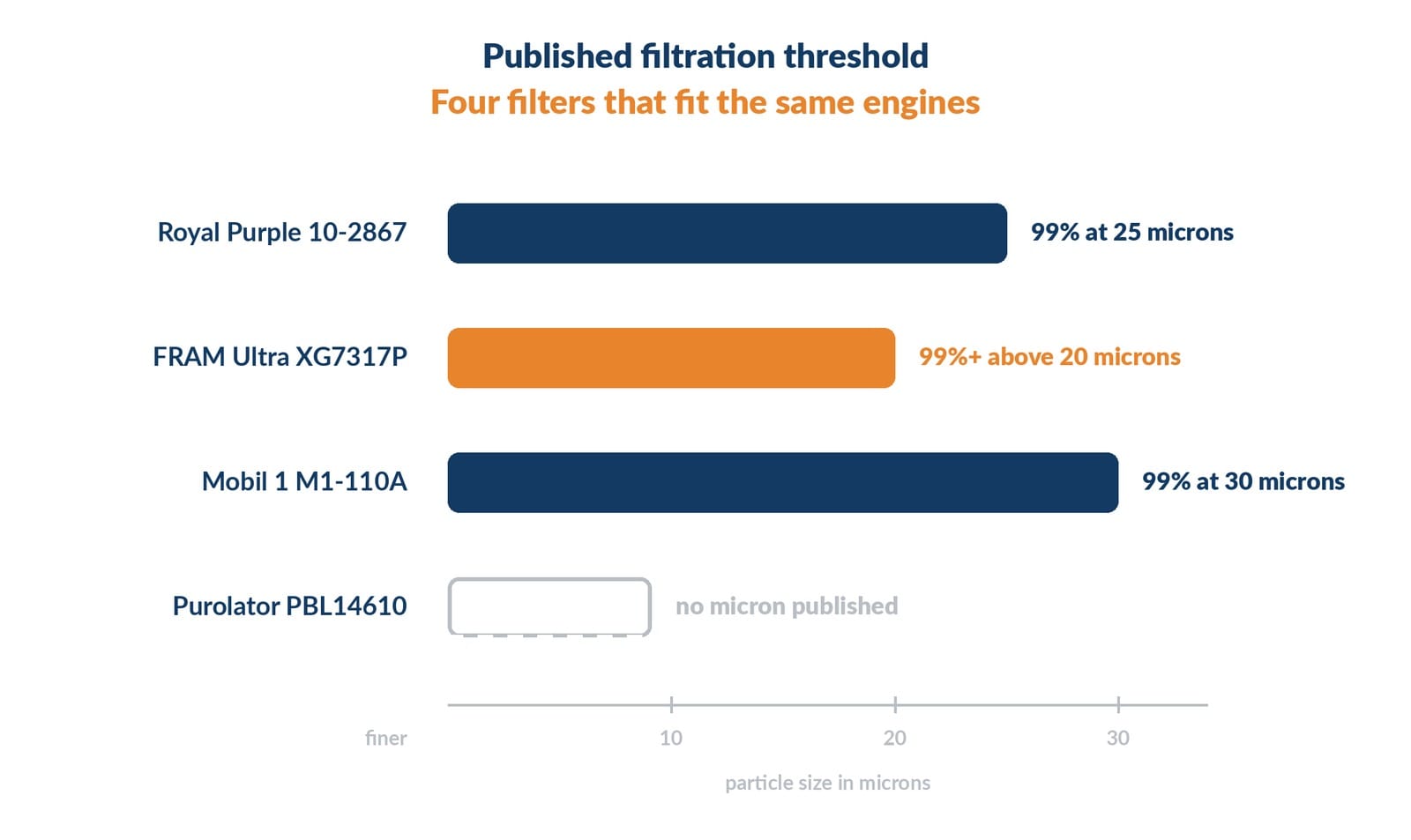
If you drive a Honda, Acura, Nissan, Infiniti or Mitsubishi from roughly 2001 onward, four of the five filters reviewed here are candidates for your engine, and you can choose between them on published data alone:
| Filter | Confirmed efficiency | Standard cited |
|---|---|---|
| Royal Purple 10-2867 | 99% at 25µm, 98.7% at 20µm, 80% at 10µm | ISO 4548-12 |
| FRAM Ultra XG7317P | 99%+ above 20µm | ISO 4548-12, other parts |
| Mobil 1 M1-110A | 99% at 30µm | ISO 4548-12 |
| Purolator PBL14610 | "over 99% Dirt Removal Power" | none stated |
Read that table as a disclosure ranking rather than a performance ranking, because that is what it actually measures. On published evidence the Royal Purple is the best documented and the Purolator the least, and none of these figures were verified independently by anyone.
Filters that publish no efficiency data
K&N sells a heavy-duty canister oil filter with a welded hex nut for tool-free removal and describes it as laboratory tested for capacity, efficiency and mechanical strength. No micron rating or efficiency percentage appears anywhere in its consumer literature. Efficiency figures for K&N oil filters circulate on forums ranging from roughly 85% to 98%, with no traceable source for any of them.
Bosch Premium uses what Bosch calls FILTECH media, a blend of natural and synthetic fibers, and third-party retailers commonly attach a 99% efficiency figure to it. Bosch's own specification page publishes no micron threshold. Treat any 99%-at-X-microns claim for Bosch Premium as third-party until Bosch confirms it directly.
Both are competent filters used by millions of vehicles. They are excluded from the picks above only because this list ranks on published evidence, and neither brand provides any.
Diesel and heavy-duty applications
Diesel oil filters are a separate category. Heavy-duty engines run larger sump capacities, higher contaminant loads, and often completely different housings and thread sizes, so a general "best diesel oil filter" pick is not meaningful without naming the platform.
Rather than repeat unverified picks, start from the platform-specific interchange work already on this site through the oil filter cross reference hub, which covers Fleetguard for Cummins and Detroit Diesel applications, Donaldson for agricultural and heavy equipment, and Kubota for compact diesel.
Matching an exact part number to the engine platform matters more on a diesel than on a passenger car, because heavy-duty housings are rarely interchangeable across manufacturers the way passenger-car spin-on filters often are.
How to read an efficiency claim
Three rules cover most of what goes wrong when people compare filters.
- A percentage with no micron size is not a specification. It cannot be compared against anything. Purolator's "over 99% Dirt Removal Power" and any bare "99% efficient" claim fall into this category.
- Lower micron is only better if the percentage holds. Filtration efficiency and micron rating have to be read as a pair. A filter rated 99% at 30 microns is making a weaker claim than one rated 99% at 20 microns, and a 20-micron filter at 70% efficiency can perform worse in practice than a 25-micron filter at 99%.
- Check which part number was tested. If the footnote names part numbers and yours is not among them, the figure describes the media, not your filter.
None of these picks account for OEM-specific requirements. If your owner's manual specifies a particular bypass valve pressure or anti-drainback design, especially on a turbocharged or direct-injection engine, verify that against your vehicle rather than choosing on this list alone. Whether the brand itself matters for your specific engine is a separate question with its own answer.
FAQ
What is the best oil filter brand overall? On published evidence, Royal Purple. It is the only brand that publishes efficiency at three particle sizes with beta ratios and a named test standard, including the unflattering 80% figure at 10 microns. FRAM is second, stating 99%+ above 20 microns under the same standard and naming the parts it tested.
Does a more expensive oil filter protect the engine better? Not reliably. Price tracks media quality loosely, but K&N and Bosch both sell at mid-to-premium prices while publishing no efficiency data at all. A cheaper filter with a confirmed ISO 4548-12 rating tells you more than an expensive one with no published number.
Can I use a synthetic media filter with conventional oil? Yes. Mobil 1, FRAM Ultra Synthetic, WIX XP and Royal Purple all state compatibility with conventional, blend and full synthetic oil. Synthetic media improves filtration and dirt capacity regardless of which oil you run, and does not require synthetic oil to work.
Why do the same filters show different efficiency numbers on different sites? Because retailers frequently copy a brand's line-wide headline figure onto a part number that was never tested for it. WIX's 23-micron figure is stated for 51515XP on WIX's own page and repeated on listings for other XP parts. Always trace a number back to the manufacturer's page and check the footnote.
Is a 20,000-mile filter worth it on 5,000-mile oil changes? No. The filter is replaced with the oil, so an extended-life rating you never approach is capacity you paid for and discarded. Match the filter's rating to your actual interval rather than buying the highest number available.
Next Step
Work out your interval first, then buy the filter that matches it. A 20,000-mile synthetic filter on a 5,000-mile conventional oil change is wasted money, and a budget filter left in for a 15,000-mile synthetic interval is a false economy in the other direction.
Then confirm the part number actually fits before you order, since four of the five filters above interchange across the same engine families and the retail listings are not consistent about which vehicles they cover.
For a platform-specific pick, this site ranks filters separately for the 6.7 Cummins, 6.7 Powerstroke, 6.6 Duramax, 5.7 Hemi, 5.3 Vortec and Toyota engines, since the specific bypass pressure and generation a given engine needs is a better filter than any general-purpose list can give you.