Best Oil Filter for 6.7 Cummins: What the Spec Sheets Say




Every 6.7 Cummins built from 2007.5 to 2024 uses the same oil filter, sold as Mopar 05083285AA, Fleetguard LF16035 and WIX 57620. The filter did not change in 2019. What does change between brands is the efficiency figure each one publishes, and those figures are not measured on the same scale.
I went looking for a clean ranking of oil filters for this engine and found something more useful instead. The four numbers most often quoted for the factory filter contradict each other, the "upgrade" filter the forums recommend carries the same published efficiency as the standard one, and the single biggest risk to a 6.7 Cummins owner buying online has nothing to do with which brand is on the can.


As an Amazon Associate we earn from qualifying purchases.
One Filter Covers Every 6.7 Cummins Ever Built
The 6.7L Cummins turbodiesel has used one spin-on lube filter across its entire production run in Ram 2500, 3500, 4500 and 5500 trucks. WIX's own catalogue entry for the 57620 lists the application as 6.7L Cummins Diesel (08-23) and Ram 2500/4500 (11-23), and the same filter reaches back into the 5.9L "B" series before it.
The three part numbers you will see on the shelf are the same filter position from three suppliers. Mopar sells it as 05083285AA, also stamped MO-285. Fleetguard sells it as LF16035, and WIX as 57620.
Nothing changed in 2019. The fourth-generation and fifth-generation trucks, the High Output engine and the Cab and Chassis models all take the same filter. If a listing tells you a 2019-and-later truck needs something different, it is wrong.
There is one Mopar number worth memorising as the wrong answer. 68492616AA is the oil filter for the 3.0L EcoDiesel V6, a completely different engine sold in the Ram 1500. Ram sells both filters under Mopar branding, they appear side by side in search results, and they do not interchange.
| WIX 57620 / Fleetguard LF16035 / Mopar 05083285AA | What the spec sheets say |
|---|---|
| Thread size | 1-16 UNF 2B |
| Height | 6.94 in (176.4 mm) |
| Largest outside diameter | 3.68 in (93.5 mm) |
| Gasket OD / ID | 2.83 in / 2.46 in |
| Rated flow | 8.72 gpm (33 L/min) |
| Hydrostatic burst minimum | 203 psi (1,400 kPa) |
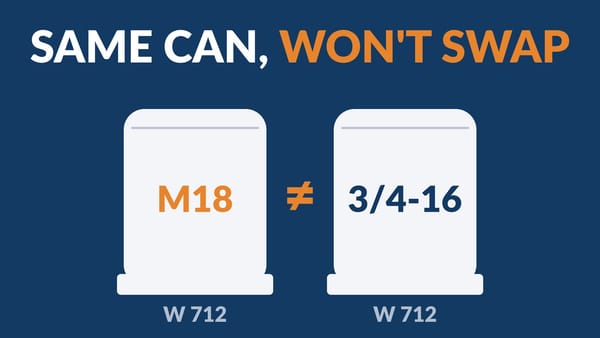
Note the thread. This is a 1-16 thread, not the 3/4-16 or 20 mm threads found on most passenger car spin-ons, which is why a generic "fits most vehicles" filter is not a candidate here at all.
The Efficiency Numbers Do Not Mean What the Listings Say
Here is where this article earned its research time. Search the Fleetguard LF16035 and you will find at least three different filtration claims, all presented as fact, all on pages selling the same filter.
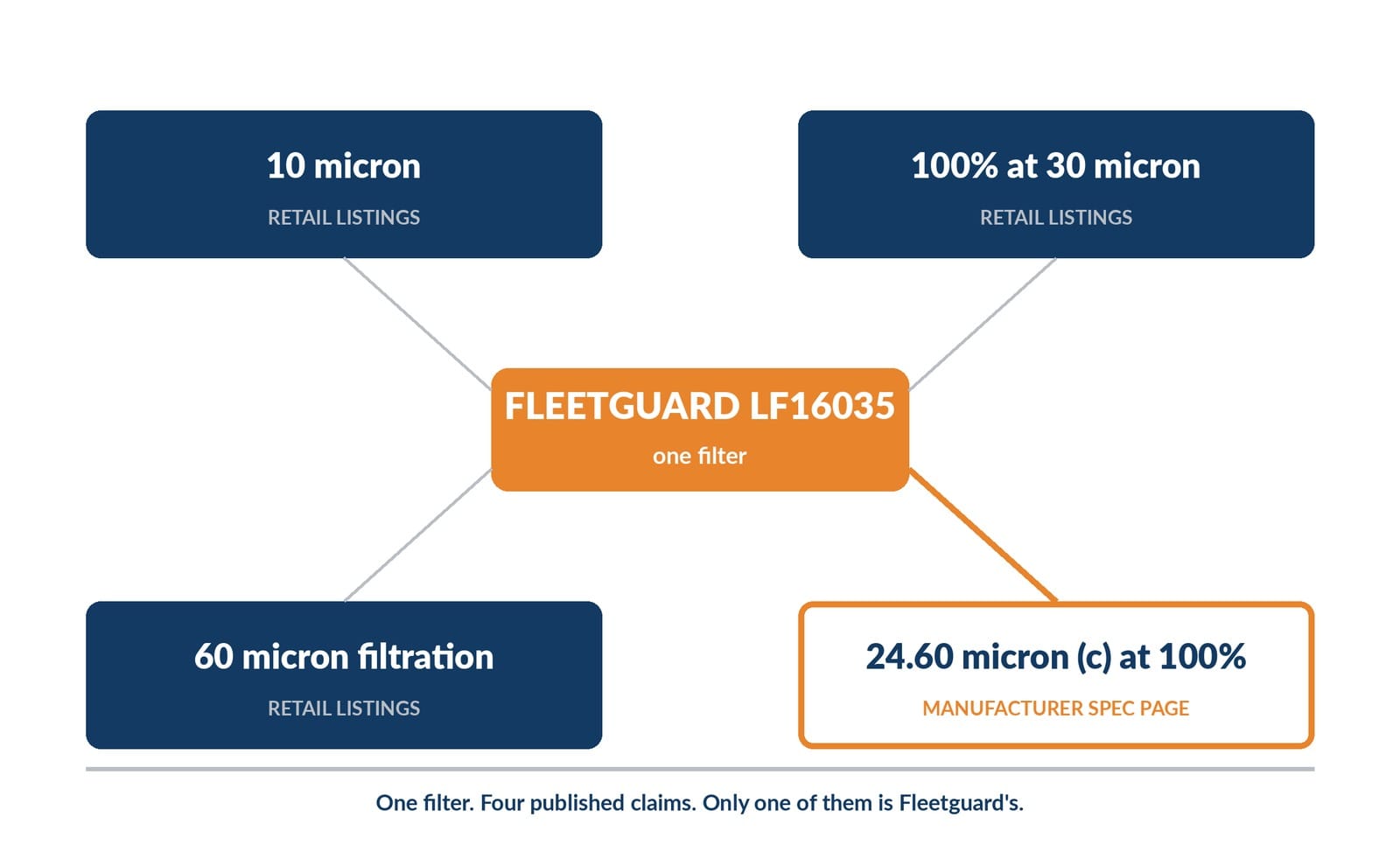
One family of listings calls it a ten micron filter. Another states 100% efficiency at 30 microns. A third describes it as providing 60 micron filtration. These cannot all be true, and none of them is the figure the manufacturer publishes.
Fleetguard's own current product page for the part states one specification: 24.60 micron (c) at 100%, listed under the heading Primary Particle Efficiency. That is the number that came from the company that makes the filter, and it matches none of the three circulating on retail pages.
What the "(c)" Actually Changes
That small "(c)" is not a typo or a footnote marker. It is a unit, and it is the reason cross-brand efficiency comparisons for this engine mostly fail.
Filter test labs count particles with automatic particle counters, and those counters have to be calibrated against a reference dust. The old calibration standard, ISO 4402, used a test dust that stopped being manufactured in 1992. Its replacement calibrates against a NIST-certified reference material, and the designation µm(c) was introduced specifically so results on the new basis could be told apart from the old ones.
The two scales do not agree. Above roughly 10 microns the new certified sizes read smaller than the old ones for the same particle population, and the source gives a worked example: 15 µm on the old basis is about 13.6 µm(c) on the new one. Below 10 microns the relationship inverts and the gap widens as particles get smaller.
So a filter rated "24.60 micron (c)" and a filter rated "15 micron" are not two points on one ruler. Any table that stacks them in the same column, and most published comparisons for this engine do exactly that, is comparing measurements taken with two different instruments.


As an Amazon Associate we earn from qualifying purchases.
How the Main Filters for This Engine Actually Compare
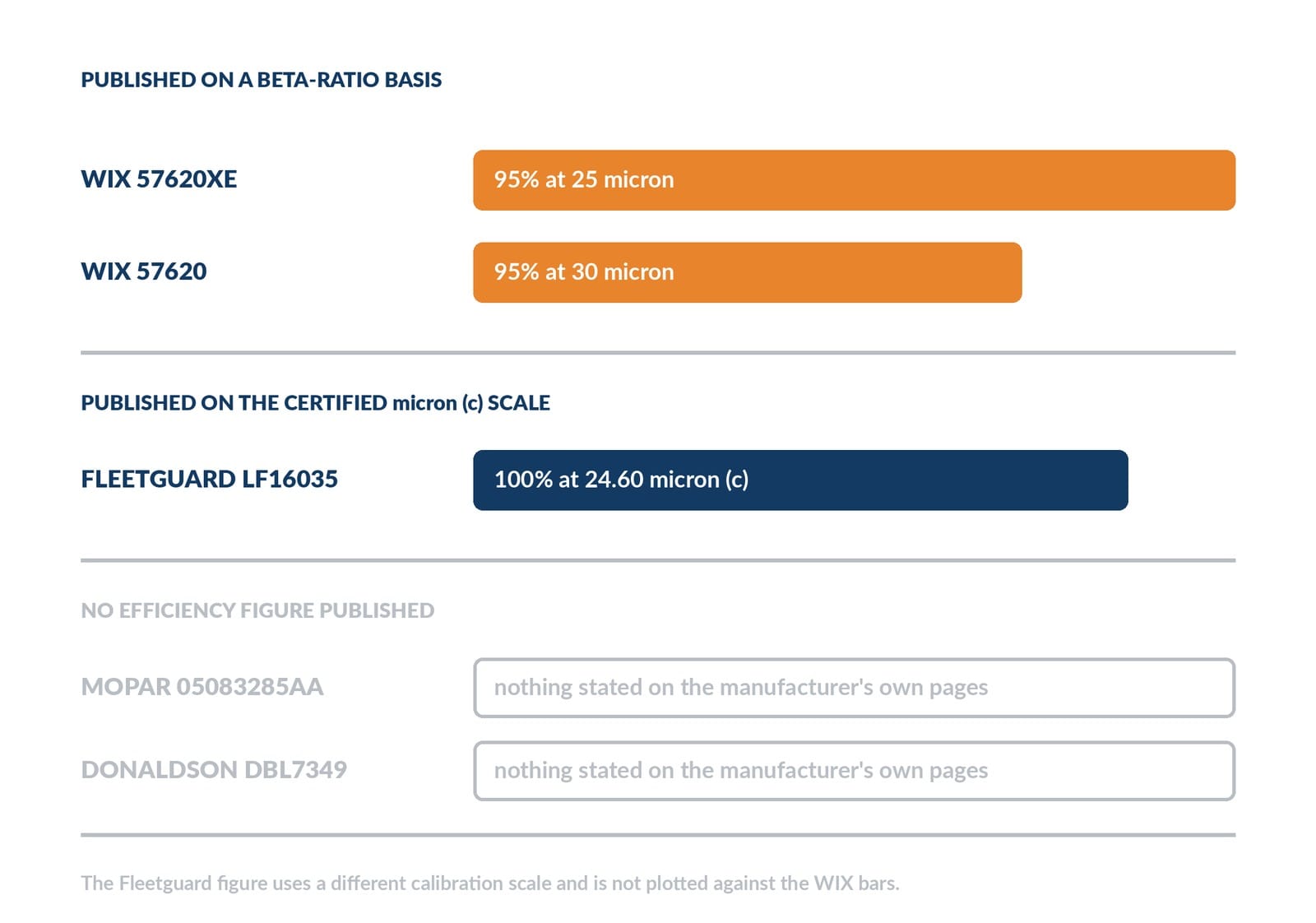
Rather than rank by reputation, here is what each manufacturer publishes on its own site for the parts that fit a 6.7 Cummins, in the manufacturer's own units.
| Filter | Published figure | Basis stated |
|---|---|---|
| Fleetguard LF16035 | 24.60 micron (c) @ 100% | Certified µm(c) scale |
| WIX 57620 | Beta 2/20 = 20/30 | Beta ratio, nominal 20 micron |
| WIX 57620XE | Beta 2/20 = 14/25 | Beta ratio, nominal 14 micron |
| Mopar 05083285AA | No efficiency figure published | None stated |
| Donaldson DBL7349 | No figure on Donaldson's own pages | None stated |
WIX publishes the most decodable data of the group, because a beta ratio converts directly into an efficiency percentage. Beta 2 is 50% efficiency and beta 20 is 95%, so the standard 57620 reads as 50% at 20 microns and 95% at 30 microns, while the extended-efficiency 57620XE is 50% at 14 microns and 95% at 25 microns.
That is a real, manufacturer-stated difference between two filters that fit the same mount, and it is stated in units you can check. It is also considerably less flattering than the "99% efficient" phrasing that appears on retail pages for both.
Donaldson is the interesting omission. The DBL7349 is widely quoted at 99% at 15 microns under ISO 4548-12, but as our Donaldson cross reference guide found, Donaldson's own live lube pages describe the Synteq media qualitatively and publish no efficiency percentage at all. Treat that figure as a third-party attribution, not a manufacturer specification.
This Filter Has No Bypass Valve, and That Is Correct
Cut open a factory 6.7 Cummins oil filter and you will find no bypass valve and no anti-drainback valve. Owners regularly report this as a defect. It is not.
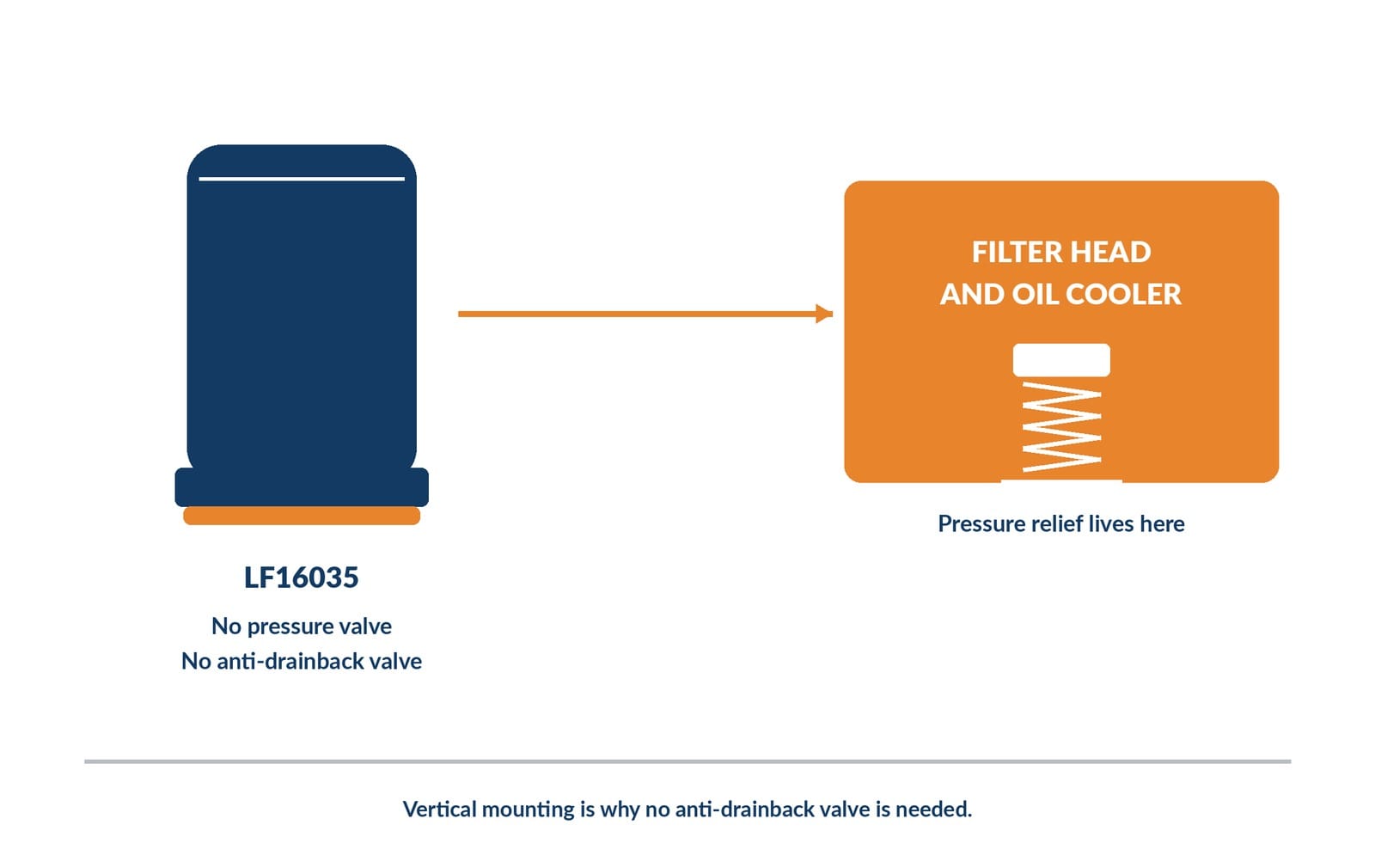
Fleetguard's own specification table for the LF16035 lists Pressure Valve: No, plainly, in the same block as the thread size. On this engine the pressure relief function lives in the filter head and oil cooler assembly rather than inside the disposable can, which is common practice on larger diesels.
The anti-drainback valve is absent for a related reason. The filter mounts vertically on the front passenger side of the engine, so gravity does not drain it back into the sump the way it would on a horizontally mounted filter.
The forum record on this is worth reading carefully, because it contains a correction. On a BobIsTheOilGuy thread about the missing valves, one member posted cut-open photos of both the Mopar MO-285 and the LF16035 and identified a coil spring inside as a bypass valve. A longtime member corrected him: that spring holds the element against the base plate and is not a valve at all. This is anecdote rather than manufacturer data, but it agrees with what Fleetguard publishes.
The practical consequence is simple. Do not reject a filter for this engine because it lacks a bypass valve, and do not pay extra for one that advertises having one. A bypass valve inside the filter is a design choice matched to the engine, not a quality tier.
The LF9028 Upgrade Everyone Recommends
Search any Cummins forum for oil filter advice and the Fleetguard LF9028 comes up within three posts. It is a Venturi combo filter: StrataPore media in a full-flow lower section with a stacked-disc bypass stage above it, and it threads onto the same 1-16 mount.
I went to check the numbers behind the recommendation and found two things that do not support it as strongly as the forums do.
First, Fleetguard's product page for the LF9028 lists its Primary Particle Efficiency as 24.60 micron (c) at 100%. That is not a better figure than the standard LF16035. It is the identical figure, alongside the identical thread size, gasket dimensions, height, rated flow and burst rating. The LF9028 also carries the same Pressure Valve: No entry.
Second, and more surprising: Fleetguard's own equipment table for the LF9028 lists Carrier Transicold refrigeration units, Kubota engines and Kamaz trucks. It does not list a single Ram truck or Cummins pickup engine. The filter's application on a 6.7 Cummins is entirely an owner-discovered interchange, not a manufacturer-listed fitment.
None of that proves the LF9028 is a bad filter, and the widely repeated claim that its bypass stage filters to around 5 microns may well be accurate. I simply could not confirm that figure anywhere on Fleetguard's own site, and the one efficiency number Fleetguard does publish for it is the same as the cheap filter it is supposed to improve on.
The same caution applies to the Baldwin BD7317, a dual-flow filter with a venturi cone that owners fit to this engine in the stock position. Baldwin's manufacturer page would not render for me across repeated attempts, so every specification I found for it came from resellers and forum posts. That is not a basis for a recommendation.


As an Amazon Associate we earn from qualifying purchases.
The Real Risk Is Not Which Brand You Pick
If you take one thing from this page, make it this. On this platform the difference between the filters above is small and arguable. The difference between a genuine filter and a counterfeit one is not.
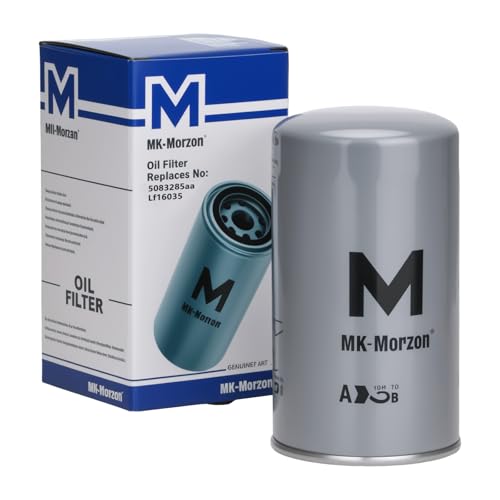
Fleetguard's parent company has said so publicly. Atmus Filtration Technologies' North American training leader warned of a surge in counterfeit Fleetguard filters sold through online marketplaces, noting there is no reliable way to verify a filter before it arrives. The Cummins specialist that republished the warning went shopping for fakes itself and photographed the results.
The failure modes named in that guide are not cosmetic: element burst or collapse, blocked lubrication, faulty bypass valves and questionable micron ratings. A commenter on the same page added the detail I found most useful, which is that counterfeit end-cap adhesive shows voids and air bubbles where the genuine bond is smooth and continuous.
What to look for before you spin one on:
- Misspelled branding, the single most reported giveaway
- Print quality on the can and the box, and missing information on either
- Logo proportions and colours that look slightly off
- Dimensions that measure marginally larger or smaller than the specification table above
- A price that undercuts every authorised seller
Buy from an authorised OEM distributor, the manufacturer's own storefront, or a diesel specialist. The saving on a suspiciously cheap filter is a few dollars against an engine that costs five figures.
Changing It: This Engine Is Not Like Other Spin-Ons
Two procedures here differ from ordinary passenger car practice, and getting them wrong causes real problems.
Pre-fill the filter. Both Ram and Cummins call for the replacement lube filter to be filled with clean oil before installation, roughly three quarters full. Installing it dry means the engine runs unfiltered and momentarily starved on start-up while the can fills.
The filter comes out sideways. It is reached through a gap between the passenger side inner fender and the frame, which means tipping a full can on its side both coming out and going in. A threaded filter plug or cap is effectively required equipment, not a convenience, and it is what makes the pre-fill step possible at all.
The tightening spec is where sources disagree, and I am not going to paper over it. DieselHub's step-by-step says to install the new filter snug by hand and not to use a filter wrench at all. Forum practice on the same engine is commonly hand-tight plus a quarter turn. Neither is a Cummins-published torque figure that I could open, so treat both as guidance rather than specification, and note that both are well short of the three-quarter to one full turn that most spin-on filters specify.
The oil pan drain plug torques to 35 lb-ft, and its gasket is integrated and not separately serviceable. Capacity is 12.0 quarts with a filter change, so subtract whatever went into the filter during the pre-fill before topping up.


As an Amazon Associate we earn from qualifying purchases.
How Often to Change It
Ram's published maximum for the 6.7L Cummins under normal duty is 15,000 miles, 12 months, or 350 hours of engine run time, whichever arrives first. Severe duty drops that to 4,000 miles, and severe duty here means dust, heavy idling and sustained low-RPM work rather than anything exotic.
In practice the oil change indicator governs. It calculates remaining oil life from engine temperature, load, RPM and driving pattern, and on a truck that idles or tows it will call for service well before the mileage ceiling.
The filter comes out at every oil change on this engine. There is no scenario in which leaving the filter on for a second interval makes sense on a 12-quart diesel sump.
FAQ
Did the 6.7 Cummins oil filter change in 2019?
No. The same filter position covers 2007.5 through 2024 Ram 2500, 3500, 4500 and 5500 trucks with the 6.7L Cummins, including the High Output engine and Cab and Chassis models. WIX's catalogue lists its 57620 across 08 to 23 model years without a break, and Mopar has carried 05083285AA throughout.
Is the Fleetguard LF16035 the same as the Mopar oil filter?
They are the same filter position and interchange directly. Fleetguard's LF16035 crosses to Mopar 05083285AA, and both share the 1-16 thread, 6.94 inch height and 2.83 inch gasket outside diameter. Fleetguard publishes an efficiency specification for its version; Mopar publishes none for its own.
Does the 6.7 Cummins oil filter have an anti-drainback valve?
No, and it does not need one. The filter mounts vertically on the front passenger side of the engine, so oil does not drain back out of it under gravity. Fleetguard also lists no pressure valve in the filter, because the relief function sits in the filter head and oil cooler assembly instead.
What micron rating is the 6.7 Cummins oil filter?
Fleetguard publishes 24.60 micron (c) at 100% efficiency for the LF16035. Retail listings variously claim 10, 30 and 60 microns for the same part, none of which match the manufacturer. The "(c)" denotes the NIST-traceable calibration scale, so the figure cannot be compared directly against a plain micron rating from another brand.
Can I use a WIX 57620 instead of the Fleetguard?
Yes. WIX lists the 57620 for the 6.7L Cummins directly, and it shares the thread and gasket dimensions. WIX's own beta data puts the standard 57620 at 50% efficiency at 20 microns and 95% at 30 microns, with its 57620XE variant tightening that to 50% at 14 and 95% at 25 microns.
What to Do Next
Write down your engine's filter number once and stop shopping by vehicle year, because on this engine the year does not change the answer. Then spend your attention on the seller rather than the brand, since every filter discussed here is a defensible choice and a counterfeit of any of them is not.
If a chart or listing gives you a micron rating without telling you the efficiency percentage and the test standard behind it, it has told you nothing. That single habit will save you more grief on this engine than any brand loyalty will.