Oil Filter Micron Rating Explained: What It Means for Your Engine




A micron rating tells you the particle size an oil filter targets, but a number alone means nothing. The rating is only meaningful when paired with an efficiency percentage. A filter marketed as "10 micron" could be capturing 95% of those particles or just 20%. Understanding both numbers is what separates a good filter choice from a misleading one.
Most people asking about micron ratings want one thing: to know if their filter is good enough to protect their engine.
The problem is that manufacturers have made micron ratings confusing. Some advertise a very low number to sound impressive. Others advertise a moderate number at extremely high efficiency. And buyers trying to compare filters often end up comparing numbers that were measured using completely different standards.
I spent time going through manufacturer technical documents, EcoGard's published analysis, and extensive BobIsTheOilGuy forum discussions to get a clear picture of how this actually works. Here is what I found.


As an Amazon Associate we earn from qualifying purchases.
What Is a Micron?
A micron is one millionth of a meter. To put that in perspective, the average cross-section of a human hair is approximately 50 microns.
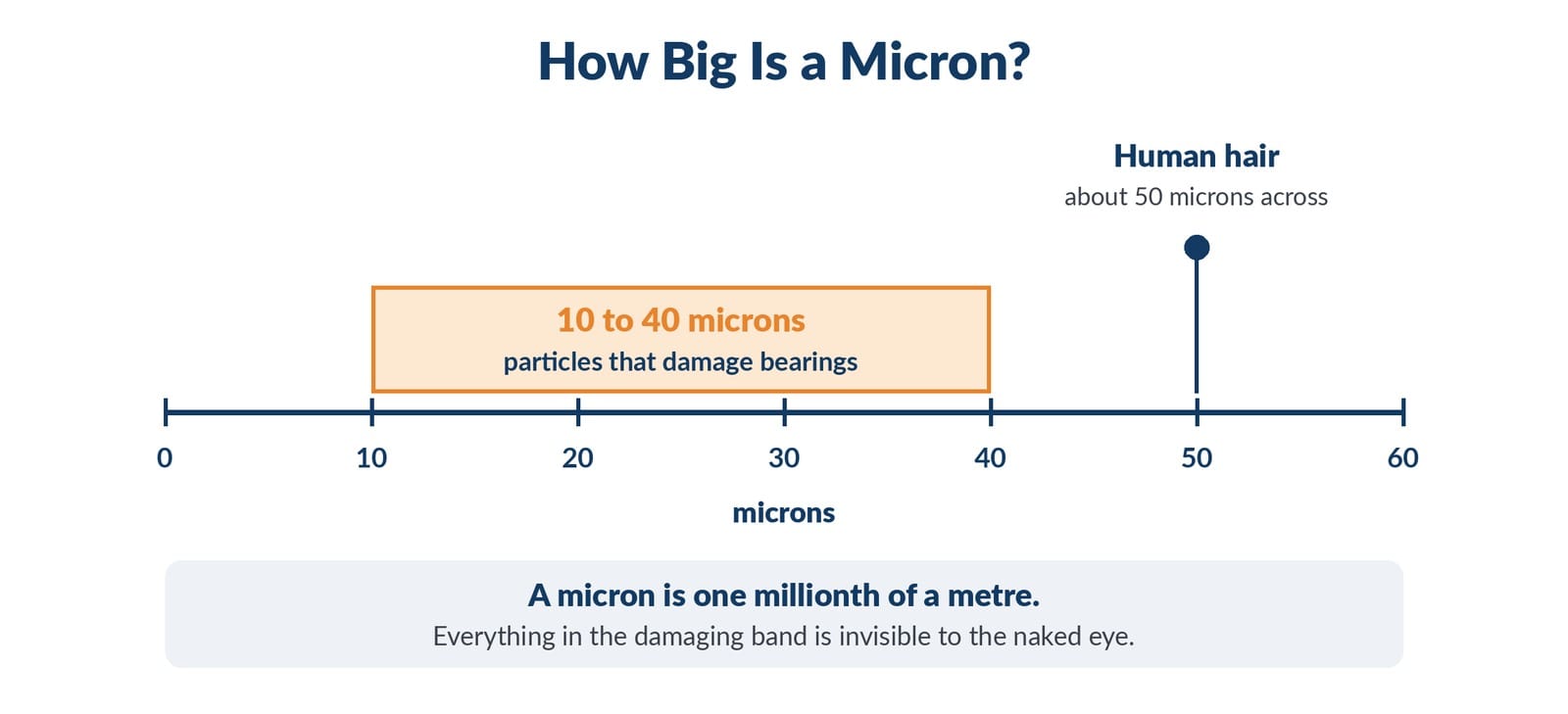
Most contaminants that damage engine bearings fall in the 10 to 40 micron range. They are completely invisible to the naked eye.
When a filter's micron rating is stated, it describes the particle size the filter targets. A filter rated at 20 microns targets particles of 20 microns or larger.
But that number alone tells you almost nothing useful.
Why a Micron Rating Without Efficiency Is Meaningless
This is the most important concept on this page.
A filter's micron rating must always be paired with an efficiency percentage to mean anything.
Here is why. The same filter can be described multiple ways:
- "95% efficient at 25 microns" (captures 95 out of 100 particles at that size)
- "20% efficient at 5 microns" (captures only 20 out of 100 particles at that size)
A manufacturer could market the second scenario as a "5-micron filter" and be technically accurate. But that filter is capturing barely one in five particles at that size. The low micron number sounds impressive. The reality is far less so.
A micron rating without an efficiency percentage is marketing, not a specification.
EcoGard uses a useful analogy: a baseball backstop is 100% efficient at stopping baseballs, but far less efficient at stopping marbles. The same mesh, two very different results depending on particle size. The micron number is the particle size. The efficiency is what actually matters.
Nominal vs. Absolute Micron Ratings
These two terms describe how a filter's micron rating was measured. They are not interchangeable.
What Is a Nominal Micron Rating?
A nominal rating expresses efficiency at 50% for the stated particle size. A filter described as "nominal 10 microns" captures approximately 50% of particles at that size.
Nominal ratings are essentially minimums. The filter may perform better, or it may not. Because test conditions vary between manufacturers, nominal ratings from different brands are not reliably comparable.
What Is an Absolute Micron Rating?
An absolute rating describes a filter that captures at least 98.7% of particles at the stated size. This rating is determined by passing oil with measurable particles through the filter, then counting what passes through.
Absolute ratings are more meaningful because they represent a consistent standard. When a filter is rated "absolute 20 microns," it removes at least 98.7% of 20-micron particles.
Side-by-Side Comparison
| Rating Type | Efficiency Standard | Reliability | Comparability |
|---|---|---|---|
| Nominal | ~50% at stated size | Low | Not reliable between brands |
| Absolute | ≥98.7% at stated size | High | Consistent standard |
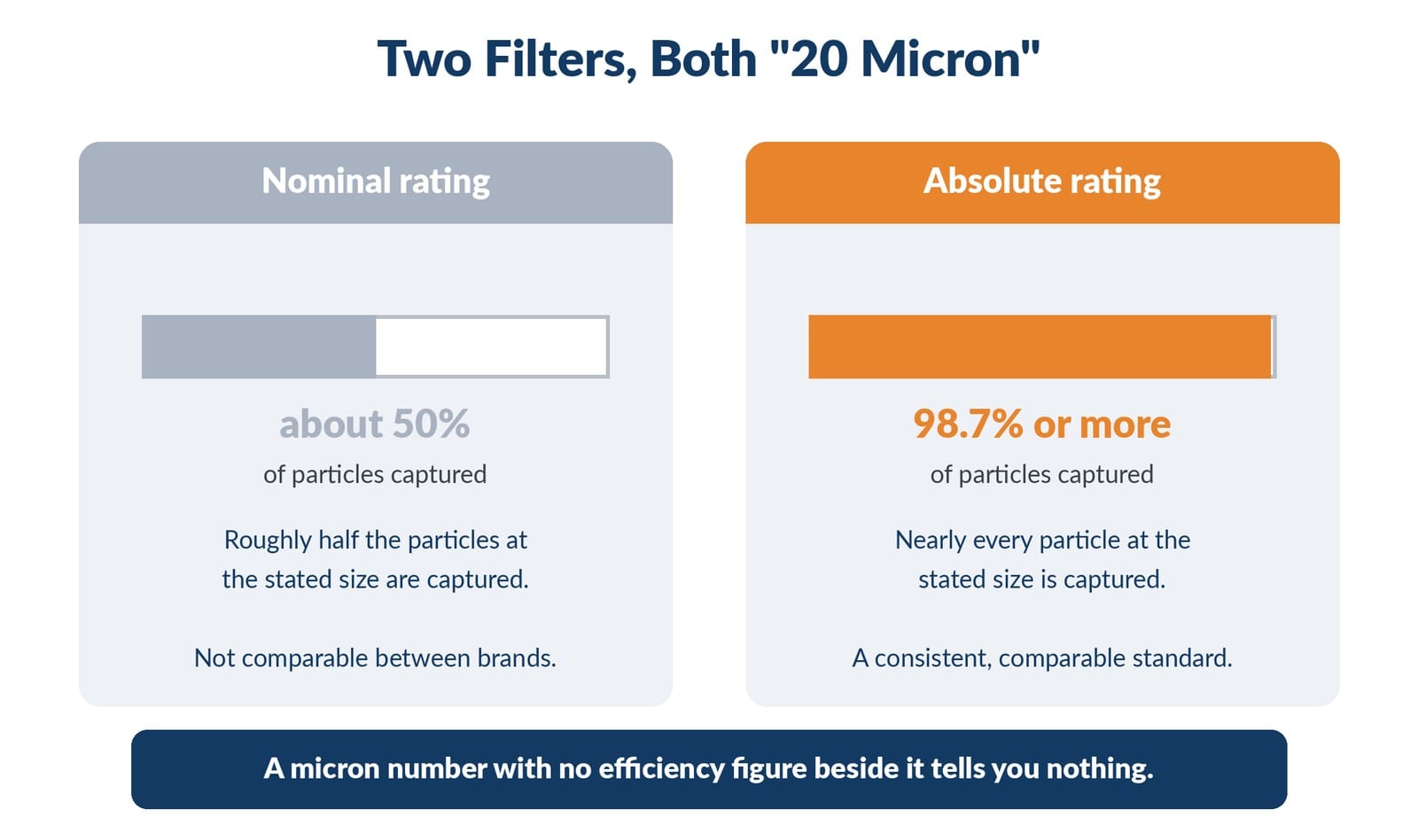
If a filter spec sheet does not specify nominal or absolute, and does not include an efficiency percentage, treat the number with skepticism.


As an Amazon Associate we earn from qualifying purchases.
The Beta Ratio: The Technical Backbone of Filter Efficiency
The industry standard for measuring filter efficiency is the beta ratio. Understanding it helps you read manufacturer specs properly.
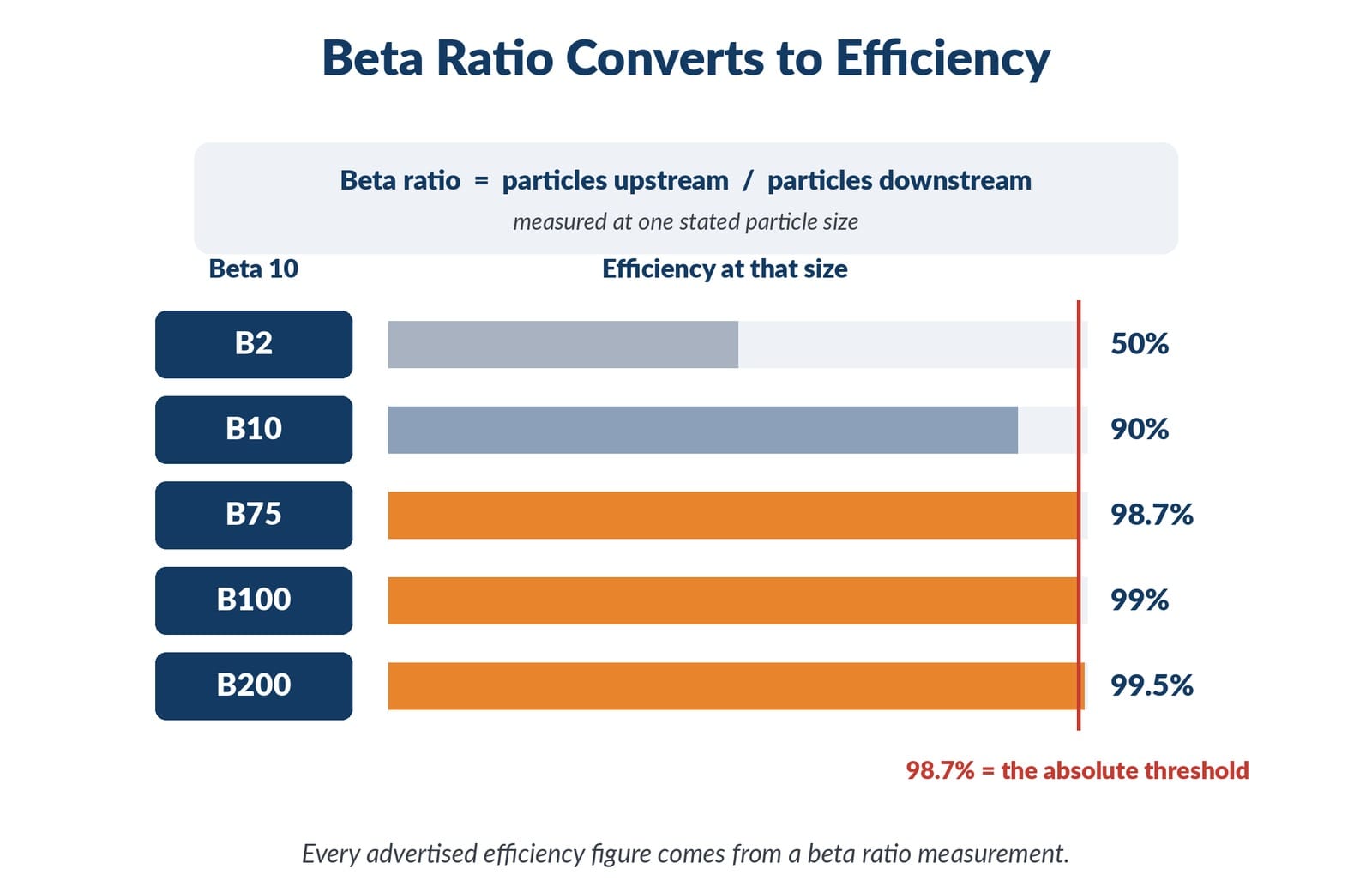
The beta ratio is calculated by dividing the number of particles of a specific size upstream of the filter by the number of the same size that pass through downstream.
Beta ratio formula:
Beta (x) = Upstream particle count ÷ Downstream particle count
A beta ratio of 200 at 20 microns means 200 particles enter the filter for every 1 that passes through. That equals 99.5% efficiency at 20 microns.
The beta ratio is determined through multi-pass testing and is the method used to calculate absolute filter ratings.
| Beta Ratio | Efficiency |
|---|---|
| β10 = 2 | 50% |
| β10 = 10 | 90% |
| β10 = 75 | 98.7% |
| β10 = 100 | 99% |
| β10 = 200 | 99.5% |
When a manufacturer claims "99% efficiency at 20 microns," that corresponds to approximately beta 100 at 20 microns.
What Micron Rating Actually Matters for Engine Protection
Not all microns are equal in terms of the damage they cause. The particle sizes most dangerous to engine bearings fall in a specific range.
Engine bearing clearances in most passenger vehicles fall roughly between 20 and 60 microns, depending on engine design. A particle sized to fit within that clearance gap can bridge across the oil film and physically scratch the bearing surface.
This is why the 10 to 40 micron range is the critical target zone for oil filtration. Particles in the 20 to 35 micron range are the most likely to cause bearing wear in full-flow lubrication systems.
Larger particles above 40 microns are also captured, but they are less likely to fit into bearing clearances. Very fine particles below 10 microns are present in oil but cause comparatively less surface damage at typical operating clearances.
The practical goal is high efficiency in the 10 to 30 micron range, not just a low micron number.


As an Amazon Associate we earn from qualifying purchases.
How Common Oil Filter Brands Rate at 20 Microns
This is where most buyers get confused. Different brands measure and report efficiency differently.
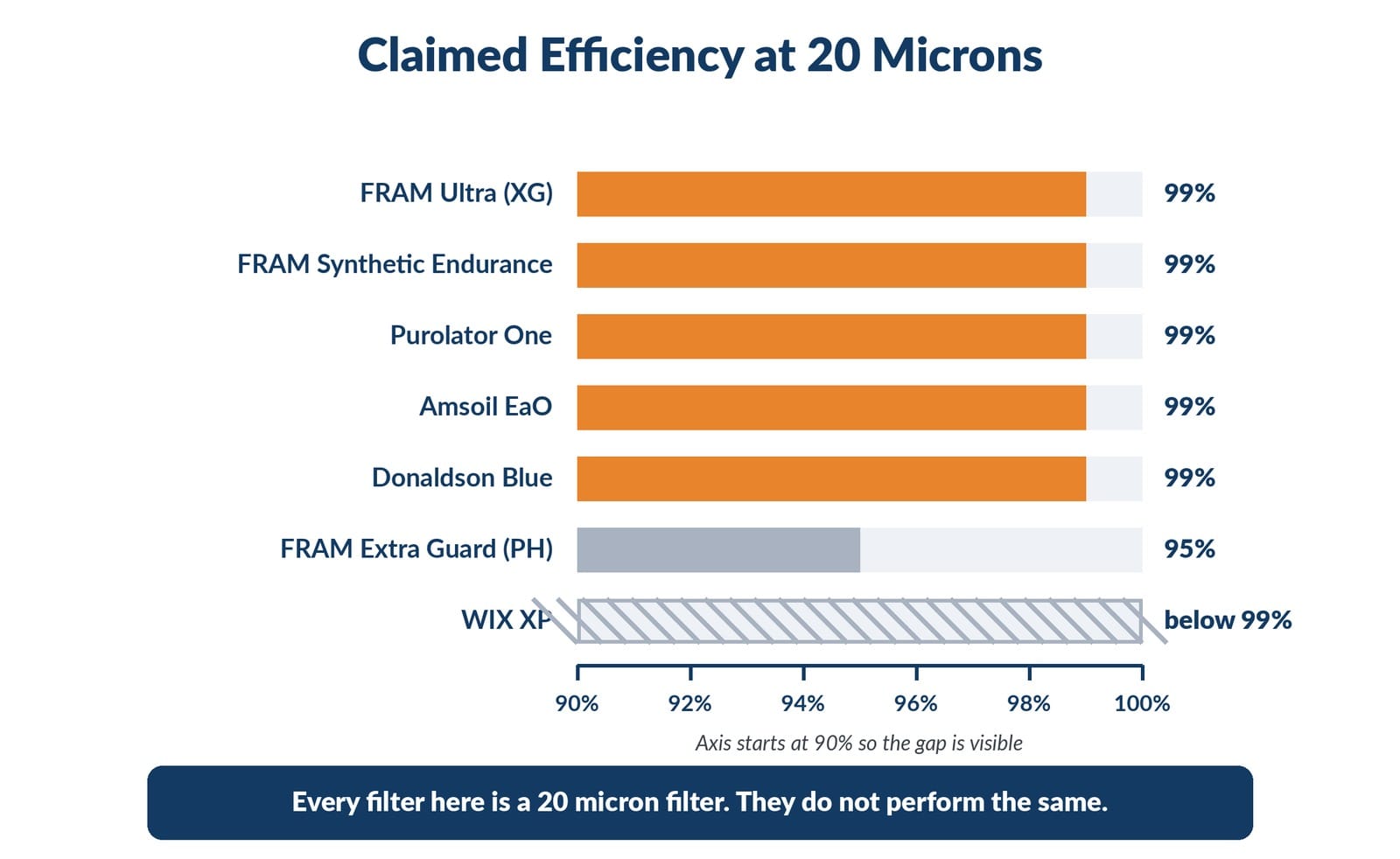
Based on data discussed by experienced members of the BobIsTheOilGuy forum engine oil filters section, including corrections from the forum's staff moderators:
| Filter | Claimed Efficiency | Micron Size | Notes |
|---|---|---|---|
| FRAM Ultra (XG) | 99% | 20 microns | ISO 4548-12 based; for up to 20,000 miles |
| FRAM Synthetic Endurance | 99% | 20 microns | Rated for 25,000 miles |
| FRAM Extra Guard (PH) | 95% | 20 microns | Standard filter, shorter intervals |
| Purolator One | 99% | 20 microns | Synthetic blend media |
| Purolator Boss | 99%+ | 25 microns | ISO 4548-12 on PBL30001; SmartFUSION full synthetic media |
| Amsoil EaO | 99% | 20 microns | Full synthetic media |
| Royal Purple | 99% | 25 microns | Dropped from 20 micron standard per forum reports |
| Donaldson Blue | 99% | 20 microns | Full synthetic media |
| WIX XP | Below 99% | 20 microns | Not 99% at 20 microns per forum analysis |
Important caveat: Filter manufacturers update their products without notice. Always verify current specs against the manufacturer's published data sheet, not just packaging claims. As BITOG staff moderator dnewton3 noted, filter makers alter their products and published lists become outdated quickly. For a current, brand-by-brand breakdown pulled directly from each manufacturer's own product page rather than forum data, see which oil filter brand publishes the strongest confirmed spec sheet.
Does a Lower Micron Rating Mean Better Filtration?
Not automatically. And chasing the lowest possible micron number can actually mislead you.
Here is why. A filter rated 10 microns at nominal (50%) efficiency is capturing half the particles at that size. A filter rated 25 microns at absolute (98.7%) efficiency is capturing nearly all particles at that size.
For engine protection in the critical 10 to 40 micron damage range, the filter with higher efficiency at 25 microns is doing more real work.
This connects to the "flow vs. efficiency" debate that comes up often in filter discussions. The concern is that tighter filters restrict flow and starve the engine of oil. According to ZeeOSix, a longtime BobIsTheOilGuy forum contributor with extensive oil filter analysis experience, this concern is largely a myth for standard passenger vehicle engines:
"Plenty of high efficiency oil filters flow just fine, and your engine won't know the difference in any minor flow difference supplied by the positive displacement oil pump."
Engines use positive displacement oil pumps, which push a fixed volume per revolution regardless of backpressure. A few PSI of additional restriction from a high-efficiency filter does not meaningfully reduce oil delivery to bearings under normal driving conditions.
How to Read a Filter Spec Sheet
When you pull up a filter's spec sheet or product page, here is what to look for and how to interpret it:
- Find the efficiency claim. Look for a percentage alongside a micron size. "99% at 20 microns" or "98.7% at 25 microns" are meaningful specs.
- Check the test standard. ISO 4548-12 is the industry standard multi-pass test for oil filter efficiency. Seeing this standard cited is a good sign the number is credible.
- Confirm nominal vs. absolute. If the spec sheet does not specify, ask directly or look for a beta ratio.
- Check rated mileage. A filter rated 99% at 20 microns for 5,000 miles and one rated 99% for 20,000 miles are not the same filter. The interval matters.
- Cross-reference independent sources. BobIsTheOilGuy forums contain years of third-party analysis comparing filter specs across brands.


As an Amazon Associate we earn from qualifying purchases.
Micron Rating and Oil Change Intervals
The micron rating of a filter matters more as the service interval gets longer.
At a 3,000 to 5,000 mile conventional oil change interval, most filters with reasonable efficiency will do their job before reaching capacity. At 10,000 miles or more on full synthetic oil, the filter needs to maintain its rated efficiency all the way to the drain date.
A standard cellulose filter rated at 95% efficiency for 5,000 miles used in a 10,000 mile synthetic oil application is a mismatch. The filter may bypass regularly in the second half of the interval, sending unfiltered oil to the bearings.
Match the filter's rated interval to your actual oil change interval. This is more important than chasing the lowest possible micron number.
FAQ
What is a micron rating on an oil filter? A micron rating tells you the particle size an oil filter targets. A filter rated at 20 microns captures particles 20 microns or larger in size. The rating is only meaningful when paired with an efficiency percentage, such as "99% efficient at 20 microns." A micron number alone does not describe how well the filter actually performs.
What is the difference between nominal and absolute micron rating? A nominal rating means the filter captures approximately 50% of particles at the stated size. An absolute rating means the filter captures at least 98.7% of particles at the stated size. Absolute ratings are more meaningful and more consistent between manufacturers. Most quality automotive oil filters are rated using absolute standards.
What micron rating is best for an oil filter? For most passenger vehicles, a filter rated 99% efficient at 20 to 25 microns is excellent protection. The particle sizes most damaging to engine bearings fall in the 10 to 40 micron range. A filter with high efficiency in that range, matched to your oil change interval, is the right choice. Do not chase the lowest micron number without checking the efficiency percentage alongside it.
Is a 10-micron oil filter better than a 25-micron filter? Not necessarily. A 10-micron filter at nominal (50%) efficiency captures half the particles at that size. A 25-micron filter at absolute (98.7%) efficiency captures nearly all particles at that size. For bearing protection in typical engines, a high-efficiency 20 to 25 micron filter outperforms a low-efficiency 10-micron filter in real-world conditions.
Do high-efficiency oil filters restrict oil flow? For most passenger vehicles, no. Engines use positive displacement oil pumps that maintain flow regardless of minor backpressure differences. The small additional resistance of a high-efficiency filter does not meaningfully reduce oil delivery under normal driving conditions.
What micron rating do most car oil filters use? Passenger car and light-duty truck oil filters typically have an absolute micron rating in the range of 25 to 30 microns. Premium filters with synthetic media often achieve 99% efficiency at 20 microns, which provides superior protection in the damage-critical particle size range.


As an Amazon Associate we earn from qualifying purchases.
What to Do With This Information
The micron rating conversation almost always leads to the same practical question: which filter should you actually buy?
The answer depends on three things. Your engine type (turbocharged engines benefit more from finer filtration). Your oil change interval (longer intervals need higher-capacity filters). And your media preference (full synthetic media achieves and maintains efficiency ratings over longer mileage).
Understanding micron ratings is how you evaluate what a filter's marketing claims actually mean in practice.