Donaldson Oil Filter Cross Reference Guide

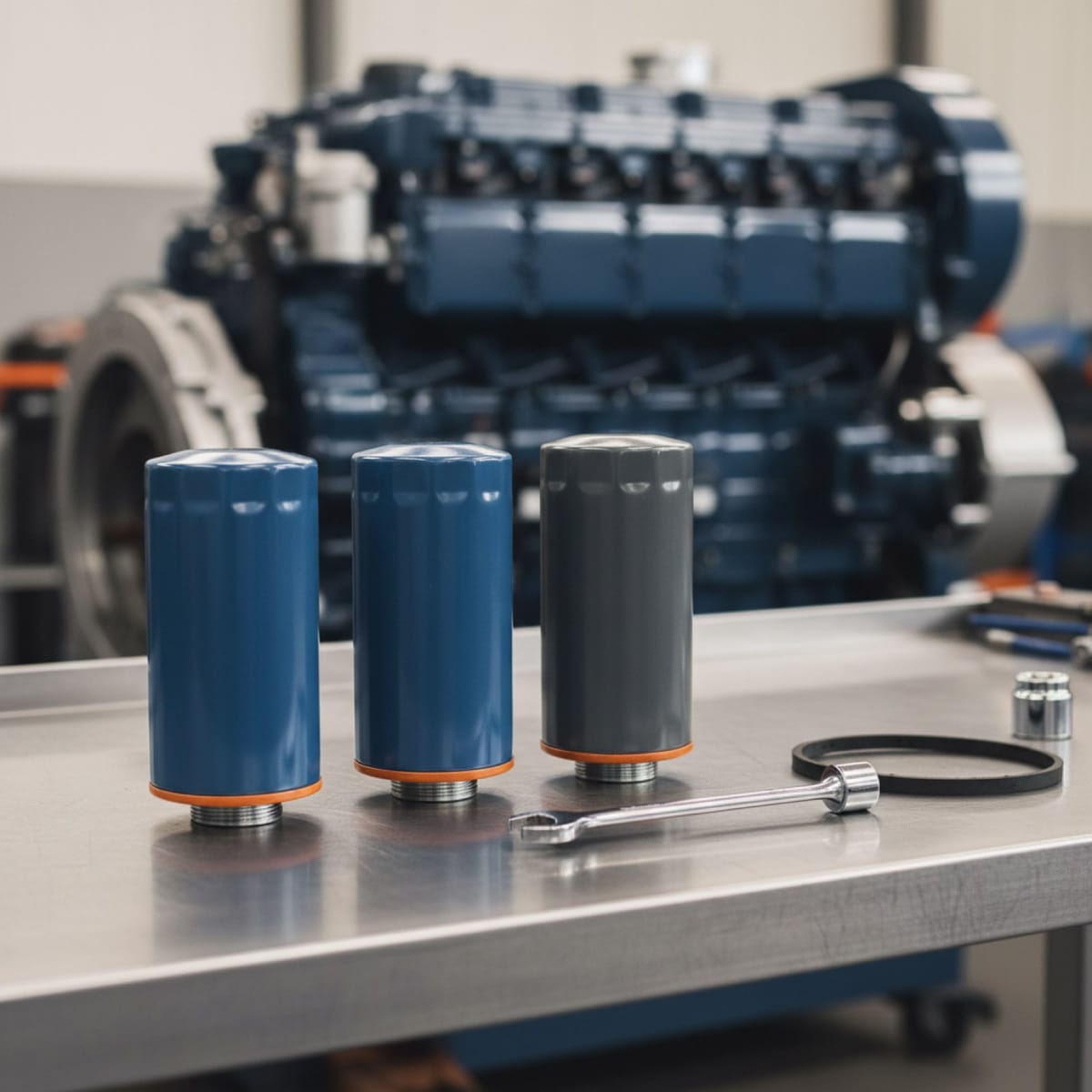


A Donaldson oil filter cross reference converts a Donaldson lube filter number into the equivalent Baldwin, Fleetguard, FRAM, WIX or Luber-finer part. Donaldson publishes its own chart organised by engine make rather than by vehicle, because the catalogue is built for diesel engines rather than passenger cars.
That last point catches people out constantly. Donaldson does not number its filters the way FRAM or WIX do, and it does not organise them the way an auto parts store does. Once you understand how the catalogue is actually structured, the cross references stop looking random.


As an Amazon Associate we earn from qualifying purchases.
What a Donaldson Oil Filter Actually Is
Donaldson is a filtration company founded in 1915, when Frank Donaldson Sr. built an air cleaner to stop dust destroying a farmer's tractor engine. Air filtration was the original business, and it still shapes the catalogue.
The lube side came much later. Donaldson describes its lube range as a complete line of oil filters for diesel engines, in two tiers: standard life, and Donaldson Blue for extended service intervals.
That is the single most useful fact for anyone cross referencing a Donaldson number. The reference points in this catalogue are engines, not vehicles. Cummins, Caterpillar, Detroit Diesel, Mack, Navistar, Volvo, Ford diesel. Not a model year and a trim level.
Donaldson's construction spec sheet lists 34 different media formulations across the liquid filter range, which is why two filters that look identical from the outside can be built very differently inside.
How to Read a Donaldson Oil Filter Part Number
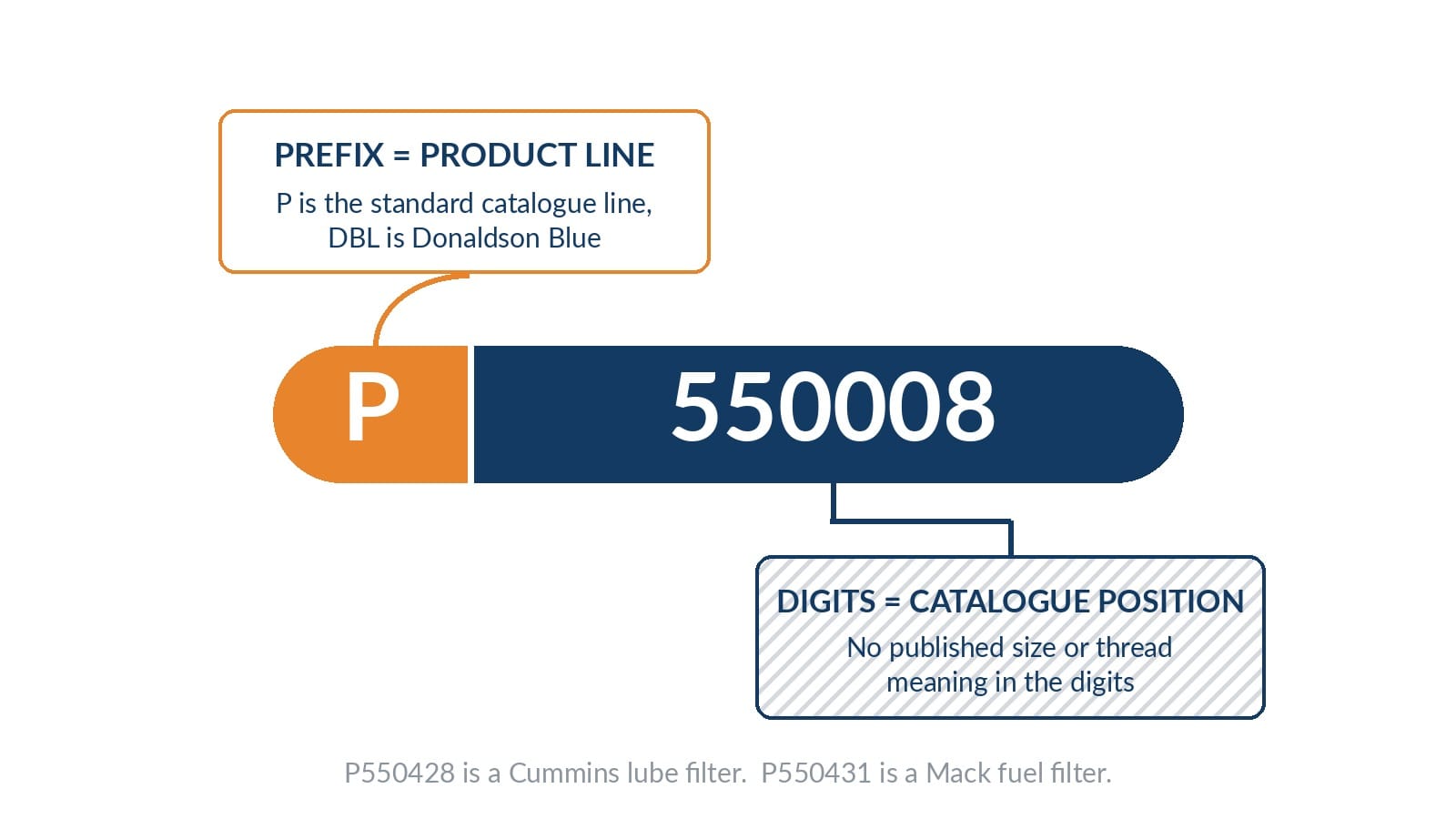
A Donaldson part number has two meaningful parts: a letter prefix that tells you the product line, and a digit string that identifies the individual filter. The prefix is the only part that reliably decodes.
What does the P prefix mean?
P is Donaldson's standard catalogue prefix. It appears on lube filters, fuel filters, air filters and hydraulic filters alike.
This is the first trap. The P prefix does not tell you what kind of filter you are holding. P550008 is a lube filter. P551100 is a fuel filter. P181126 is an air filter. Same prefix, three completely different products.
If a chart tells you a P-number is an oil filter, that claim needs checking against Donaldson's catalogue, not assumed from the prefix.
What do DBL and ELF mean?
DBL is Donaldson Blue lube, the premium tier. DBF is Donaldson Blue fuel. The Blue prefixes carry Synteq synthetic media and upgraded seals.
ELF was the older Endurance Lube Filter line. Donaldson folded it into the Blue range, so ELF7349 and DBL7349 are the same filter reached through two generations of numbering. You will still find ELF numbers in older cross reference charts, including current printed ones.
Do the digits encode the size?
No, and this is where most DIY cross referencing goes wrong.
Take two numbers three digits apart in Donaldson's own catalogue. P550428 is a full-flow lube filter for Cummins. P550431 is a fuel filter for Mack. Adjacent numbers, different fluids, different engines.
The digits are catalogue positions, not specifications. Donaldson does not publish a decoder for them, so treat nearby numbers as unrelated until the catalogue says otherwise.
Two Donaldson numbers that look almost identical can have different threads, different gasket diameters and different valve settings. Never substitute one for the other on the strength of the number alone.


As an Amazon Associate we earn from qualifying purchases.
Donaldson Oil Filter Cross Reference Chart
I built this chart from two manufacturer publications rather than one: Donaldson's own liquid filtration cross reference and Baldwin's quick cross reference form.
They do not agree on everything, which turned out to be the most useful finding in this whole guide. So the chart is split by how much confidence each row deserves.
Rows both manufacturers agree on
These appear in both documents with matching numbers. This is as solid as a published cross reference gets.
| Donaldson | Engine | Baldwin | Fleetguard | FRAM | WIX |
|---|---|---|---|---|---|
| P554005 | Caterpillar | B99 | LF691A | PH3335 | 51792 |
| P555570 | Caterpillar | BT230 | LF3342 | PH3519 | 51268 |
| P552100 | Detroit Diesel | B495 | LF3620 | PH7405 | 51971 |
| P550371 | Navistar | B7039 | LF3630 | PH3786 | 51734 |
| P550425 | Volvo (bypass) | B7685 | LF3654 | P9407 | 51660 |
Luber-finer equivalents for the same five rows: LFP4005, LFP5570, LFP2160, LFP2286 and LFP8642.
Rows from Donaldson's catalogue only
Baldwin's chart does not carry these part numbers, so there is no second document to check them against. They come straight from Donaldson and are almost certainly right, but treat them as single-sourced.
| Donaldson | Engine | Baldwin | Fleetguard | FRAM | WIX |
|---|---|---|---|---|---|
| P556007 | Caterpillar | B75 | LF3328 | PH3545 | 51798 |
| P555680 | Caterpillar | BT274 | LF654 | PH36 | 51261 |
| P558615 | Cummins | BT339 | LF3349 | PH3976 | 51607 |
| P558616 | Cummins | BT427 | LF3345 | PH3900 | 51602 |
| P550731 | Ford | B157 | LF3443SC | PH7014 | 51754 |
Luber-finer equivalents: LFP6007, LFP791, LFP780, LFP3900 and LFP781.
Rows where the two documents conflict
Do not buy from these until you have checked with a distributor. The disagreement is listed in full further down.
| Donaldson | Engine | Where the documents disagree |
|---|---|---|
| P551670 | Cummins / Detroit Diesel | WIX number: 51970 or 51870 |
| P550367 | Navistar | Fleetguard number: LF3640 or LF3883 |
| P551807 | Cummins / Volvo | Fleetguard number: LF3973 or LF17503 |
| P550784 | Ford | Baldwin maps B134 to a different Donaldson number |
| P550428 | Cummins | Baldwin cell: BT595 or B7177 |
| P559000 | Cummins | Fleetguard, Luber-finer and WIX all differ |
| P553191 | Mack | Baldwin cell: B7600 or B76 |
| P550777 | Detroit Diesel (bypass) | Luber-finer: LFP777B or LFP8643 |
Full-Flow, Bypass and Combination: Donaldson Separates Them
Donaldson's catalogue splits lube filters into three categories that most consumer charts flatten into one. Getting this wrong means fitting a filter into the wrong circuit entirely.
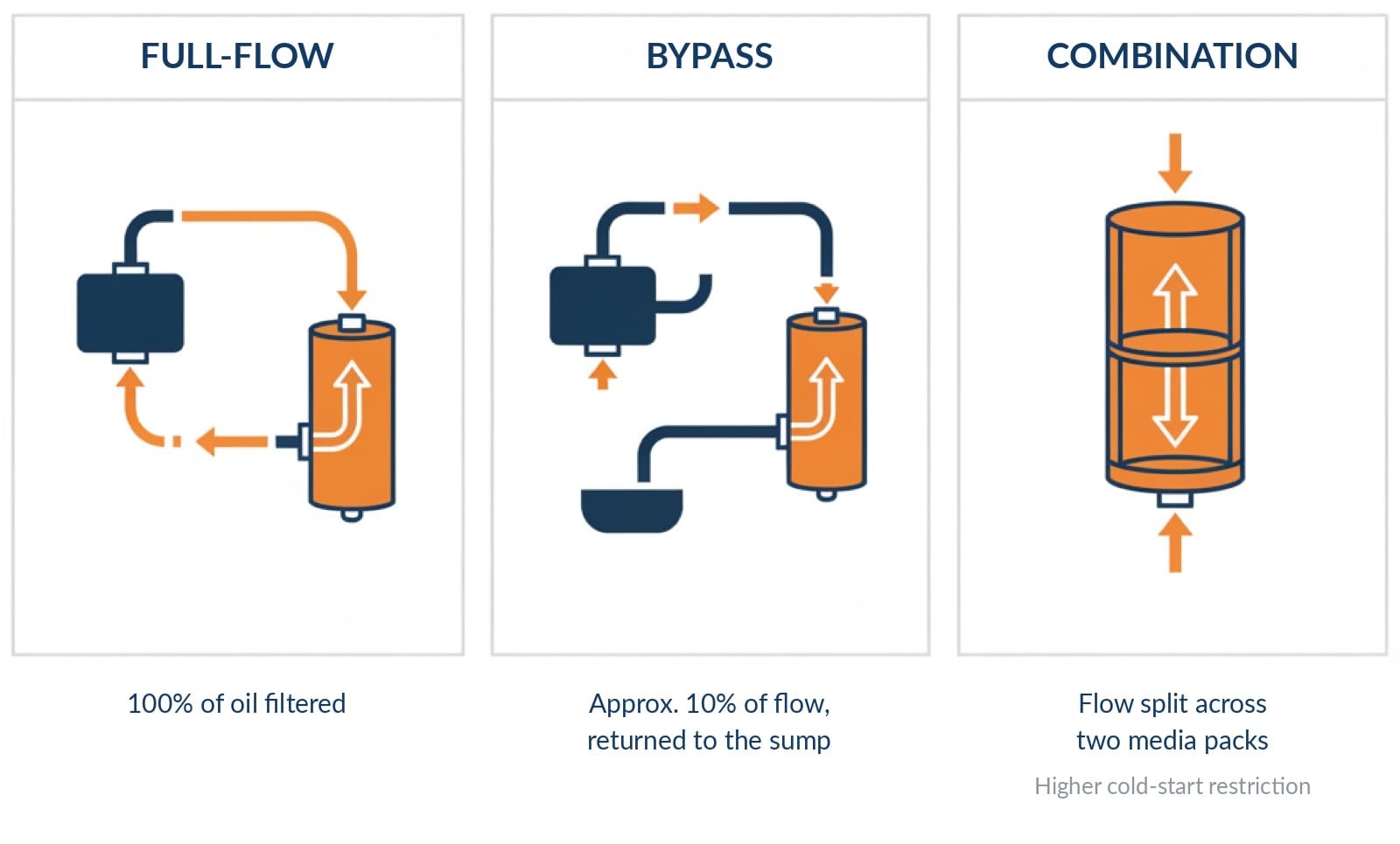
Full-flow filters clean 100% of the oil before it reaches the engine. This is what nearly everyone means by "oil filter". Most of the chart above is full-flow.
Bypass filters are different animals. They take approximately 10% of the oil flow and return the cleaned oil to the sump, on a separate circuit sometimes called a kidney loop. In the chart above, P550777 and P550425 are both catalogued as bypass filters, not full-flow.
Combination or two-stage filters try to do both jobs in one can. Donaldson's own engineering position is blunt about the trade-off: splitting flow between two media packs raises cold-start restriction, which can hold the bypass valve open longer and push unfiltered oil through the engine at exactly the wrong moment. P553000 is a combination filter in Donaldson's Cummins listing.
Donaldson makes a specific point of this: a combination filter is not the same thing as a full-flow filter with an integral bypass valve. The two get labelled interchangeably online, and they are not interchangeable in a lube circuit.
Standard Grade vs Donaldson Blue
Donaldson runs two lube tiers, and the cross reference charts often list only one of them.
| Standard grade | Donaldson Blue | |
|---|---|---|
| Prefix | P | DBL |
| Media | Cellulose or synthetic, matched per application | Synteq synthetic |
| Built for | Predictable duty, standard service schedules | Extended drains, severe duty |
| Seals | Standard | Upgraded seals, gaskets and potting |
Donaldson's stated advantage for the Blue tier is the media structure: man-made fibres with more uniform pore size than cellulose, small-diameter fibres that hold finer contaminants, thermally bonded fibres for higher capacity, and lower pressure drop both when new and in service.
Lower pressure drop matters more than it sounds. It lets the bypass valve close earlier on a cold start, which means the engine spends less of its most vulnerable minutes running on unfiltered oil.
One honest caveat about the numbers. Third-party listings and forum efficiency tables commonly put Donaldson Blue at 99% at 20 microns, and that figure circulates widely enough to appear in most published micron rating comparisons.
I could not confirm it on Donaldson's own site. Their live lube pages describe the Synteq media qualitatively and publish no efficiency percentage or micron figure at all. Treat the 99% at 20 microns number as a third-party attribution rather than a manufacturer specification until Donaldson publishes one.


As an Amazon Associate we earn from qualifying purchases.
Does Donaldson Make an Oil Filter for a Passenger Car?
Generally, no. Donaldson's lube catalogue targets diesel engines in trucks, agriculture, construction, mining and power generation. There is no passenger car lookup on the scale that FRAM, WIX or Purolator offer, because that is not the market.
Some Donaldson numbers do land in filter families that overlap with older domestic vehicles. P550008 is a spin-on with a 3/4-16 UN thread, roughly 3.66 inches across and 5.14 inches tall, and it crosses to Baldwin B2 and B253, Fleetguard LF551A and LF3313, and AC-Delco PF2. That is the large classic spin-on family, not a modern car filter.
If you drive a gasoline passenger car, the practical answer is that Donaldson is not built for you, and a cross reference into their catalogue is solving a problem you do not have.
Why Online Donaldson Cross Reference Charts Contradict Each Other
This is the part worth reading before you trust any chart, including a printed one.
While building this guide I found a widely circulated Donaldson chart that puts Fleetguard LF3349 and Baldwin B179 against P550008. Donaldson's own brochure puts LF3349 on P558615, and P550008's actual cross list runs to Baldwin B2 and B253 and Fleetguard LF551A. The popular chart is simply wrong on that row, and it is wrong in a way that would have you fitting a Cummins filter to something else entirely.
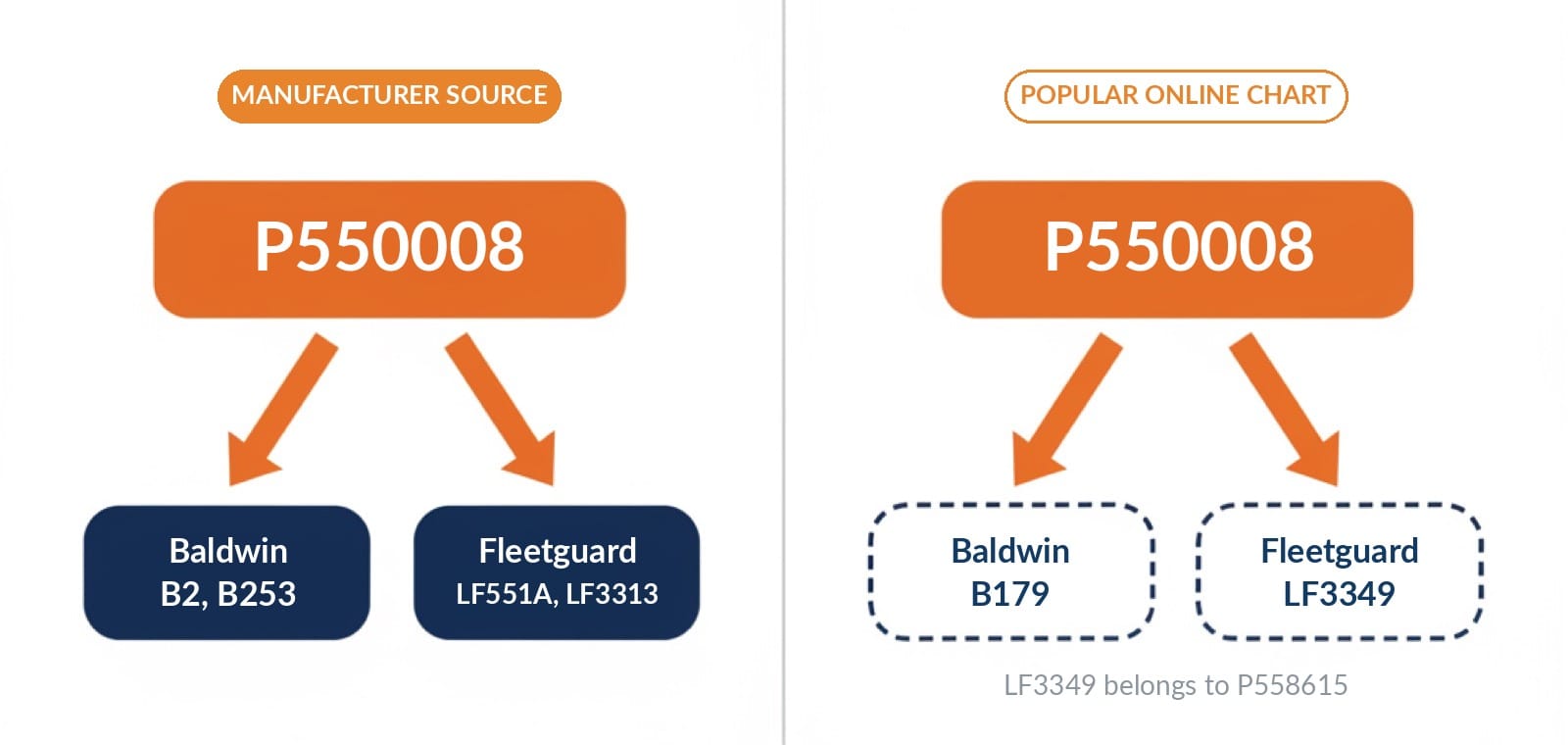
The same chart lists P553191 as an air filter and P550777 as a fuel filter. Donaldson catalogues the first as a Mack full-flow lube filter and the second as a Detroit Diesel bypass lube filter.
Manufacturer documents are better, but they are not perfect either. Setting Donaldson's chart beside Baldwin's turned up eight rows where the two disagree:
- P551670: Donaldson gives WIX 51970. Baldwin gives 51870 for the Cummins application and 51970 for Detroit Diesel. Same Donaldson number, two WIX numbers.
- P550367: Donaldson gives Fleetguard LF3640. Baldwin gives LF3883.
- P551807: Donaldson gives Fleetguard LF3973. Baldwin gives LF17503.
- P550784: Donaldson maps it to Baldwin B134. Baldwin maps B134 to a different Donaldson number entirely.
- P550428: Donaldson gives Baldwin BT595. Baldwin's own form gives B7177.
- P559000: Donaldson gives LF9000, LFP9001 and WIX 57745. Baldwin gives LF9070, LFP9000 and 57745XD.
- P553191: Donaldson gives Baldwin B7600. Baldwin gives B76.
- P550777: the Luber-finer number is LFP777B in one and LFP8643 in the other.
And a primary source can simply have a typo. On the P550821 row, Donaldson's own PDF has a column shift that prints a WIX number underneath the FRAM heading.
None of those rows carry full numbers in the chart above. If you need one of them, take it to a Donaldson distributor with your engine serial number rather than trusting either document alone.
To be fair to both publishers, several of these are probably not errors at all. Baldwin numbers its own catalogue and Donaldson numbers its own, and a filter that Baldwin splits into two part numbers may be a single number at Donaldson. That still leaves you needing to know which of the two is right for your engine.
The pattern behind all of this is consolidation. Donaldson merges several competitor part numbers into one of its own, which is why P551670 answers to both Baldwin B96 and the Luber-finer numbers LFP670 and LFP911. Charts that assume a clean one-to-one relationship break as soon as they hit a consolidated number.


As an Amazon Associate we earn from qualifying purchases.
How to Cross Reference a Donaldson Filter Properly
- Start from the engine, not the old can. Get the engine make, model and serial number. The Donaldson catalogue is indexed by engine, so this is the fastest and most reliable entry point.
- Note the filter's role in the circuit. Full-flow, bypass or combination. Substituting across categories is the most expensive mistake available here.
- Look the number up in Donaldson's own catalogue rather than an aggregator. Donaldson runs a cross reference lookup on its own site.
- Check the four physical specs before you buy: thread size, gasket outer diameter, overall height, and whether the filter carries an internal bypass valve.
- Expect consolidation. If your old filter's number maps to a Donaldson number that also replaces three other brands' numbers, that is normal, not an error.
- Treat any single online chart as a hypothesis. Confirm it against a second source before you spin a filter on. The same discipline applies to oil filter cross references generally, not just Donaldson's.
Frequently Asked Questions
Is a Donaldson filter better than a Fleetguard or Baldwin?
All three are heavy-duty brands built to meet or exceed OEM requirements, and all three are used as factory fill by engine makers. The meaningful comparison is tier for tier: a Donaldson Blue filter competes with a competitor's premium line, not with a standard-grade filter from another brand.
What is the difference between P552100 and DBL7405?
The P prefix is Donaldson's standard grade and DBL is Donaldson Blue, the premium tier with Synteq synthetic media and upgraded seals. Where both exist for one application, they fit the same mount but are built for different service intervals and duty cycles.
Can I use a Donaldson oil filter in a gasoline engine?
Donaldson's lube catalogue is built for diesel engines and does not offer passenger car coverage. Some numbers overlap with older large-thread domestic filter families by coincidence of size, but there is no published gasoline car application list to work from.
Why does one Donaldson number replace several competitor numbers?
Donaldson consolidates. Rather than mirroring every competitor's part number one for one, it groups filters that share thread, gasket, height and valve specifications into a single catalogue number, so one Donaldson filter can supersede several others.
Are ELF and DBL filters the same thing?
Effectively yes for matching numbers. ELF was the older Endurance Lube Filter line, and Donaldson absorbed it into the Donaldson Blue range, so DBL7349 supersedes ELF7349. Older charts and older shelf stock still carry the ELF numbers.


As an Amazon Associate we earn from qualifying purchases.
Before You Order
Write down your engine make, model and serial number, then confirm four things about the filter you are replacing: thread size, gasket outer diameter, height, and whether it sits in the full-flow or bypass circuit. With those five pieces of information, any Donaldson distributor can give you a correct number in one call, and you will be able to tell immediately whether an online chart is guessing.