How Often Should You Change a Fuel Filter?

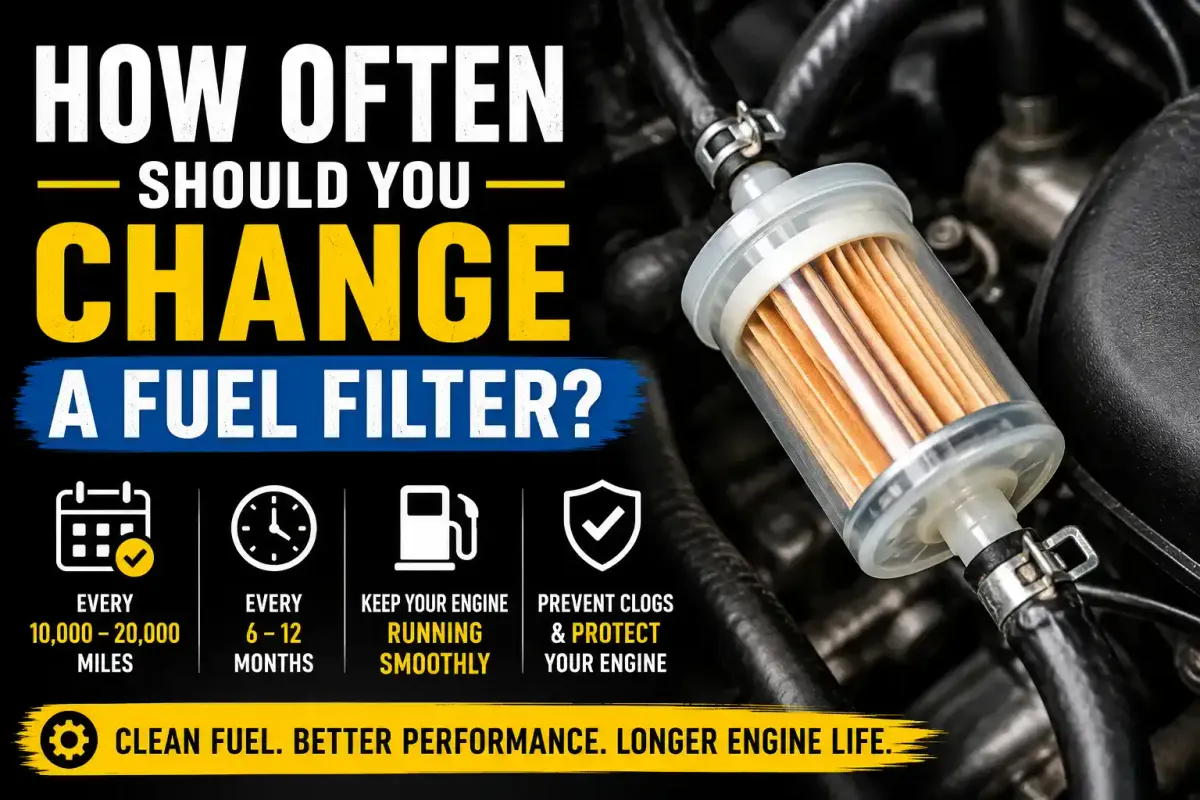
Most vehicles with a serviceable inline fuel filter need it replaced every 20,000 to 30,000 miles. Diesel trucks with external filters typically follow a tighter schedule: every 15,000 to 22,500 miles. If your car's owner's manual lists no fuel filter interval, your vehicle likely has an in-tank integrated filter that is not routinely replaced.
How Often Should You Change a Fuel Filter?
The honest answer depends on whether your vehicle even has a serviceable filter. Two distinct categories exist.

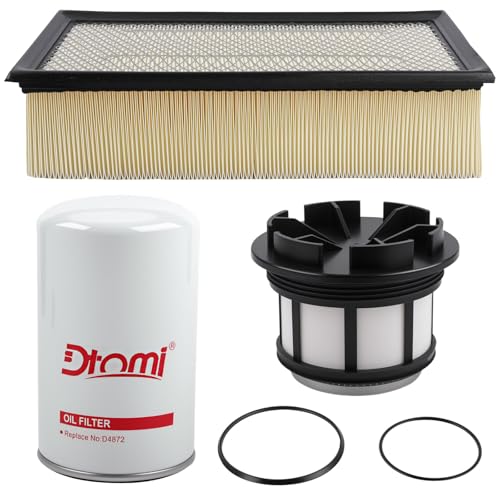

External inline filters are the traditional design. They sit in the fuel line somewhere between the tank and the engine, accessible without dropping the fuel tank. These have a real service interval, and they need to be replaced on schedule.
Integrated in-tank filters are built into the fuel pump module inside the tank. Most manufacturers call them "lifetime" filters, meaning they are not listed in the maintenance schedule at all. On these vehicles, the filter is only addressed if the fuel pump is replaced.


The first thing to check is your owner's manual maintenance schedule. If fuel filter is listed with a mileage interval, you have a serviceable external filter. If it is not listed at all, your filter is integrated.
General Replacement Intervals by Fuel Type
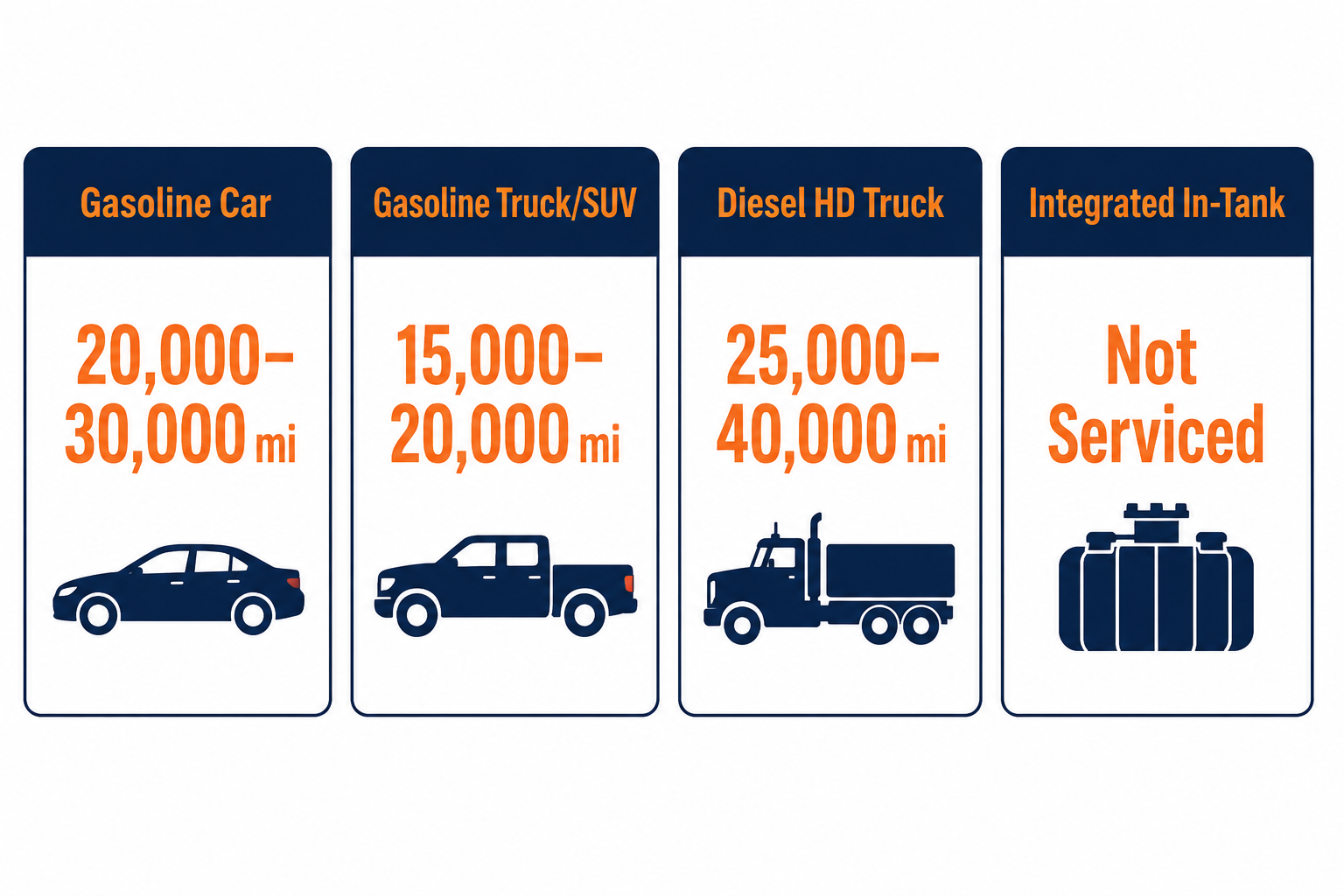
These are general ranges. The owner's manual is always the authoritative source for your specific vehicle.

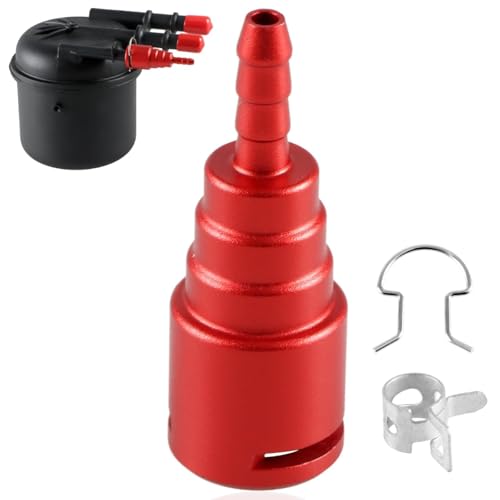

What Interval Does the Manufacturer Recommend?
Manufacturer recommendations vary significantly. Here are the general patterns I found going through common vehicle categories.
Gasoline Vehicles
Older vehicles from the 1990s through early 2000s typically list 20,000 to 30,000 mile intervals. Some older Ford and GM models specified 30,000 miles; many older imports specified 20,000 to 25,000 miles.


From roughly 2000 forward, most gasoline passenger cars switched to integrated in-tank filters. Toyota, Honda, Nissan, and most Japanese manufacturers made this transition early. When they did, fuel filter disappeared from the maintenance schedule entirely.
American trucks and some European brands retained external filters longer. Many full-size truck platforms from GM, Ford, and Ram used external inline filters well into the 2010s.


Diesel Trucks
Diesel systems require more frequent filtration maintenance. The three major HD truck platforms follow similar patterns.
Ford Super Duty (Power Stroke diesel): The 6.7L Power Stroke specifies changing both fuel filters every 22,500 miles under normal driving conditions. Under severe service or biodiesel use, Ford shortens this to 15,000 miles.
Ram HD (Cummins diesel): Ram specifies changing the fuel filter every 15,000 miles on the 6.7L Cummins under normal conditions, or when the instrument cluster prompts a fuel filter service message.
GM HD (Duramax diesel): The Duramax diesel specifies a 22,500-mile fuel filter replacement interval on most model years from 2011 onward. Earlier 2001–2010 models used a 15,000-mile interval.
These intervals assume clean diesel fuel from reputable stations. Shorter intervals apply if you regularly use untreated diesel, fuel from questionable sources, or if you notice increased water-in-fuel warning lights.
How Does Driving Conditions Affect the Interval?
Manufacturers set their base intervals assuming normal driving conditions. If your driving falls into what most manufacturers define as "severe service," you should shorten the interval.
What Counts as Severe Service for Fuel Filter Replacement?
Poor fuel quality. If you regularly fuel up at stations with older underground storage tanks, buy fuel in regions known for water contamination in the supply chain, or notice sediment in the fuel, your filter is loading up faster than the standard interval assumes.
Off-road driving. Dust and dirt that enters through the fuel cap during off-road refueling or in dusty environments can accelerate filter loading.
Towing and hauling. Heavy towing does not directly affect how fast the filter loads with particles, but it increases the demand on the fuel system. A filter that might be at 60% capacity under normal conditions can cause noticeable symptoms sooner on a truck under heavy tow load.
Diesel with water accumulation. Diesel trucks in humid climates, or those that sit for extended periods, accumulate water in the filter faster. Drain the water separator more frequently in these conditions.
Older vehicles. Rust and tank corrosion increase with vehicle age. An older vehicle fueling from an aging steel tank produces more filter-loading rust scale than a newer vehicle with a plastic tank.
A reasonable rule for severe service: cut the standard interval by 25 to 30 percent and inspect the filter at that point.
How Do You Know If Your Car Has a Serviceable Fuel Filter?
This is the question most drivers skip, and it determines everything else.
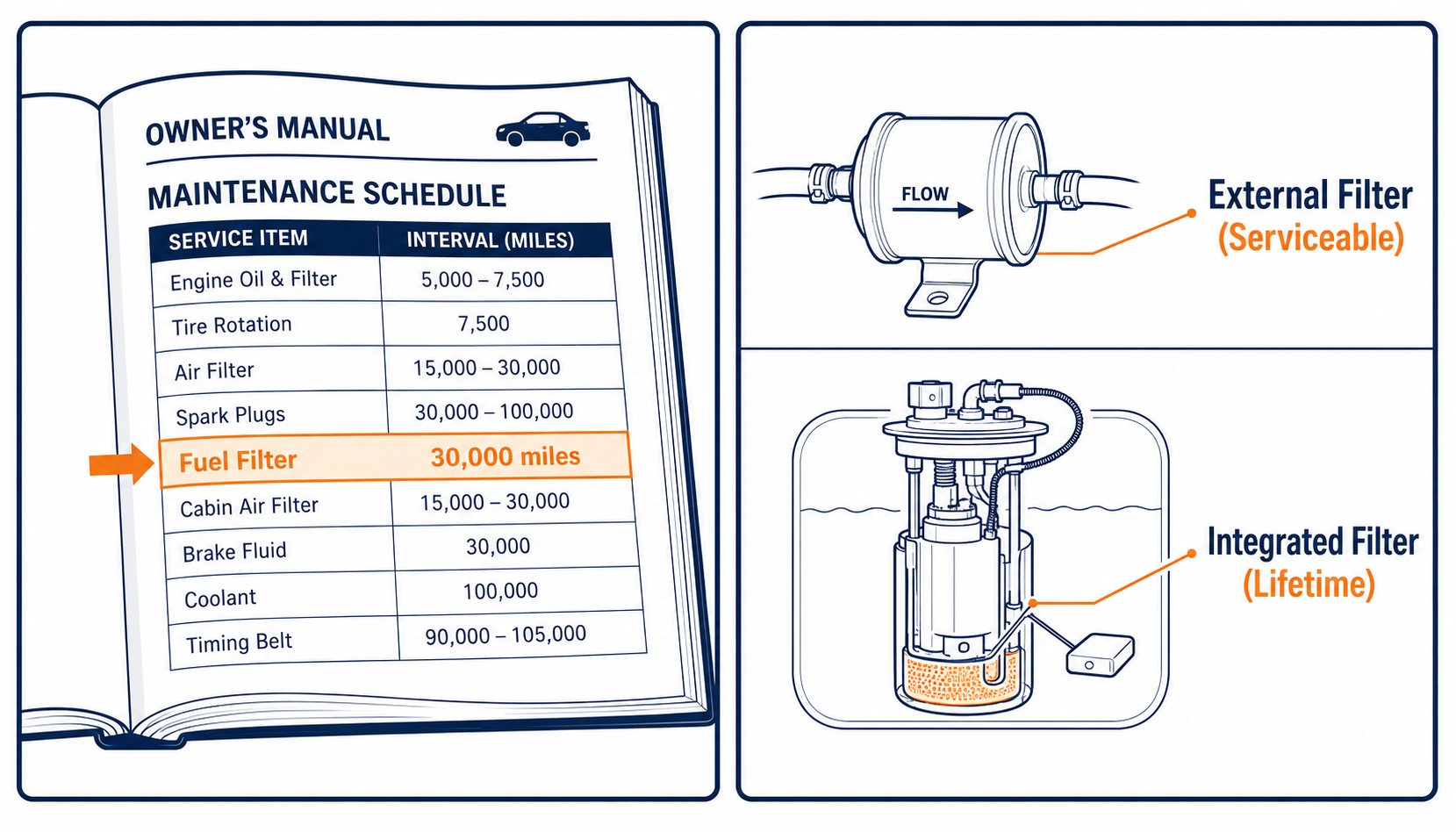
Check the Owner's Manual Maintenance Schedule
Open the maintenance section of your owner's manual. Look for "fuel filter" in the scheduled service items. If it is listed with a mileage interval, your vehicle has an accessible external filter. If it is not there at all, your filter is integrated into the fuel pump module.
Check the Vehicle's Age and Type
As a general guideline, most vehicles from the mid-2000s forward that are standard gasoline passenger cars will not have a serviceable external filter. Most heavy-duty diesel pickups built to the current day will have one. European brands often retained external filters longer than Japanese or American passenger cars.
Look Under the Vehicle or Under the Hood
On vehicles with external inline filters, the filter is often visible. Common locations include along the frame rail under the driver or passenger side, under the hood near the firewall, or along the engine bay near the fuel line connections.
It will be a small cylindrical canister, typically two to four inches long, with a fuel line connected at each end.
If you see no such canister anywhere in those locations and your manual lists no interval, the filter is inside the tank.
What Happens If You Go Too Long Without Changing It?
A fuel filter that has reached capacity does not fail cleanly. It degrades performance in a pattern that starts subtle and becomes undrivable.
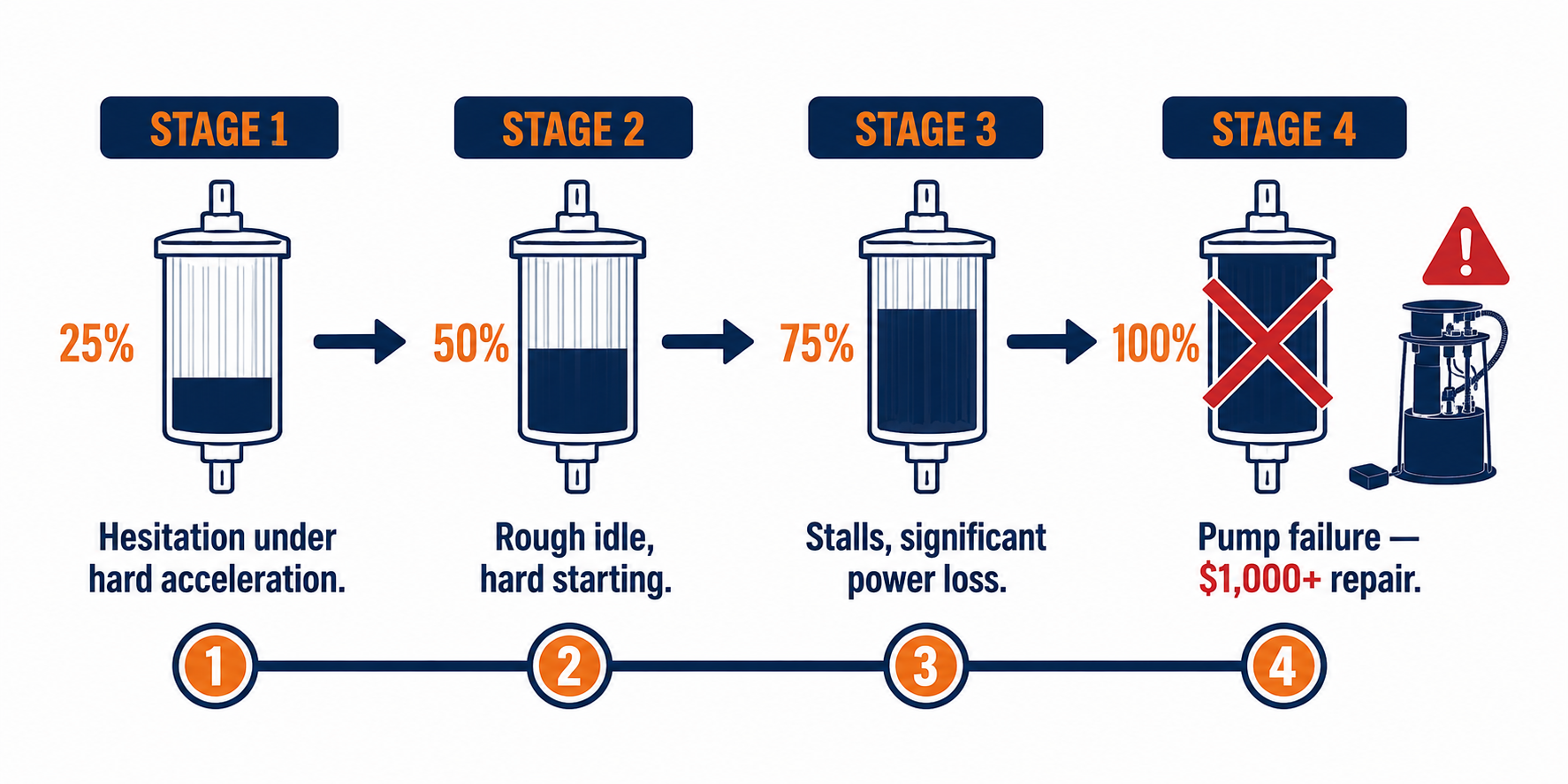
First sign: Hesitation under hard acceleration. The engine has enough fuel at idle and light load but cannot keep up when you open the throttle.
Second sign: Rough idle, slightly hard starting, occasional stumbles at low speed. The restriction is now affecting fueling even when demand is modest.
Third sign: Stalls at stops, difficulty restarting, significant power loss across all driving conditions. At this point the filter is heavily loaded and the fuel pump is working against sustained restriction.
End stage: The pump fails. The fuel pump has to push harder against a clogged element for thousands of miles, and the extra strain shortens its life. Fuel pump failure is an expensive repair: parts and labor on an in-tank pump module typically run $1,000 to $1,500 on most passenger vehicles, and significantly more on trucks.
The connection matters: neglecting a $15 to $30 filter can directly cause a $1,000-plus pump failure. This is the most financially consequential maintenance item most drivers overlook.
Can You Wait If the Car Seems Fine?
Many drivers skip the fuel filter because the car drives normally. The problem is that early-stage restriction does not produce obvious symptoms. The filter can be 50, 60, or even 70 percent loaded with debris and the car will still accelerate, idle, and start without any noticeable issue.
By the time symptoms appear, the filter is already at the point where damage to the fuel pump has likely begun.
The interval exists for a reason. A filter that appears to be working fine may be putting continuous strain on the fuel pump. I would not delay a fuel filter change on a vehicle with a confirmed serviceable external filter just because the driving feel is normal.
The Cost Math
An external inline fuel filter costs $15 to $50 depending on vehicle and brand. Professional installation adds $50 to $100 in labor on most vehicles. Total replacement cost: $65 to $150.
Fuel pump failure costs $1,000 to $1,500 for parts and labor on most vehicles, and significantly more on trucks with larger tank assemblies.
Replacing the filter on schedule is a direct investment against that much larger repair.
How Often Should You Drain the Water Separator on a Diesel Filter?
Diesel fuel filter maintenance has an additional step that gasoline drivers do not think about: draining the water separator.
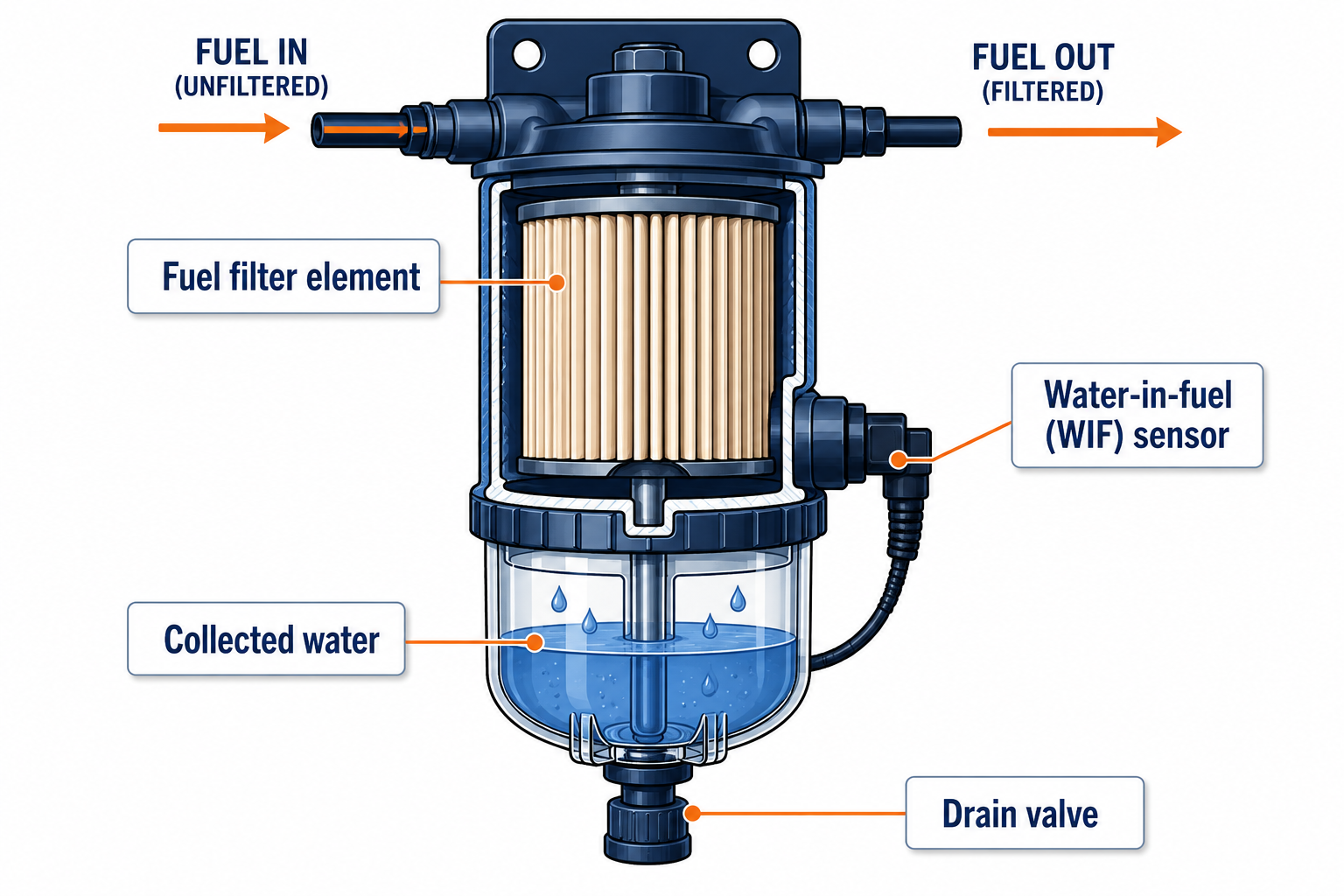
The water separator collects water that settles out of diesel fuel as it passes through the filter. Most diesel trucks have a water-in-fuel (WIF) sensor that triggers a dashboard warning light when the bowl is full. When that light comes on, drain the separator as soon as possible.
In practice, many diesel truck owners drain the separator every 10,000 miles regardless of whether the warning light appears, especially in humid climates where water accumulation is faster. Draining between filter changes is a quick maintenance step that extends filter life and protects injection components.
Do not confuse draining the water separator with replacing the filter. They are two separate tasks.
FAQ
How often should I change my fuel filter?
For vehicles with an external inline fuel filter, change it every 20,000 to 30,000 miles on gasoline vehicles and every 15,000 to 25,000 miles on diesel. Most post-2000 gasoline passenger cars have an integrated in-tank filter that is not routinely replaced. Check your owner's manual maintenance schedule.
Does my car even have a serviceable fuel filter?
Check your owner's manual. If the maintenance schedule lists a fuel filter with a mileage interval, your vehicle has a serviceable external filter. If it is absent from the schedule, the filter is integrated into the fuel pump module inside the tank and is not routinely replaced.
What are the symptoms of a clogged fuel filter?
Hesitation under hard acceleration is the first sign. It progresses to rough idle, hard starting, and stalling. A severely clogged filter will prevent the engine from running. These symptoms overlap with other fuel system problems, so confirming the filter condition is important before assuming it is another cause.
Can a clogged fuel filter damage the fuel pump?
Yes. The fuel pump pushes against the restriction of a clogged filter. That sustained extra load causes premature pump wear. Many fuel pump failures on high-mileage vehicles trace back to a neglected filter. Replacing the filter on schedule is the primary way to protect the pump.
How often should I change a diesel fuel filter?
Most heavy diesel trucks specify every 15,000 to 22,500 miles, though each manufacturer's service manual lists the exact interval. The 6.7L Cummins is typically 15,000 miles, the 6.7L Power Stroke is every 22,500 miles under normal conditions, and the Duramax is 22,500 miles for 2011-and-later models. Shorten these intervals if fuel quality is a concern.
How long does a fuel filter replacement take?
On accessible external inline filters, replacement is a 30 to 60 minute job for a shop. Some filters are more accessible than others. Diesel truck filters under the hood are typically quick. Filters mounted along the frame rail or near the tank take longer.
If you are noticing hesitation, rough idle, or hard starting before reaching your replacement interval, see the clogged fuel filter symptoms guide for a full breakdown of the progression and diagnosis steps.