Cat Fuel Filter Cross Reference Guide



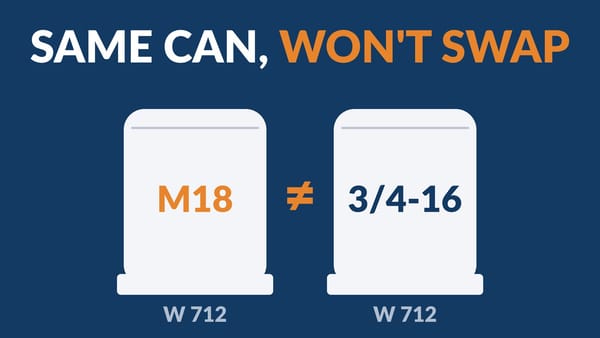
The Cat 1R-0750 is a spin-on secondary fuel filter from Caterpillar's Advanced Efficiency line. Caterpillar's own filter publication puts that line at 5 to 10 microns absolute and says secondary fuel filters are typically 4 micron absolute, removing more than 98% of particles that size and larger. The 2 micron figure attached to this filter all over the internet is a nominal rating from other brands' catalogues, measured on a different scale from Caterpillar's.
The 1R-0750 is probably the most cross-referenced diesel fuel filter in existence, partly because pickup owners fit it to engines Caterpillar never built. That popularity is also why its cross reference data is such a mess: the numbers that circulate for it do not all agree, and the filtration figure most people quote has no manufacturer behind it.


As an Amazon Associate we earn from qualifying purchases.
What Cat's Fuel Filter Efficiency Tiers Actually Mean
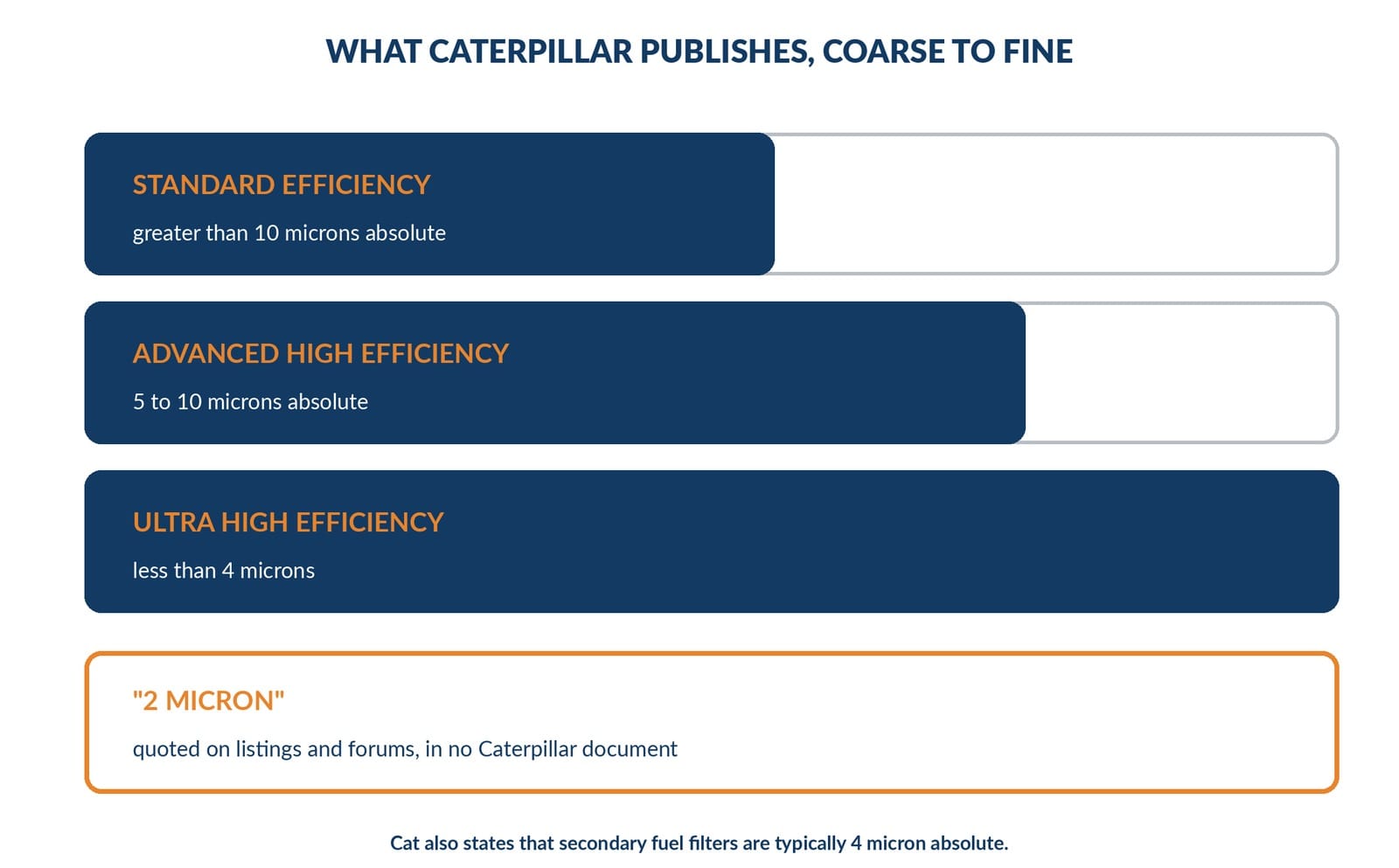
Caterpillar sorts its fuel filters into three efficiency levels, and its filter recommendations publication states each one:
| Cat efficiency level | Rating as Caterpillar states it |
|---|---|
| Standard Efficiency | greater than 10 µm absolute |
| Advanced High Efficiency | 5 to 10 µm absolute |
| Ultra High Efficiency | less than 4 µm |
The same document says primary filters may be Standard or Advanced Efficiency, while secondary filters should be Advanced High Efficiency, with Ultra High Efficiency required in harsh applications.
It also states that secondary fuel filters are typically 4 micron absolute and remove more than 98% of all particles 4 microns and larger until restriction becomes excessive. Those two statements sit in the same publication and are not quite the same claim, so the honest reading is a range: a Cat secondary filter is in the single-digit micron band, at the fine end of it, and Caterpillar does not publish a beta ratio to pin it down further.
So Is the CAT Fuel Filter a 2 Micron Filter?
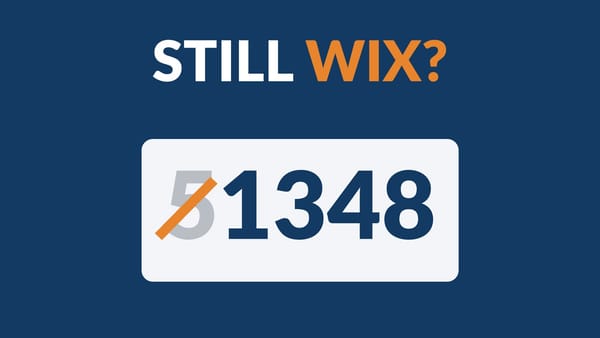
Not in Caterpillar's terms. The 2 micron figure comes from other manufacturers' catalogues, where it is a nominal rating: WIX publishes 2 micron nominal for the 33528 that crosses to this filter. Caterpillar's table is written in absolute terms, and the two scales do not compare.
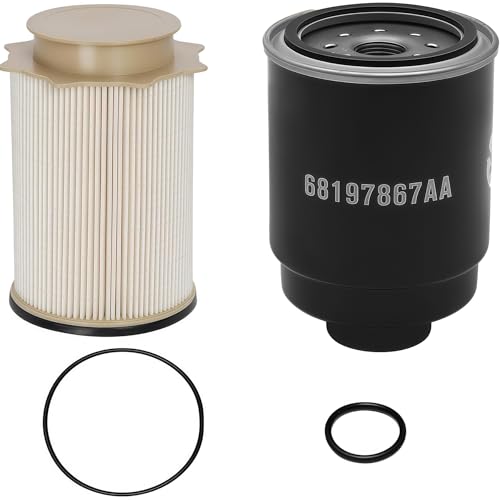
Caterpillar's parts catalogue lists the 1R-0750 as an Advanced Efficiency Secondary Fuel Filter, a spin-on with out-to-in flow, 3.374 inches in diameter and 7.146 inches long. Nothing in that listing states a micron rating either.
A nominal 2 micron rating and an absolute 5 to 10 micron rating can describe the same filter. Dropping the word nominal is what turns them into an argument.
If you are choosing a filter by rating, the fuel filter micron rating guide explains why a nominal number from a seller and an absolute number from a manufacturer are not comparable in the first place.
What the 1R-0750 Crosses To
Baldwin's current quick cross reference, published as Form 570, gives a complete row for its equivalent:
| Brand | Part number |
|---|---|
| Baldwin | BF7633 |
| Donaldson | P551740 |
| Fleetguard | FF5320 |
| Fram | P8334 |
| Luber-finer | LFF3347 |
| WIX | 33528 |
That row comes straight from Baldwin's own cross reference chart, which is the strongest single source available for this filter, and it is the row I would work from.
The Numbers That Disagree
Here is where it gets interesting, and where every page that publishes one tidy chart is hiding something.
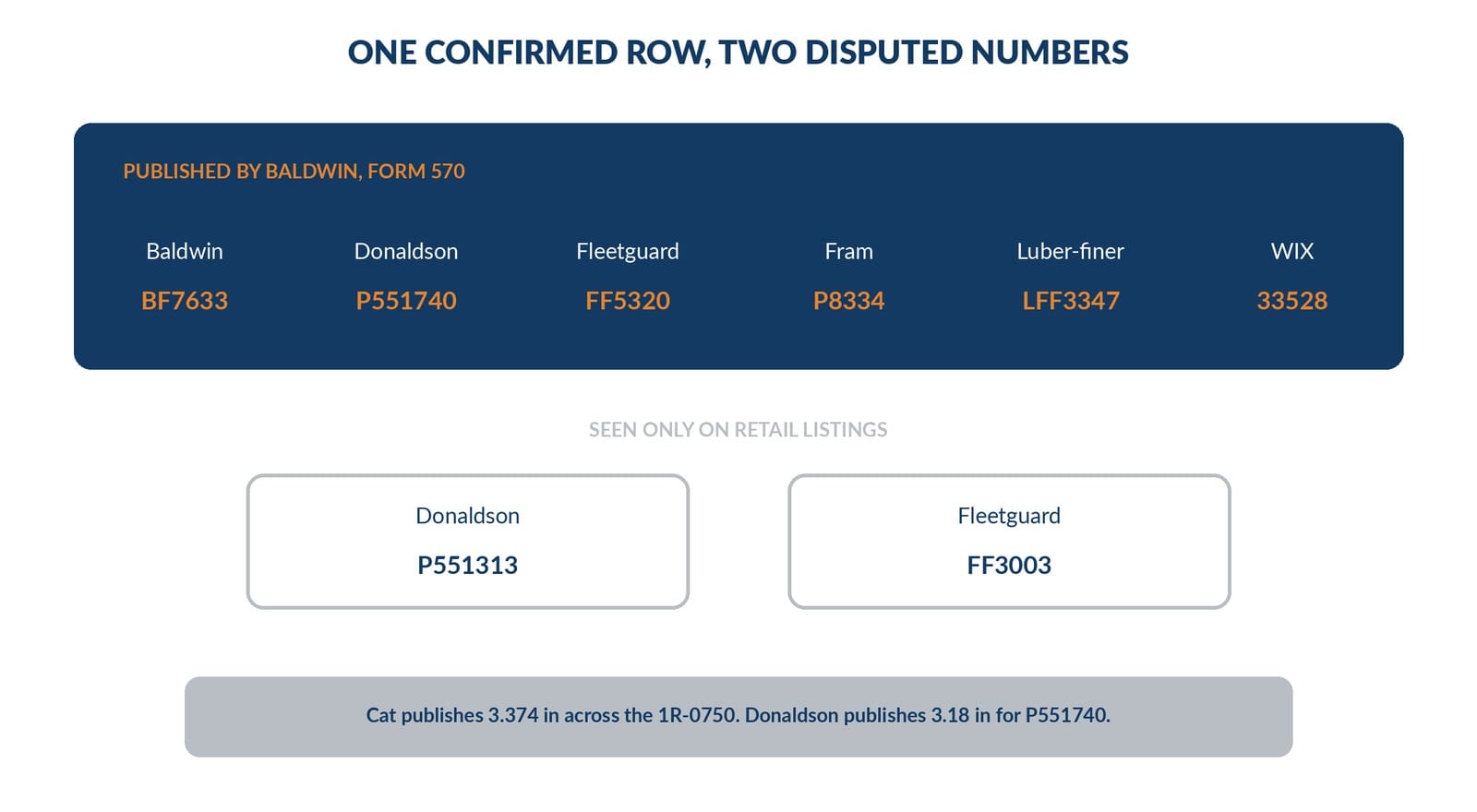
Baldwin's chart pairs BF7633 with Donaldson P551740. Retail listings for the same Baldwin filter routinely name Donaldson P551313 instead, and at least one seller lists Fleetguard FF3003 where Baldwin's chart says FF5320.
Dimensions add a second question. Caterpillar publishes a 3.374 inch diameter for the 1R-0750. Donaldson's published outside diameter for P551740 is 3.18 inches, which is not the same filter envelope, and no manufacturer document I could find states the Cat number and the Donaldson number together.
What that means in practice: treat the Baldwin row as the confirmed interchange, treat the Donaldson and Fleetguard alternatives as unresolved, and measure the filter you are replacing before you buy any of them. The fuel filter cross reference guide covers the specifications a chart never confirms for you.


As an Amazon Associate we earn from qualifying purchases.
Primary and Secondary Cat Filters Are Not the Same Job
On Cat machines the primary filter sits ahead of the transfer pump and is often a combined filter and water separator, while the secondary filter is the fine one protecting the injection system.
Cat allows Standard or Advanced Efficiency in the primary position and expects Advanced High Efficiency or better in the secondary position. Crossing a secondary number into a primary housing, or the reverse, is the most common way this goes wrong, even when the thread matches.
If your primary filter has a bowl, it also has a drain, and the water draining procedure matters more than the filter brand does.
When Caterpillar Considers the Filter Restricted
There is a number for this, and it is more useful than any service interval. Caterpillar states that a secondary fuel filter is typically restricted when it reaches 10 psi delta pressure across the filter.
The same publication sets the fuel cleanliness Cat expects: ISO 18/16/13 or cleaner with water content of 0.05% or less reaching the engine filters, which are designed as the final cleaning step rather than the only one.
Those two figures together explain most field complaints. A filter fed dirtier fuel than that standard hits 10 psi early, and the engine starts showing the symptoms of a clogged fuel filter well before the replacement interval is up.


As an Amazon Associate we earn from qualifying purchases.
Counterfeits Are a Real Problem With This Part Number
Because the 1R-0750 sells in enormous volume outside Caterpillar's own market, it attracts fakes. Caterpillar's filter publication warns that counterfeit or look-alike products can appear identical to the genuine part while performing far worse, and that failures caused by non-Cat filters are not covered by Caterpillar warranty.
The practical defence is buying through a Cat dealer or authorised outlet, or buying a named aftermarket equivalent such as the Baldwin, Fleetguard or WIX number above from a supplier that stands behind it. A no-name filter in Cat-yellow packaging at an unusual price is the pattern to avoid.
Frequently Asked Questions
What micron is the Cat 1R-0750 fuel filter? Caterpillar does not publish a micron rating for the individual part. Its filter publication places the Advanced Efficiency line at 5 to 10 microns absolute and says secondary fuel filters are typically 4 micron absolute, removing over 98% of particles at that size. The widely quoted 2 micron figure is a nominal rating published by other brands, not a Caterpillar specification.
What is the Baldwin equivalent of the Cat 1R-0750? Baldwin's BF7633. Baldwin's own cross reference chart lists that filter against Donaldson P551740, Fleetguard FF5320, Fram P8334, Luber-finer LFF3347 and WIX 33528. Retail listings sometimes name different Donaldson and Fleetguard numbers, which is why measuring the old filter is worth the two minutes.
Is the Cat fuel filter better than the OEM filter on my truck? Caterpillar publishes efficiency tiers rather than per-part ratings, and most pickup OEMs publish nothing comparable, so there is no like-for-like comparison to make. Fitting any filter outside its intended application also puts the housing, thread and pressure rating on you rather than on either manufacturer.
What is the difference between a primary and secondary Cat fuel filter? The primary filter sits before the transfer pump, is often combined with a water separator, and may be Standard or Advanced Efficiency. The secondary filter sits after the pump, protects the injection system, and Caterpillar expects Advanced High Efficiency or Ultra High Efficiency there.
When should a Cat fuel filter be changed? Caterpillar treats 10 psi of pressure drop across a secondary filter as the point at which it is restricted. That is a condition rather than a mileage, which is why fuel quality changes the real interval so much.
What to Do Next
Before ordering any cross-referenced replacement, measure the filter you are taking off: thread, gasket diameter, body diameter and length. Then match it against the Baldwin row above rather than a seller's listing, and keep the position in mind, since a secondary filter and a primary water separator are different parts doing different jobs.