FASS Fuel Filter Cross Reference Guide



FASS publishes its own cross reference sheet, and it works differently from every other brand's. It does not map one FASS number to one equivalent. It lists alternatives grouped by micron rating, from 2 micron up to 14 micron, on the same 1-14 inch thread, and tells you to treat all of them as emergency parts rather than replacements.
A FASS system carries two spin-on filters, and the pair is the whole point of the product: one separates water, the other catches particulates, and the pump sits between the tank and the engine's own filtration. Cross referencing them is less about finding a match and more about deciding what filtration level you are willing to run.


As an Amazon Associate we earn from qualifying purchases.
Which FASS Filter Goes Where
FASS groups its replacement filters into three families on its cross reference sheet.
| FASS family | Part numbers | Thread |
|---|---|---|
| Water separator | FF-3003, FF-3010, XWS-3002, XWS-3002XL | 1-14 in |
| Fuel filter | FS-1001, FS-1020, PF-3001, PF-3001XL | 1-14 in |
| HD series fuel filter | FF1003, XWS-1002 | 1 1/2-16 in |
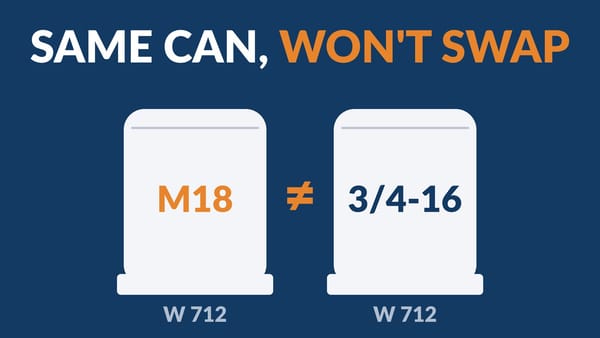
The XL numbers are the longer-bodied versions used on the XL systems, and the HD series uses a completely different thread, so an HD filter and a Titanium filter are not interchangeable even though both are FASS parts.
Because a FASS mounts ahead of the engine, its filters do not replace the factory fuel filter. They sit upstream of it, which is why the position of a filter relative to the pump matters more here than on a stock truck.
FASS Cross References by Micron, Not by Part
Open FASS's filter cross reference sheet and you will not find a one-to-one table. The water separator section lists alternatives in bands: a 2 micron group, a 3 micron group, a 4 micron group, a 6 micron group, a 9 to 10 micron group with drains, and a 14 micron group. The fuel filter section runs from 10 to 14 micron up to 20 micron.
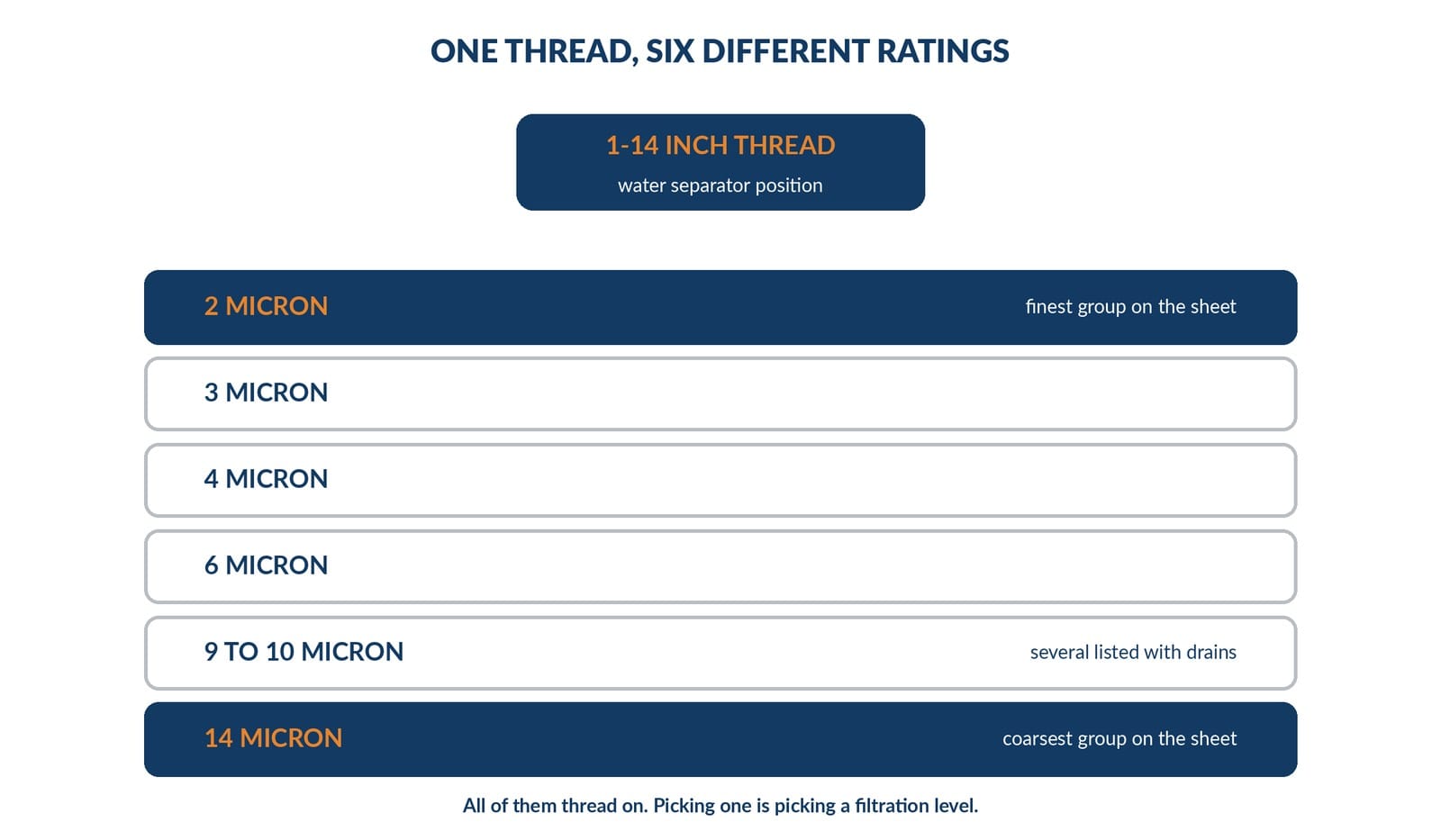
Every filter in those bands shares the 1-14 inch thread. Nothing else about them matches.
A list where the alternatives span 2 to 14 microns is not an equivalence table. It is a menu, and choosing from it means choosing a filtration level yourself.
That is the single most important thing to understand about cross referencing a FASS filter. The fuel filter micron rating guide explains what moving between those bands does to flow and to injector protection.
What the 2 Micron Group Contains
The finest water separator group on the sheet lists Baldwin BF7633, Carquest 86528, CAT 1R-0750, Wix 33528 and Wix 33674, among others.
That is the same interchange family covered in the Cat fuel filter cross reference, which matters for a reason FASS's sheet does not mention, covered in the next section.


As an Amazon Associate we earn from qualifying purchases.
FASS Says to Use the Alternatives for Emergencies Only
This is printed on the sheet itself, and it is unusually direct for a manufacturer cross reference:
Through 3rd party and field testing, we have found that no other filter removes water or particulates as effectively as the FASS Filters. We recommend our cross-reference filters for emergency use only.
Read that as the manufacturer declining to warrant the substitutes rather than as a technical finding, since no test data accompanies it. The practical effect is the same either way: FASS publishes the list so you can keep a truck moving, not so you can run a different filter permanently.
Two Manufacturer Documents Disagree, and It Matters
FASS's sheet labels CAT 1R-0750 as a 2 micron filter. Caterpillar's own filter publication does not support that number. Caterpillar sorts its fuel filters into Standard, Advanced High Efficiency and Ultra High Efficiency tiers, places Advanced at 5 to 10 microns absolute and Ultra High below 4 microns, and catalogues the 1R-0750 as an Advanced Efficiency secondary filter.
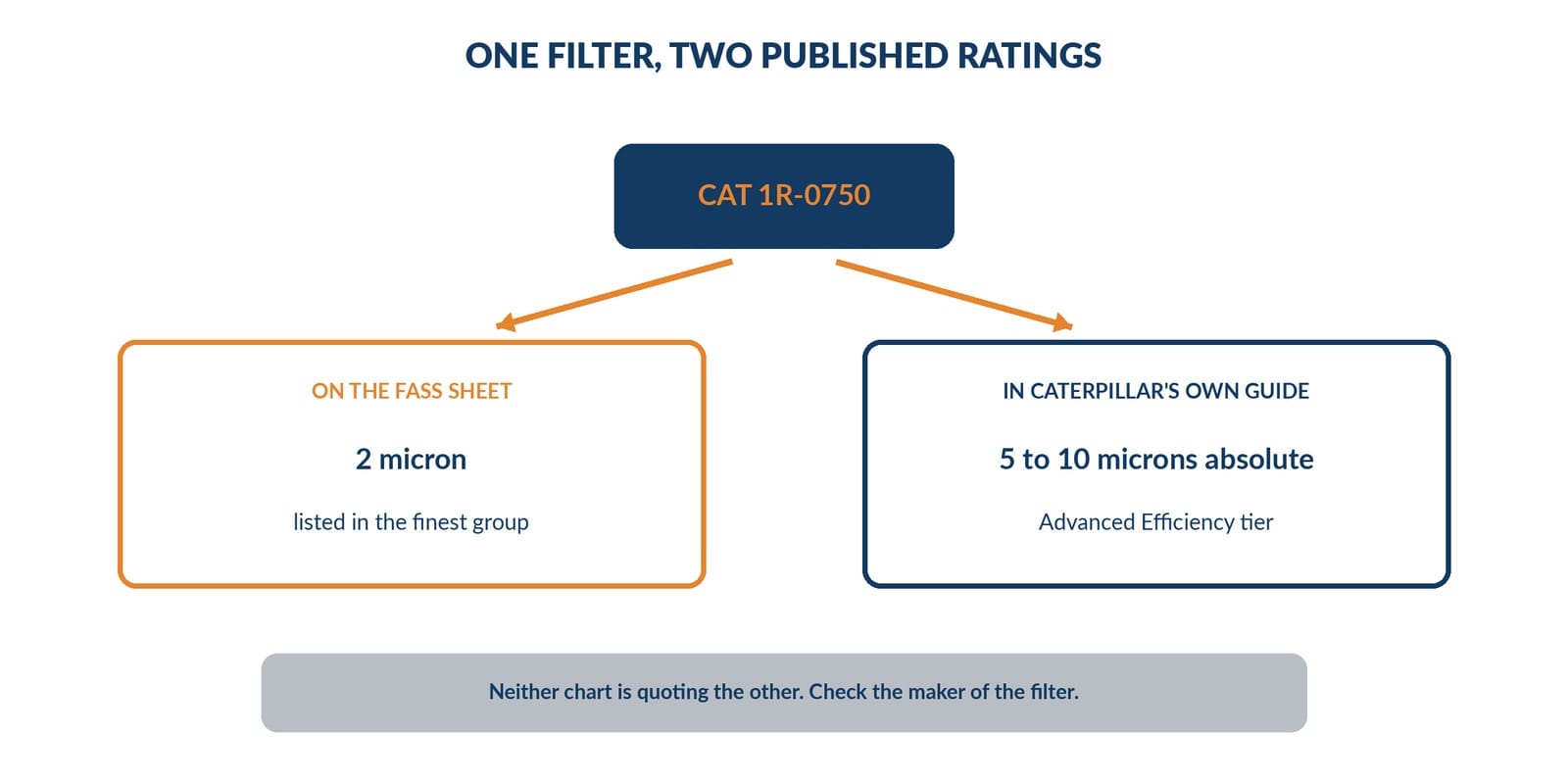
So the 2 micron figure that follows that Cat filter around the internet turns out to be printed on other manufacturers' charts, where it is a nominal rating. Caterpillar's own tiers are stated in absolute terms, and the WIX catalogue shows the same split, so the two numbers are different scales rather than a straight contradiction.
There is a second discrepancy on the same page. FASS lists FF5320 and P8334 as Donaldson numbers. Baldwin's own current quick cross reference puts those same numbers under Fleetguard and Fram respectively, with Donaldson's equivalent in that row being P551740.
What to do with that: treat the micron bands on the FASS sheet as FASS's opinion of where each alternative sits, and confirm the brand and the rating in that brand's own catalogue before buying. Two charts disagreeing is the normal state of fuel filter interchange data, which the fuel filter cross reference guide covers in general terms.
What FASS Does Not Publish
The sheet names FASS's own filters as section headings and then lists only other brands in the columns. It never states the micron rating of the XWS-3002, the PF-3001, the FS-1001 or the FF-3003.
The 2 micron and 3 micron figures attached to those parts across the internet come from retailer listings, not from FASS. If you need a documented rating for a compliance or warranty reason, that gap is worth knowing about before you quote a number to anyone.


As an Amazon Associate we earn from qualifying purchases.
Choosing a Substitute Without Guessing
- Match the thread first. 1-14 inch for Titanium and Signature series filters, 1 1/2-16 inch for HD series. A filter from the wrong family will not thread on.
- Match the body length. XL systems use the longer XL filters, and a short filter in an XL housing changes capacity, not just fitment.
- Pick the micron band deliberately, rather than taking the first number on the sheet. Finer restricts flow, coarser passes more through to the engine's own filter.
- Keep the drain if your position has one. Several entries in the 9 to 10 micron group are listed with drains, which is what makes draining water possible without pulling the filter.
- Go back to FASS parts at the next service. The sheet's own wording makes the substitutes a stopgap, and the replacement interval is when to close that loop.
Frequently Asked Questions
What micron are FASS filters? FASS does not state a micron rating for its own filters on its cross reference sheet. The 2 micron and 3 micron figures widely quoted for the XWS-3002 and PF-3001 come from retail listings rather than from FASS, so treat them as seller-stated until FASS publishes otherwise.
Can I use a CAT 1R-0750 in place of a FASS filter? FASS lists it in the 2 micron water separator group on its own sheet, so it fits the thread. Caterpillar places that filter in its Advanced Efficiency tier at 5 to 10 microns absolute rather than at 2 microns, so the two manufacturers do not agree on what you would be fitting.
What is the difference between the FASS water separator and the fuel filter? They occupy different positions on the pump. The water separator removes water and coarse debris, the particulate filter handles fine contamination, and FASS assigns different part numbers and different cross reference bands to each. Swapping them is not a like-for-like change.
Are FASS XL filters different from standard FASS filters? Yes. The XL parts, such as XWS-3002XL and PF-3001XL, are longer bodies for XL systems. They share the 1-14 inch thread with the standard filters but hold more, so a standard filter in an XL housing gives up capacity.
Is it safe to run a non-FASS filter permanently? FASS recommends its cross reference filters for emergency use only. No test data accompanies that statement, so it reads as the manufacturer declining to warrant substitutes rather than as evidence they fail. Either way, a permanent swap is your call rather than a documented equivalence.
What to Do Next
Before ordering anything from the cross reference sheet, write down which position you are replacing, the thread, the body length and the micron band you intend to run. A FASS filter number tells you none of that on its own, and the sheet will happily offer you a 14 micron filter where a 2 micron one was.