Engine Air Filter Cross Reference & Lookup Guide

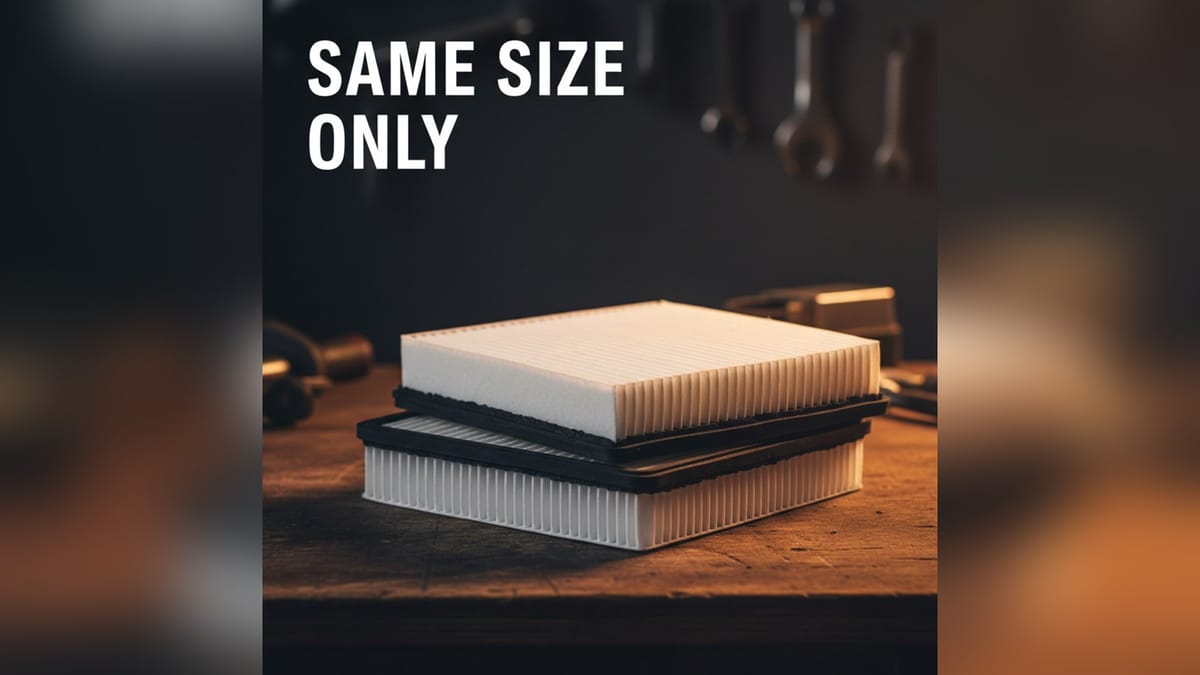


An engine air filter cross reference matches a shape: the panel's length, width and depth, and the seal that presses against the airbox lid. It does not match filtration, because almost no brand publishes an efficiency figure for a passenger car air filter. Fitment is the easy half.
Oil and fuel filters cross by thread. Air filters cross by outline, which sounds easier until you realise the chart has no way of telling you whether the replacement seals properly once the lid is clipped down.


As an Amazon Associate we earn from qualifying purchases.
What an Engine Air Filter Cross Reference Matches
Three things, all geometric: the outline of the panel, its depth, and the shape of the sealing edge. A filter that matches all three in a round or conical housing also has to match the inner diameter where it registers.
That is why the interchange tables for air filters are reliable in one narrow sense and useless in another. They will tell you that six brands make a filter the same size as yours. They will not tell you what it stops.
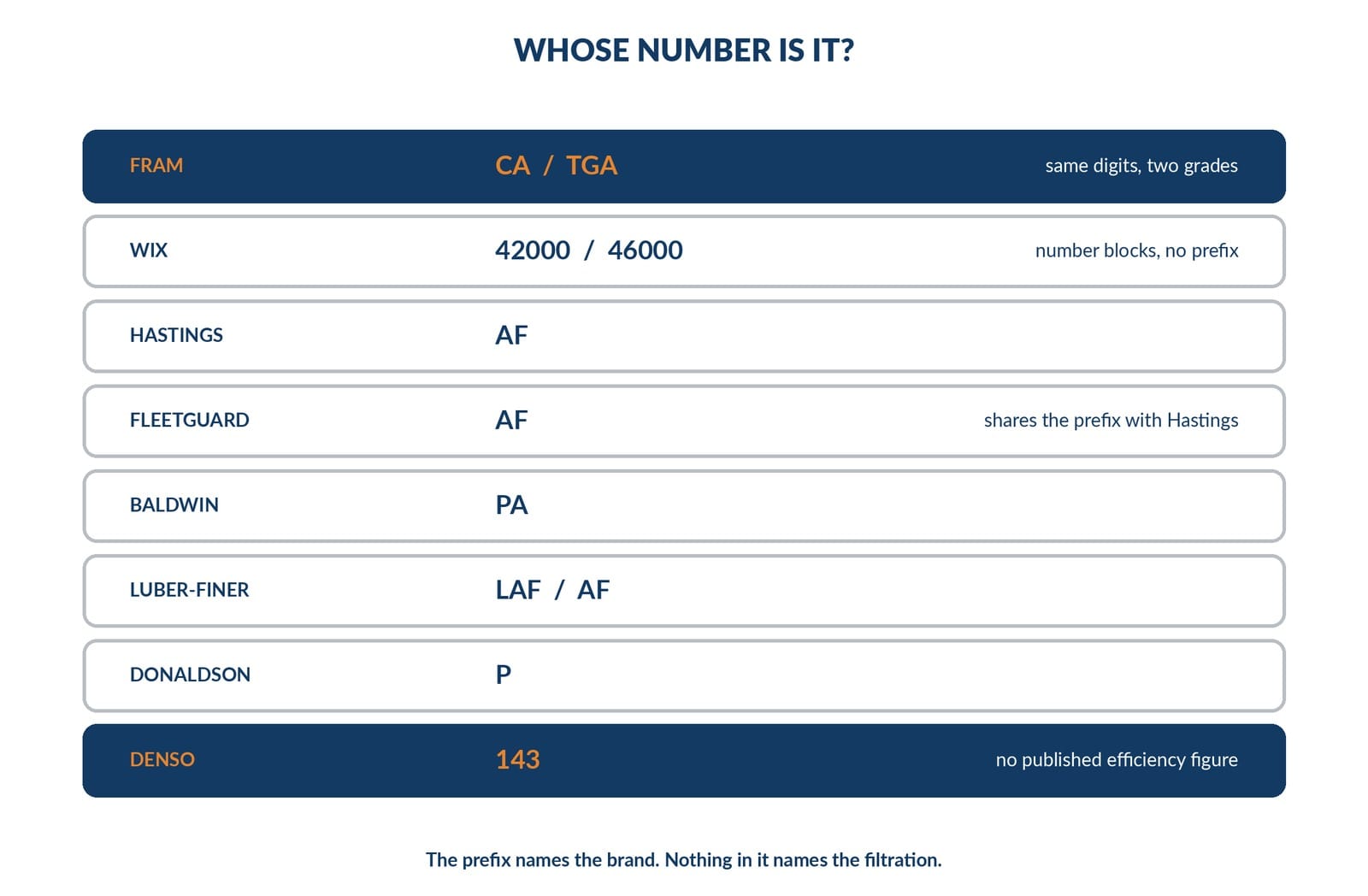
Brands publish this data under their own numbering, and the blocks are easy to recognise once you have seen them:
| Brand | Air filter numbering |
|---|---|
| FRAM | CA for Extra Guard, TGA for Tough Guard |
| WIX | 42000 and 46000 blocks |
| Hastings | AF prefix |
| Baldwin | PA prefix |
| Fleetguard | AF prefix |
| Luber-finer | LAF and AF prefixes |
| Donaldson | P prefix |
Denso uses a 143 prefix on its aftermarket air filters, which is the brand most often searched alongside this topic and the one with the least published specification behind it.
FRAM Numbers Follow the Same Digit Rule as Its Oil Filters
Worth knowing because it saves a lookup. FRAM's CA10262 and its Tough Guard sibling TGA10262 are both published at 1.872 inches high, 10.470 long and 9.929 wide. Identical dimensions, identical digits, different media: cellulose in the Extra Guard, a cellulose and synthetic blend in the Tough Guard.
Swap the letters, keep the digits, and the fitment holds. It is the same rule the FRAM oil filter cross reference runs on, and the air line inherits it.
A Verified Multi-Brand Row
Baldwin publishes a quick cross reference that sets seven air filter brands side by side, which is the strongest single source on this topic. Its air filter table runs Hastings, Baldwin, Donaldson, Fleetguard, Fram, Luber-finer and WIX across one row.
Two rows from it, exactly as printed:
| Column | Row one | Row two |
|---|---|---|
| Hastings | AF2 | AF145 |
| Baldwin | PA613 | PA2008 |
| Donaldson | P607225 | PPP524355 |
| Fleetguard | AF1667 | AF400 |
| Fram | CA161PL | TGA326 |
| Luber-finer | LAF2 | LAF348 |
| WIX | 42030 | 42098 |
Note what happens in the FRAM column. One row lands on a CA number with a PL suffix, the next on a TGA number, so even within one chart the FRAM entries come from different product lines. The digits do not line up across brands either, which is the normal state of filter interchange and the reason a chart is a starting point rather than an answer.


As an Amazon Associate we earn from qualifying purchases.
What Nobody Publishes
Here is the gap that matters more than any chart. Pull the spec sheets for passenger car air filters and the efficiency figures are not there.
FRAM's product pages for both the CA and TGA numbers above list dimensions, media type, shape and flexibility, and no efficiency rating or dust-holding capacity at all. Denso describes three successive layers of media and precision-molded seals that eliminate bypass, with high airflow, superior dust holding capacity and maximum efficiency, and attaches a number to none of it.
Every brand in the aisle claims better filtration. None of them, at this level of the market, publishes the test result.
The standard those claims would be measured against is ISO 5011, which is gravimetric: dust fed in, dust captured, weighed and divided. That test and what its percentages really mean are covered in oil filter vs air filter, and the heavy duty side of the industry does publish to it. The automotive aisle mostly does not.
So when a cross reference offers you six equivalents, the honest position is that you are choosing on price, availability and construction, not on measured filtration.
The Seal Is the Part the Chart Cannot Check
A panel filter does its job only if air cannot go around it. Denso's own description makes the point by naming moulded seals as the thing that eliminates bypass, and bypass is exactly what a slightly-wrong cross reference causes.
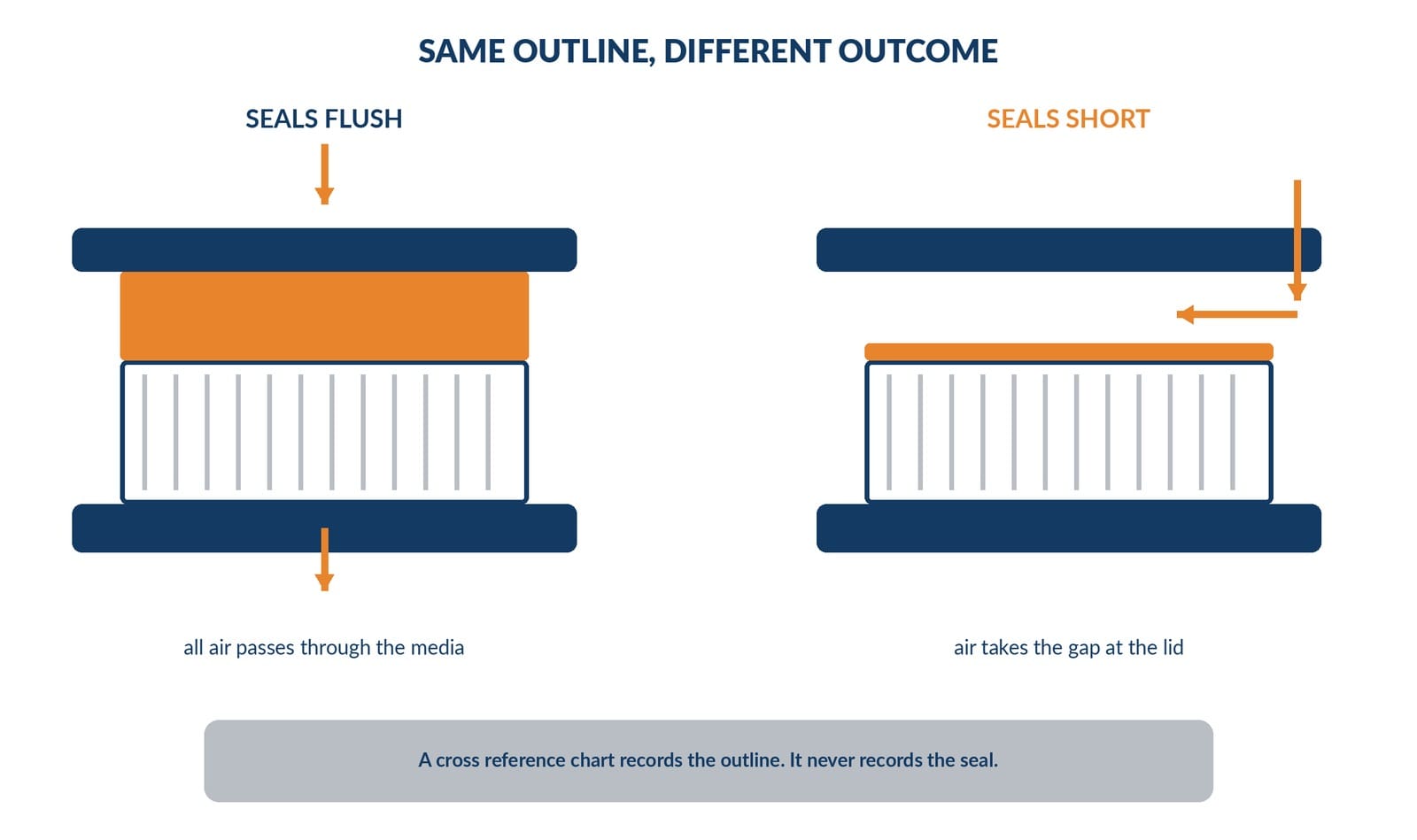
Check three things on the new filter before the airbox closes:
- The sealing edge material and height. Foam, moulded rubber and plain cardboard edges are not interchangeable even at identical outside dimensions.
- Depth. A filter a few millimetres too shallow lets the lid clamp on nothing, and one too deep stops the lid latching square.
- Any locating tabs or cutouts on the frame, which exist because the housing has posts that have to pass through them.
If the lid needs pressure to latch, or latches with a gap at one corner, the filter is wrong no matter what the chart said. Unfiltered air at that corner is doing the damage described in what a dirty or failed air filter does.
Filter Makers and Vehicle Makers Give Different Intervals
One more thing a cross reference will not tell you: the replacement interval moves depending on who you ask.
FRAM states that its Extra Guard air filter protects for up to 12 months or 12,000 miles. Vehicle manufacturers typically schedule the engine air filter much further out, in the range covered by the engine air filter replacement interval guide.
Neither figure is wrong. One is a filter maker's rating for its own product, the other is a service schedule for a specific vehicle in normal conditions. When you cross to a different brand, you inherit that brand's interval, not the one printed on the box you threw away.


As an Amazon Associate we earn from qualifying purchases.
How to Cross Reference an Engine Air Filter Safely
- Start from the vehicle in a manufacturer catalogue rather than from a number. Denso, FRAM, WIX and Baldwin all run vehicle lookups, and Denso's also accepts a competitor part number or a VIN.
- Write down the published dimensions, including depth, before you compare anything.
- Use a manufacturer chart for the interchange, not an aggregator. Baldwin's seven-brand table is the one to reach for first.
- Compare the old filter physically against the new one, edge to edge, before fitting.
- Close the airbox and check the latches seat without force. That final check is the one that matters, and it is the only one the chart was never able to make for you.
Frequently Asked Questions
Do engine air filters cross reference between brands? Yes, by dimensions. Manufacturer charts such as Baldwin's set Hastings, Baldwin, Donaldson, Fleetguard, Fram, Luber-finer and WIX numbers side by side for the same filter. What they confirm is that the panels are the same size and shape, not that they filter to the same standard.
What is the Denso air filter cross reference? Denso runs its own lookup that accepts a vehicle, a Denso number, a competitor part number or a VIN. Denso air filters use a 143 prefix and the company publishes no efficiency percentage or dust capacity figure, describing its three-layer media and moulded seals qualitatively instead.
Is a FRAM CA number the same filter as the TGA number? Same fitment, different media. CA10262 and TGA10262 are both published at 1.872 by 10.470 by 9.929 inches, with cellulose media in the Extra Guard and a cellulose and synthetic blend in the Tough Guard. The digits carry the fitment and the letters carry the grade.
Why do air filter cross references not list efficiency? Because the brands do not publish it at this level of the market. Dimensions, media type and shape appear on the product pages; ISO 5011 efficiency results generally do not. Charts can only carry data that exists, which is why they stop at fitment.
What happens if a crossed air filter does not seal properly? Air bypasses the media and carries dust straight into the intake. That is worse than a dirty filter, because a loaded filter still filters while a bypassing one does not. Check the seal height, the depth and the latch fit before driving.
What to Do Next
Measure the depth of the filter you are removing, not just its outline. Depth and sealing edge are where crossed air filters go wrong, and they are the two numbers the chart in front of you is least likely to have checked.