Oil Filter vs Air Filter: What's the Difference?



An oil filter cleans the engine oil that lubricates the bearings, pistons and camshaft. An engine air filter cleans the air the engine breathes before it reaches the combustion chamber. One filters a liquid under pressure, the other filters air under suction, and they sit in completely different places, wear out on different schedules and fail in very different ways.
People mix these two up constantly, partly because a quick lube shop tends to offer both at the same visit. They are not alternatives to each other. Your engine needs both, and a good one of either cannot make up for a bad one of the other.


As an Amazon Associate we earn from qualifying purchases.
What Is the Difference Between an Oil Filter and an Air Filter?
The oil filter protects the engine's moving parts from what is already inside the engine. The air filter stops dirt from getting inside in the first place.
| Point of comparison | Oil filter | Engine air filter |
|---|---|---|
| What it cleans | Engine oil, a liquid pumped under pressure | Intake air, drawn in by engine vacuum |
| Where it sits | Screwed onto the engine block, or a cartridge in a housing | Inside a plastic airbox under the hood |
| What it catches | Metal wear particles, soot, sludge, dirt that got past the intake | Dust, sand, pollen, insects, road grit |
| How it is rated | Particle count efficiency at a stated micron size | Percentage of test dust captured by weight |
| When it is replaced | At every oil change | Typically every 15,000 to 30,000 miles |
| What a clogged one does | Opens a bypass and sends unfiltered oil to the bearings | Restricts airflow and costs acceleration |
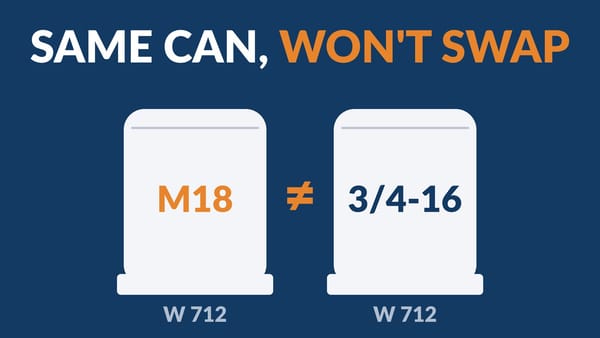
The two are never interchangeable. They share no part numbers, no sizes and no mounting points.
What Does an Oil Filter Do?
An oil filter sits in the lubrication circuit between the oil pump and the engine's bearings. Every drop of oil the pump pushes through the engine passes through its pleated media first.
What it removes is mostly generated by the engine itself: microscopic metal from wearing surfaces, combustion soot that slips past the piston rings, and oxidised oil. It also catches any dirt that entered through the intake, which is where its job connects to the air filter's.
Inside the canister there are two valves the air filter has no equivalent of. An anti-drainback valve holds oil in the filter when the engine is off, and a spring-loaded bypass valve lets oil skip the media if the filter is too restricted to flow.


As an Amazon Associate we earn from qualifying purchases.
What Does an Engine Air Filter Do?
An engine air filter cleans the enormous volume of air a running engine draws in. It is a flat panel or a round element of pleated paper, synthetic or oiled cotton media, clamped inside the airbox ahead of the throttle body.
Its target is abrasive mineral dust. Silica from soil is hard enough to scour cylinder walls and piston rings, and once it is inside the engine it cannot be removed by anything except the oil filter.
A car also has a second air filter that has nothing to do with the engine. That one cleans the air you breathe inside the cabin, and the cabin air filter vs engine air filter comparison covers how to tell them apart.
How Do the Oil Filter and Air Filter Work Together?
The two filters are layers of the same defence, placed in series. The air filter is the first barrier and the oil filter is the last one before the bearings.
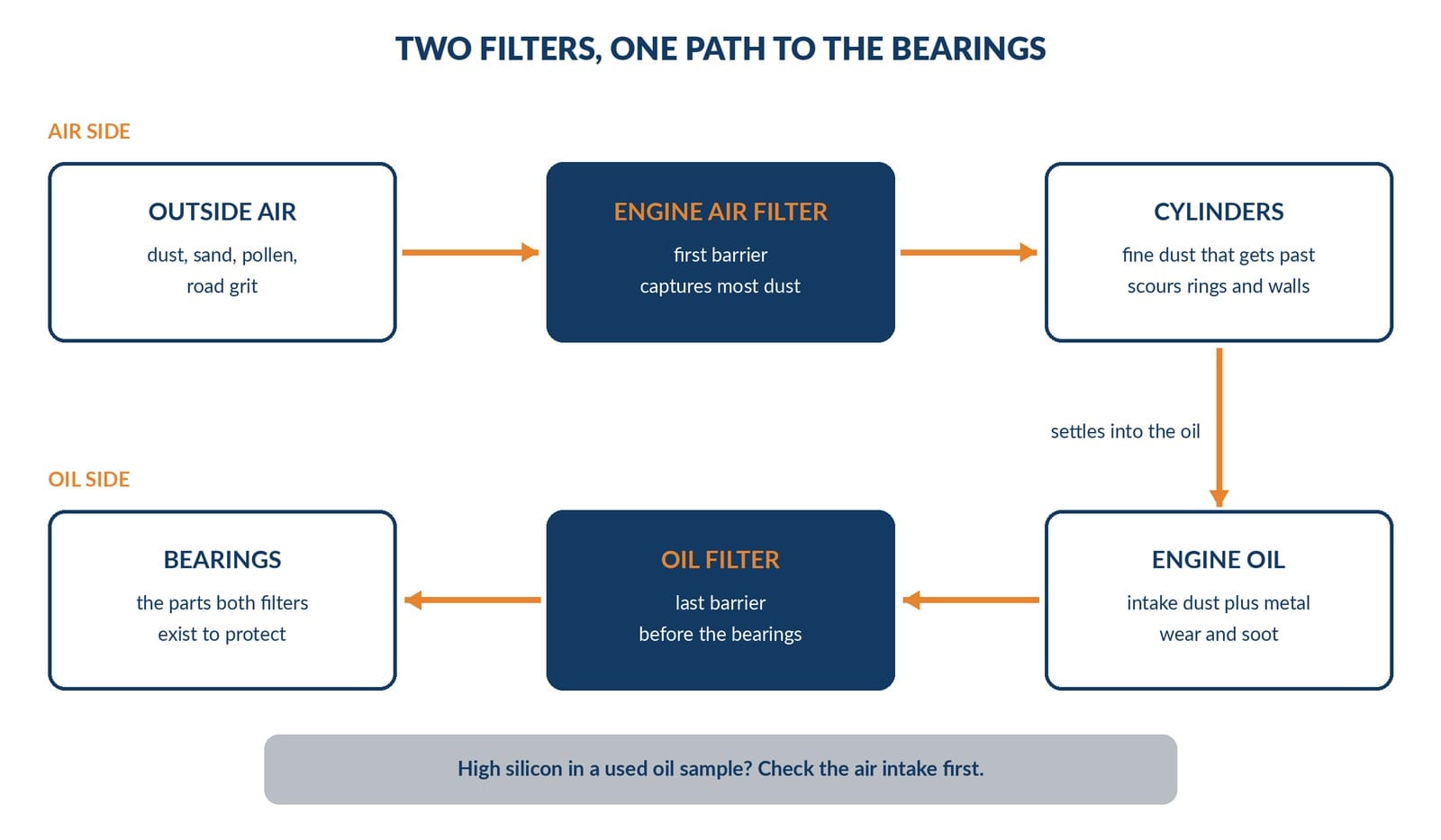
No air filter is perfect. Even efficient air filters that remove 99% of dust let through a remainder of very small particles, from submicron up to over 10 microns, and much of that ends up suspended in the oil. From there, any dust in the oil is pumped through the oil filter before it reaches the bearings.
This is why oil analysis labs use silicon as a dust indicator. A rising silicon reading in a used oil sample usually points upstream, at a torn air filter, a loose airbox clamp or a cracked intake duct, rather than at the oil filter.
A cheap air filter makes the oil filter work harder. A neglected oil filter wastes the protection a good air filter bought.


As an Amazon Associate we earn from qualifying purchases.
How Is Each Filter Rated?
Both filter types advertise efficiency as a percentage, and both numbers often start with 99. They are not measuring the same thing, and comparing them directly is a mistake.
Oil Filter Ratings: Particle Counts at a Micron Size
Oil filters are tested to ISO 4548-12, a multi-pass test with online particle counting. Oil laced with test dust is circulated through the filter repeatedly, and particles of each size are counted upstream and downstream.
The result is a beta ratio: upstream count divided by downstream count at a given size. A beta of 20 equals 95% efficiency and a beta of 200 equals 99.5%. That is why an oil filter claim only means something with a micron size attached, a point the oil filter micron rating guide goes into in detail.
Air Filter Ratings: Dust Captured by Weight
Engine air filters are tested to ISO 5011, which is gravimetric. A known amount of test dust is fed into the filter at a constant rate until it reaches its restriction limit, and efficiency is the weight of dust captured divided by the weight fed in.
Weight-based numbers are dominated by the large, heavy particles, so they climb very high very easily. On that scale Donaldson's cellulose air filters exceed 99.9%, and the difference between 99.0% and 99.9% means ten times more dirt reaching the engine. A 99% air filter and a 99% oil filter are describing entirely different tests.
How Often Should You Replace Each Filter?
The oil filter gets replaced at every oil change, whether that is 5,000 miles on conventional oil or 10,000 on full synthetic. It is not a separate service item.
The engine air filter runs on its own, much longer schedule, typically every 15,000 to 30,000 miles under normal conditions. Gravel roads, construction zones and dry climates shorten that a lot.
So a typical car goes through several oil filters for every air filter. The sensible habit is to replace the oil filter with every oil change and pull the air filter out for a look at the same visit, replacing it only when it is visibly loaded.
What Happens When Each Filter Clogs?
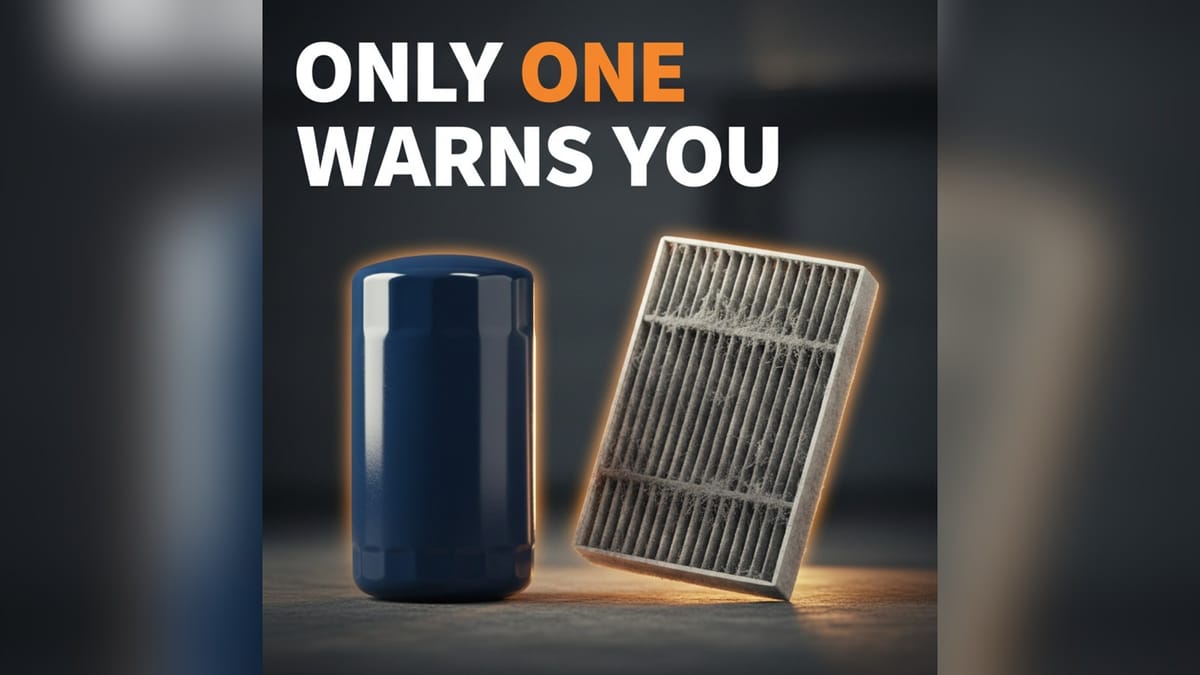
This is where the two differ most, and it is the part most comparisons skip. A clogged air filter tells you. A clogged oil filter hides.
A Clogged Oil Filter Bypasses Itself
When the oil filter media gets too restricted, pressure builds across it until the bypass valve opens. That valve is typically set to open at 8 to 15 psi, and once it does, unfiltered oil flows straight to the engine.
The engine keeps full lubrication, so nothing feels different from the driver's seat. There is no warning light for a bypassing oil filter, and the damage is slow wear rather than a sudden symptom. That is why the signs of a bad oil filter tend to show up late.
A Clogged Air Filter Costs Power, Not Fuel
A restricted air filter starves the engine of air, and on a modern fuel-injected car the engine computer compensates by trimming fuel to match. In Oak Ridge National Laboratory testing, a clogged filter had no measurable effect on fuel economy in modern fuel-injected cars, while carbureted engines lost 2 to 6%.
What did change was acceleration. With a clogged filter, 20 to 80 mph times at full throttle were 6% slower on a 2006 Dodge Charger, 7% slower on a 2003 Toyota Camry and 11% slower on a 2007 Buick Lucerne. Severe restriction can go further, into the rough idle and hesitation covered in what a dirty air filter does to an engine.
Which One Is Worse to Neglect?
The oil filter, in most cases. A neglected air filter is noticeable and mostly costs performance, and it keeps filtering the whole time it is clogged, since a loaded filter actually captures dust more efficiently.
A neglected oil filter stops filtering altogether once it bypasses, and gives no sign that it has. The exception is a torn or badly fitted air filter, which is the worst case of all, because it lets raw dust straight into the cylinders.
Frequently Asked Questions
Is an oil filter the same as an air filter? No. An oil filter cleans the liquid engine oil that lubricates the engine's moving parts, and an air filter cleans the air going into the engine for combustion. They are different shapes, sit in different places, use different media and are never interchangeable.
Do you need to change the air filter every time you change the oil? No. The oil filter is replaced with every oil change, but the engine air filter usually lasts 15,000 to 30,000 miles. Inspecting it at each oil change is a good habit. Replace it when the media is visibly loaded with dirt, or sooner if you drive on dusty roads.
Which is more important, the oil filter or the air filter? Both protect the engine, but a neglected oil filter is more dangerous because it bypasses silently and sends unfiltered oil to the bearings. A clogged air filter mainly costs acceleration and announces itself. A torn air filter is the exception, since it lets abrasive dust directly into the cylinders.
Can a dirty air filter make engine oil dirty? Yes. Dust that gets past a damaged, poorly sealed or low-efficiency air filter ends up suspended in the oil, where the oil filter has to catch it. Oil analysis labs track this through silicon readings, and high silicon usually points to an air intake problem rather than the oil filter.
Is the air filter the same as the cabin filter? No. The engine air filter cleans air for the engine and sits in the airbox under the hood. The cabin air filter cleans air for the passenger compartment and usually sits behind the glove box. When a shop says "air filter" without qualification, they almost always mean the engine air filter.
What to Do Next
Check when your oil filter was last changed and when the engine air filter was last looked at, since the second is far easier to forget. If the air filter has gone past 15,000 miles without an inspection, pull the airbox lid and hold the element up to a light before your next oil change.