Pollen Filter vs Cabin Filter: Are They the Same Thing?

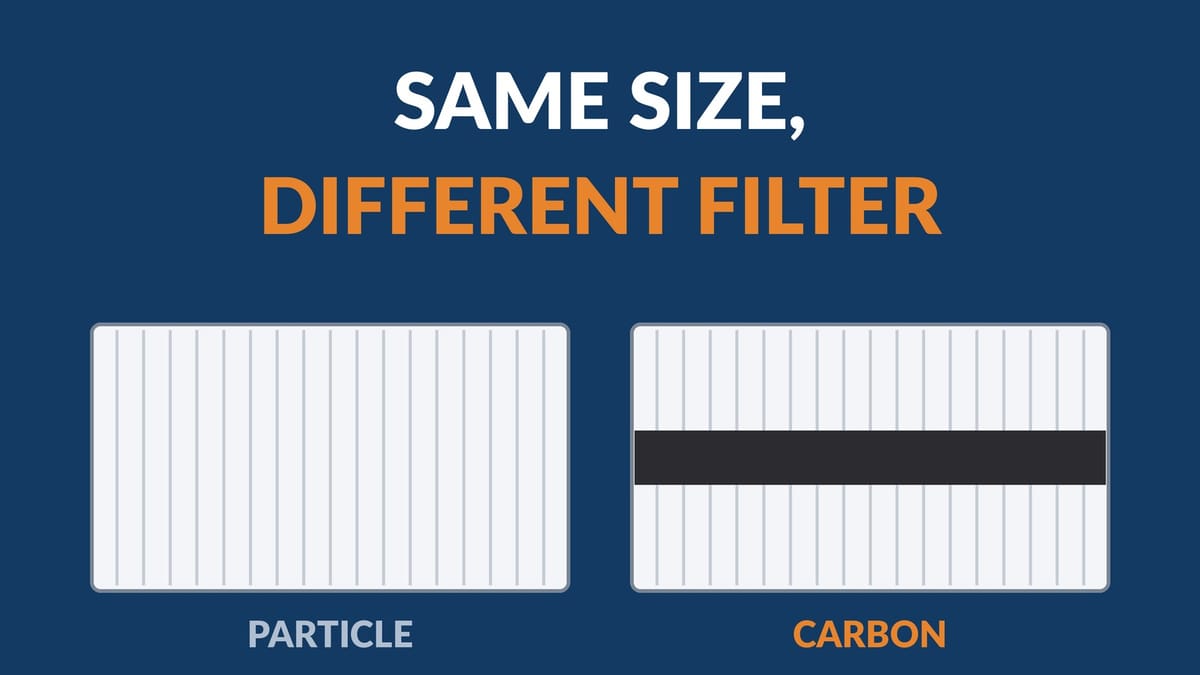
Yes. A pollen filter and a cabin filter are the same component, sitting in the same housing, cleaning the air that reaches your dashboard vents. One part, two names. What has quietly changed is that in parts catalogues, "pollen filter" has stopped being a synonym and started being a grade, and it is the cheaper one.


As an Amazon Associate we earn from qualifying purchases.
Is a Pollen Filter the Same as a Cabin Air Filter?
They are the same part. There is no separate pollen element hidden somewhere else in the car, and no vehicle has both. The pleated panel behind the glovebox or under the windscreen cowl is the whole system.
The two names are regional habit more than anything else. Honda's own parts literature calls it a cabin air filter and says it removes dust, pollen and debris from outside air, while British and European factors shelve the identical part under "pollen filter". If a garage quotes you for one and a parts site sells you the other, nothing has gone wrong.
Worth separating this from the other naming mix-up people hit, which is the cabin air filter against the engine air filter. Those genuinely are two different parts doing two different jobs.
Why Does One Part Have Two Names?
The original name was neither. The first production cabin air filter arrived on the 1989 Mercedes-Benz SL roadster and was called the micronAir cabin air filter, built by Freudenberg after decades of making engine and industrial filter media.
It was not designed around hay fever. The idea traces to the 1950s, when a Freudenberg chauffeur complained that polluted air coming into the car was dirtying his clothes, and the fix was nonwoven fabric over the intake. Pollen only enters the story in 1995, when a pleated medium replaced the original flat one.
So "cabin air filter" is what the part was christened, and "pollen filter" is a marketing handle attached six years later that stuck hardest in Britain and Germany. The name describes the contaminant that sold the part, not the one it was built for.


As an Amazon Associate we earn from qualifying purchases.
What "Pollen Filter" Means on a Parts Shelf
This is where the two names stop being interchangeable. Take one car, the VW Passat B3/B4. MANN-FILTER lists CU 2672, a particulate filter measuring 268 by 192 by 30 mm, and CUK 2672, an activated carbon filter measuring 268 by 192 by 30 mm.
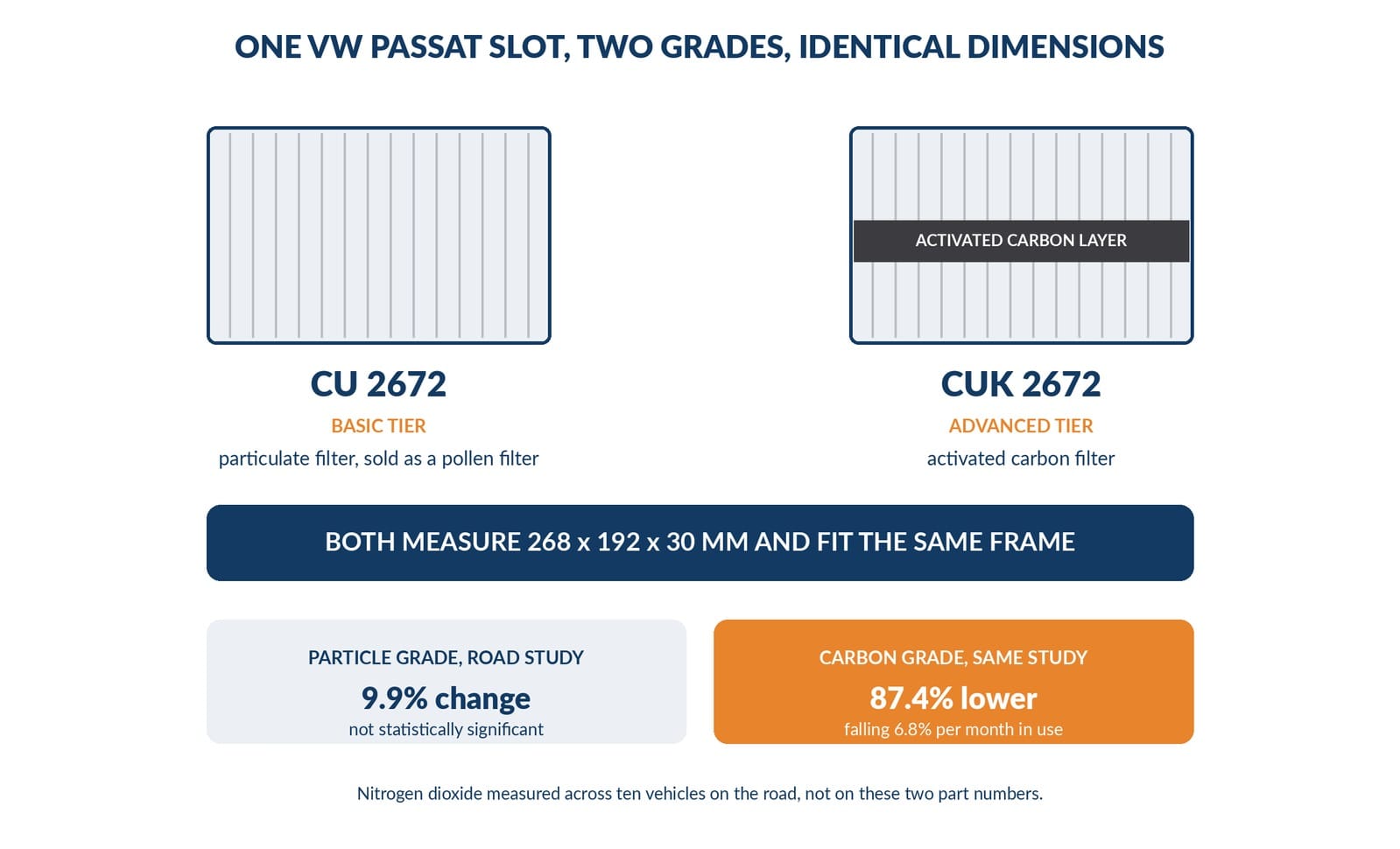
Identical dimensions, identical slot, two different OE numbers, two different tiers. MANN calls the CU its BASIC line and the CUK its ADVANCED line. Bosch splits its range the same way, into standard cabin filters, activated carbon cabin filters and a premium tier.
The shorthand has spread beyond the trade. When researchers at the University of Birmingham needed a word for the plain non-carbon version in a published study, they called it the pollen filter. In practice, if a listing says "pollen filter" and nothing about carbon, assume you are buying the particle-only grade.
Is Pollen Actually the Hard Part?
No, and this is the part that should change how you shop. Pollen is among the easiest things in the air for a cabin filter to stop, because it is enormous by filtration standards.
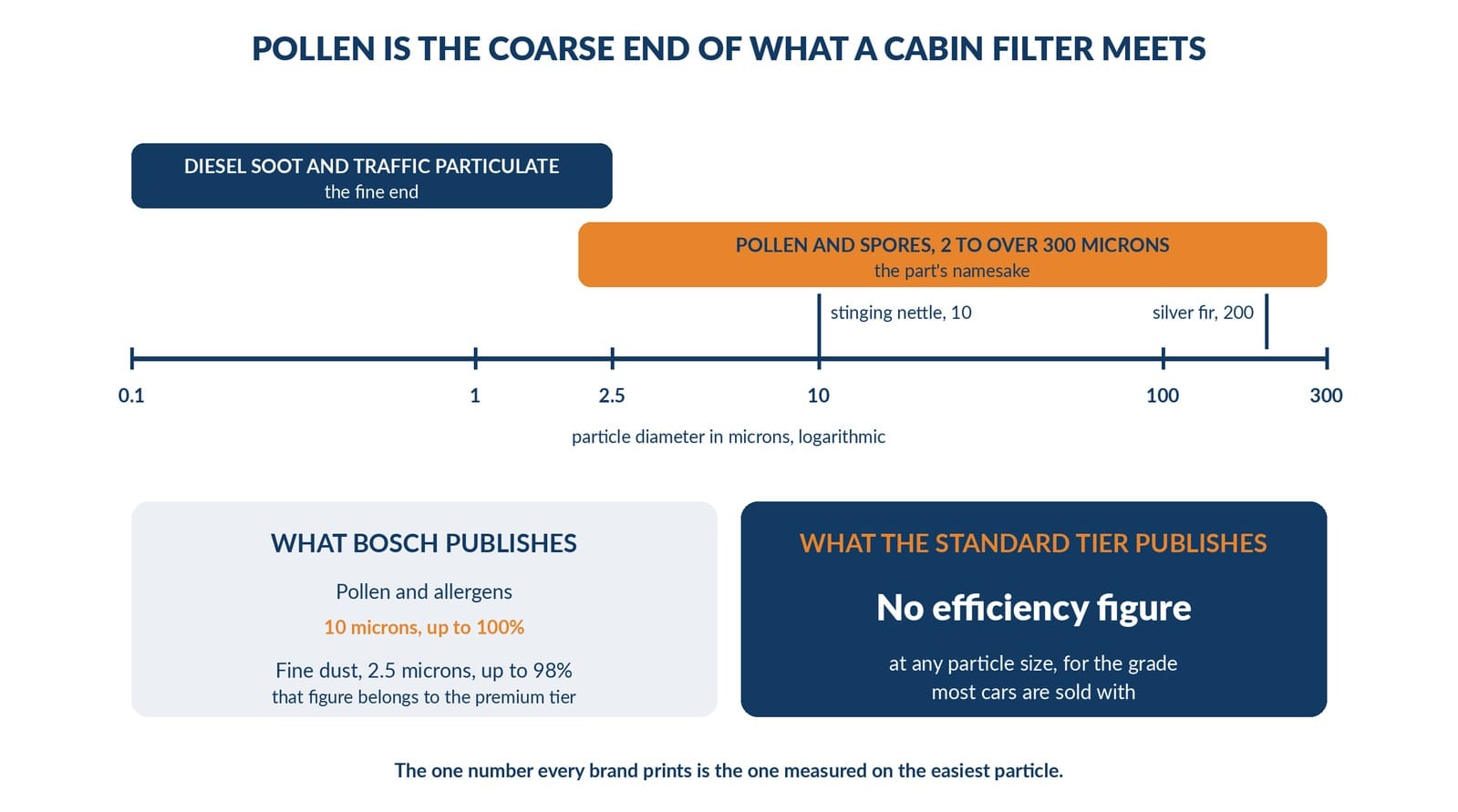
Across central European species, pollen and spore diameters run from about 2 µm to over 300 µm, with stinging nettle near 10 µm and silver fir near 200 µm. The grains that drive hay fever sit in the tens of microns. Diesel soot and traffic particulate sit two orders of magnitude below that.
The manufacturers' own numbers show the gap. Bosch's cabin filter literature publishes separation of pollen and allergens at 10 µm up to 100%, and fine dust at 2.5 µm up to 98%, and the certified fine dust figure belongs to the premium tier. The standard tier carries no published efficiency figure at all.
Naming the part after pollen advertises the one job it was always going to do well, and says nothing about the jobs that separate a cheap filter from a good one.
What a Pollen Filter Does Not Do
Gases pass straight through it. A plain particle filter is a mechanical sieve, and nitrogen dioxide, ozone and exhaust fumes are molecules, not particles.
The size of that gap was measured directly. A 2023 study in Science of the Total Environment instrumented ten vehicles built between 2004 and 2020 and compared new standard filters against new activated carbon filters on the road in Birmingham. With new standard pollen filters, mean in-cabin nitrogen dioxide was 50.8 µg/m³, a 9.9% reduction against on-road air that was not statistically significant. With new activated carbon filters it was 9.2 µg/m³, an 87.4% reduction.
Two caveats the authors are clear about, and both matter. Only one filter brand was tested, so the figures should not be read as a property of every filter on the market. And carbon fades: the study measured efficiency falling by 6.8% per month of use, with filters already in service averaging 34.2% rather than 87.4%.
If you sit in traffic, that is the comparison that decides your purchase, and it is covered properly in our breakdown of carbon and HEPA-grade cabin filters against standard ones.


As an Amazon Associate we earn from qualifying purchases.
Can You Fit a Carbon Filter Where a Pollen Filter Was?
In most cases yes, because the housing does not care. The CU and CUK pair above are the same physical size in the same frame, which is exactly why one supplier can offer three grades for one application.
What you are changing is media thickness and airflow resistance, not fit. If your car shipped with a plain filter and you move up, expect slightly more restriction and the same replacement routine behind the glovebox or under the cowl.
Should You Ask for a Pollen Filter or a Cabin Filter?
Ask for the part number. The name tells a counter assistant what shape you want and nothing about what grade you are getting, and the part itself is often unmarked.
Owners run into this constantly. On a BMW Z4 forum thread about choosing a replacement, one owner reported that his usual supplier did not distinguish between carbon and non-carbon in its listings, another ordered one brand and received a different one entirely, and a third pulled out a factory carbon filter that had been sitting badly seated in its frame.
The practical test is visual. A carbon filter has a dark grey or black layer sandwiched between pale pleats, while a particle filter is uniformly white, cream or pale green. Check what came out before you decide what goes in, and use a vehicle lookup to confirm the dimensions rather than trusting the name on the box.

As an Amazon Associate we earn from qualifying purchases.
Does Any Test Standard Settle the Argument?
Not cleanly. The reference test is DIN 71460-1, "Road vehicles, air filters for motor passenger compartments, part 1: test for particulate filtration", published in 2006.
The company that built the first cabin filter is also its most useful critic. Freudenberg describes DIN 71460 as a pure laboratory environment test whose results can only to a small extent be transferred to real operating conditions, and notes there are no unified global standards for testing these filters at all.
That is the honest position. A percentage printed on a cabin filter box is a lab number produced under a method the seller chose, so comparing two brands' claimed figures is not a like-for-like comparison, and a filter with no published figure is not necessarily worse than one that prints a large one.
FAQ
Is a pollen filter and a cabin filter the same thing?
Yes, they are the same part in the same housing. The difference is vocabulary rather than hardware, though in parts catalogues "pollen filter" usually indicates the particle-only grade, while the activated carbon version is listed under its own name and costs more.
Do all cars have a pollen filter?
Most passenger cars built since the mid-1990s have one, but it is not universal, and some older and budget models were sold without the element even though the housing exists. If your car has a cabin filter, that is your pollen filter.
Does a pollen filter actually help with hay fever?
For pollen specifically it should, because the grains are large enough for any cabin filter to capture. It does nothing for traffic gases, so if your symptoms are triggered by exhaust rather than pollen, a carbon filter is the relevant upgrade.
How often should a pollen filter be changed?
Bosch recommends every 15,000 km or once a year for its cabin filters. Carbon filters have a second clock, since adsorption capacity depletes with use, and our guide to cabin filter replacement intervals covers how driving conditions move that figure.
Is a pollen filter the same as the engine air filter?
No. The engine air filter feeds the intake and protects the engine, while the pollen or cabin filter feeds the ventilation system and protects you. They are different sizes, different media and different service intervals.
The Bottom Line
Treat the two names as one part, and treat the grade as the real decision. If you only want pollen stopped, the cheapest filter that fits will do it, because pollen is the easy case.
Before you order, pull the old filter out and look at it. A dark middle layer means the car was built with carbon, and replacing it with something listed simply as a pollen filter is a downgrade nobody will tell you about.