Best Oil Filters for Honda: 8 Picks Now That the OEM Filter Changed Hands

The FRAM Ultra Synthetic XG7317P is the oil filter to buy for almost any Honda, because it is the only one here that puts an efficiency percentage, a micron size and a test standard on the manufacturer's own page. Honda itself publishes none of the three. And in 2026 the OEM box you order is often not the OEM box that arrives.
Almost every Honda built since 1983 takes the same oil filter. Honda's own catalogue shows 15400-PLM-A02 superseding nineteen earlier part numbers and covering Accords from 1984, CR-Vs from 1997, Odysseys from 1995 and Pilots from 2003. One filter, four decades, one thread. Which means the brand on the can is not a small decision on a Honda. It is the entire decision.


Then the factory that made it closed.
| # | Filter | Best for | Efficiency it publishes |
|---|---|---|---|
| 1 | FRAM Ultra Synthetic XG7317P | 20,000-mile intervals | 99%+ above 20 microns, ISO 4548-12 |
| 2 | Honda 15400-PLM-A02 | Matching the number in your manual | Nothing published |
| 3 | Honda 15400-RTA-003 | A Japan-made OEM box | Nothing published |
| 4 | WIX 57356XP | Hard driving and hot restarts | "Up to 99%", no micron size given |
| 5 | Purolator ONE PL14610 | Value among the Mann+Hummel filters | No micron rating published |
| 6 | Bosch 3323 | Households with mixed makes | Nothing on Bosch's own page |
| 7 | Mobil 1 M1-110A | Buying one tonight | Nothing on Mobil's own page |
| 8 | ECOGARD S4610 | Spending the least | Nothing published |
Read the next two sections before the picks. They explain why two of the eight are the same filter from the same carmaker, and why that is not padding.
One Part Number, Four Decades of Hondas
Honda does not do what Chevrolet and Ford do. There is no generation split, no changeover year to get wrong, no larger and smaller version of the same filter. A HondaPartsNow parts specialist answering a 1989 Prelude owner put it as plainly as anyone could: that is the oil filter for all Hondas except the S2000.


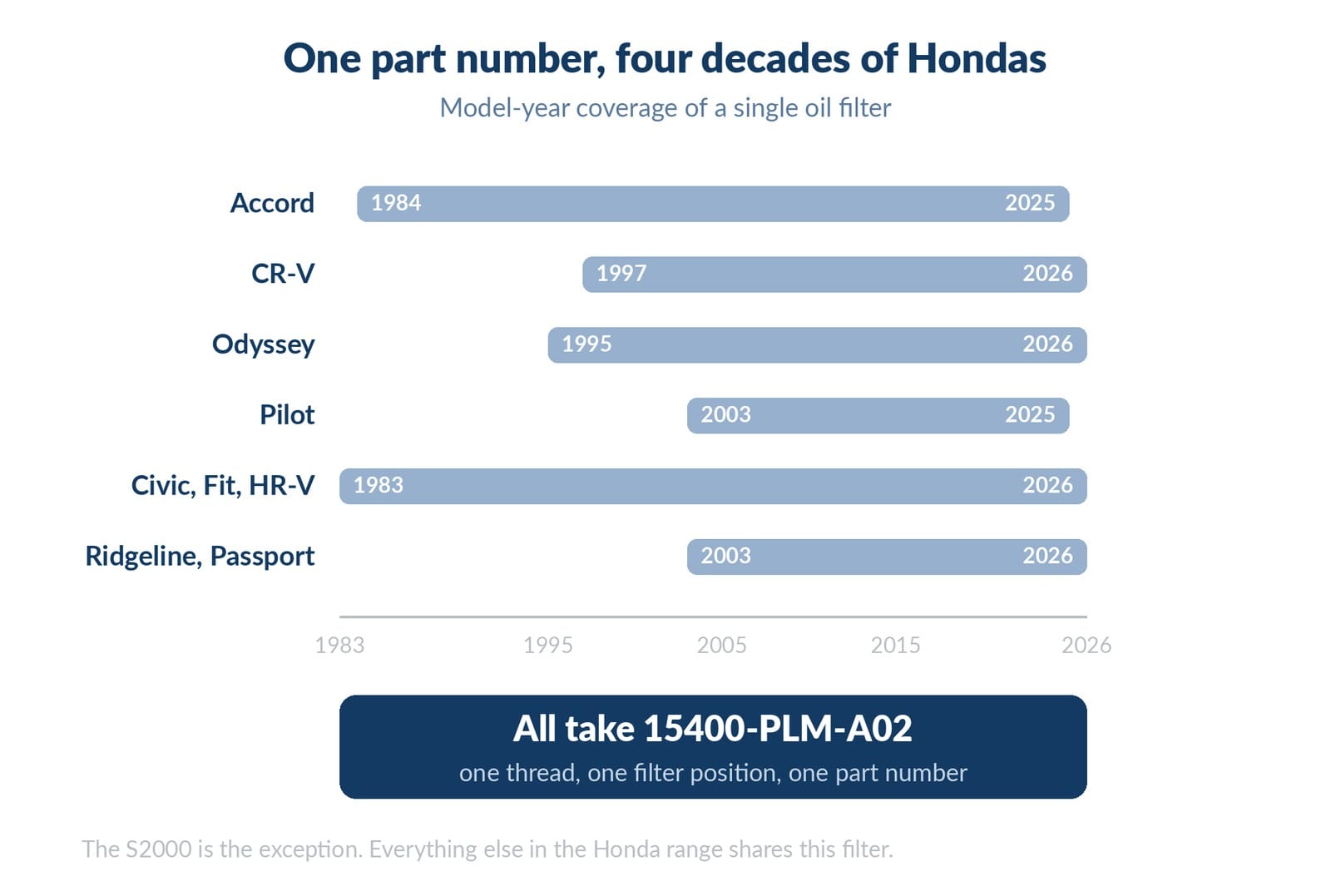
The consequence is easy to miss. On a 5.3 Vortec or a 6.6 Duramax, most of the buying risk is fitment, and we have written both of those articles around exactly that problem. On a Honda the fitment risk is close to zero. Every filter in this article threads onto an M20 x 1.5 stud and seals against the same block.
So the only thing left to get right is what is inside the can. That makes the published specification unusually important here, and it makes the near-total absence of published specifications from most of these brands the real story of the category.


The Box Changed in 2026, and Nobody Told the Listings
The 15400-PLM-A02 was made in the United States by FRAM. Honda's own catalogue still describes the part, in writing, as the "Oil (Honeywell) Filter", naming the supplier lineage on the part record itself.
First Brands, which owned FRAM, entered Chapter 11. Its Greenville, Ohio filter plant closed on 30 April 2026, with 302 jobs lost, alongside WARN notices at Bowling Green, Cleveland and Tiffin. That was the plant behind the most common OEM oil filter on American roads.


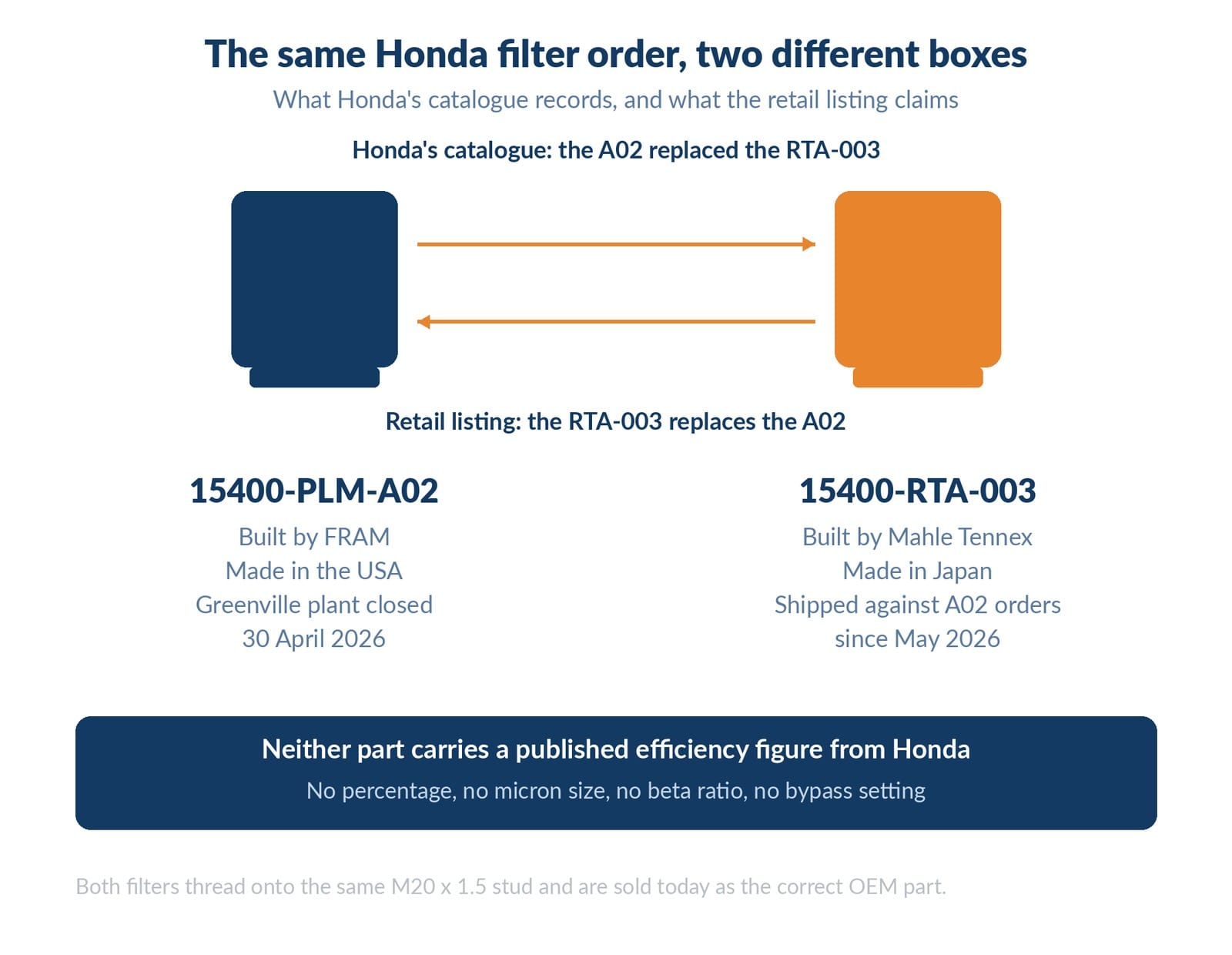
What happened next is the thing no other Honda buying guide has caught up with. Dealers began filling 15400-PLM-A02 orders with boxes marked 15400-RTA-003, a filter made by Mahle Tennex in Japan. An owner in New York ordered three A02s in May 2026 and received three RTA-003s; another reported being billed for the A02 and handed the 003 across the counter.
Here is the part that makes it genuinely confusing rather than merely annoying. Honda's parts catalogue lists 15400-RTA-003 as one of the nineteen numbers that the A02 replaced. The substitute is the older part. The Amazon listing for the RTA-003, meanwhile, states the reverse, telling buyers it replaces the superseded A02.


| Filter | Who makes it | Where | What Honda's catalogue says |
|---|---|---|---|
| 15400-PLM-A02 | FRAM, historically Honeywell | United States | The current number, replacing nineteen older ones |
| 15400-RTA-003 | Mahle Tennex | Japan | One of the nineteen it replaced |
Two different companies, two countries, two part numbers pointing at each other, and a parts counter handing over whichever one is in the bin. Owners report physical differences too, including a different hole count on the mounting plate. Neither filter carries a published efficiency figure from Honda, so there is no specification to settle the question with.
This is why the aftermarket picks below matter more on a Honda in 2026 than they did in 2024. A named aftermarket filter with a published number is now the most predictable thing you can buy for this engine.
1. FRAM Ultra Synthetic XG7317P: Best for 20,000-Mile Intervals

The FRAM Ultra Synthetic XG7317P is the only filter in this article whose maker publishes an efficiency percentage, the micron size it was measured at, and the standard it was measured under.
FRAM states 99%+ filtration efficiency and up to 20,000 miles of protection on dual-layer synthetic media, with a silicone anti-drainback valve rated to more than three times the hot-oil life of nitrile and a metal centre tube. On a Honda that anti-drainback claim earns its keep, because these filters mount where gravity drains them between starts.
Twenty microns is the tightest threshold anybody quotes for this application. Everything else in this article is looser, vaguer, or silent.
| FRAM Ultra Synthetic XG7317P | What the catalogues say |
|---|---|
| Filtration efficiency | 99%+ above 20 microns, ISO 4548-12 |
| Filter media | Dual-layer synthetic |
| Anti-drainback valve | Silicone |
| Fits | Honda Accord, Civic, CR-V, Fit, Odyssey, Pilot and Acura equivalents |
The catch, and it is the same one we found on the Hemi: read FRAM's own asterisk. The 99%+ figure comes from testing "XG8A, XG3387A and XG4967 or equivalent FRAM TG or EG models". The XG7317 is not on that list. FRAM is publishing a product-line average and letting it stand for every filter in the line, exactly as it does on the 5.7 Hemi filter.
There is a second thing to weigh, and it is new. First Brands is in bankruptcy and the plant that built this line has closed. Buy what is on the shelf, not a case of twelve for the next four years.
Skip it if you want a supply chain you can count on in eighteen months.
2. Honda 15400-PLM-A02: Best Match for the Number in Your Manual

Buy the 15400-PLM-A02 if you want the part number your owner's manual, your dealer's system and every forum thread all agree on, and you accept that Honda publishes nothing about how well it filters.
Its case for existing is coverage and certainty rather than performance. Nineteen superseded part numbers collapse into this one. If your Honda was built between 1983 and 2026 and is not an S2000, this threads on and seals.
What you cannot do is compare it to anything. Honda publishes no efficiency percentage, no micron size, no beta ratio and no bypass setting for it. A filter with no published specification cannot be ranked against one that has three, which is the only reason it sits second rather than first.
| Honda 15400-PLM-A02 | What the catalogues say |
|---|---|
| Filtration efficiency | Not published |
| Filter media | Not published |
| Anti-drainback valve | Present, no material published |
| Fits | 1984-2025 Accord, 1997-2026 CR-V, 1995-2026 Odyssey, 2003-2025 Pilot and most other Hondas |
The catch: this is the number in shortest supply. Order it and you may receive the RTA-003 below, from a different manufacturer on a different continent, billed as the part you asked for.
Skip it if you would rather choose the filter yourself than let a parts bin choose it for you.
3. Honda 15400-RTA-003: Best Japan-Made OEM Box

The 15400-RTA-003 is the filter a lot of Honda owners are now receiving whether they chose it or not, and buying it deliberately is the only way to control which one you get.
Mahle Tennex builds it in Japan. That is the whole appeal, and it is not nothing: owners who have compared the two describe different construction at the mounting plate, and a long-standing preference for the Japanese-built filter runs through the Honda forums.
Be careful about how much weight that preference carries. It rests on country of origin and on physical inspection, not on a published number, because there is no published number. One BITOG member bought up every RTA-003 he could find precisely because the internet told him they were the good ones, and said so with visible self-awareness.
| Honda 15400-RTA-003 | What the catalogues say |
|---|---|
| Filtration efficiency | Not published |
| Filter media | Not published |
| Anti-drainback valve | Present, no material published |
| Fits | The same applications as the 15400-PLM-A02 |
The catch: Honda's catalogue lists this as one of the numbers the A02 replaced, so you are deliberately buying the older part number. Supply is erratic, and the listings contradict the catalogue about which supersedes which.
Skip it if you need to order the same thing twice and have it arrive the same way twice.
4. WIX 57356XP: Best Construction for Hard Driving

The WIX 57356XP is the pick if you care about what the filter is built from rather than what the box claims.
WIX describes the XP line as hybridised synthetic fibres with up to 99% dirt trapping efficiency, with an ethylene acrylic gasket and solid metal end caps for extreme driving. It measures 86.4 mm tall and 68.2 mm across on an M20 x 1.5 thread.
Catalogue data for this application gives a 21 micron nominal rating, a beta ratio of 2/20=6/20, a 363 PSI burst pressure and an 8 to 11 PSI relief valve setting. That burst figure is the highest of any filter here. Our WIX cross reference covers how the company's numbering separates the standard and XP lines.
| WIX 57356XP | What the catalogues say |
|---|---|
| Filtration efficiency | "Up to 99%", no micron size attached |
| Filter media | Listed as enhanced cellulose in catalogue data; marketed as hybridised synthetic fibre |
| Anti-drainback valve | Yes |
| Fits | Acura and Honda 2001-2018 per the listing; 2001-2026 Civic and 2003-2025 Accord per catalogue data |
The catch: the media description and the fitment both come back two different ways depending on which WIX-sourced page you read, and the premium XP carries the same 21 micron nominal rating as the cheaper standard 57356. Paying more does not buy a better published number here.
Skip it if you only want one filter, since the standard 57356 sells on Amazon by the case of twelve.
5. Purolator ONE PL14610: Best Value Among the Mann+Hummel Filters

The PurolatorONE PL14610 is the mid-tier filter that owners' own spec sheets suggest outperforms the premium one above it.
Purolator sells three filters into this Honda application: the TECH TL14610, the ONE PL14610 and the BOSS PBL14610. The BOSS is the flagship, built around SmartFUSION full synthetic media, a double-helix centre tube, a heavy steel casing and a PuroSEAL ethylene acrylic gasket, rated to 20,000 miles.
Now the awkward part. An owner who requested spec sheets from the manufacturer for the Honda-fitment parts and posted them to BITOG in 2024 reported the ONE at 99% efficiency at 30 microns, tighter than the BOSS above it and tighter than the Mobil 1. Those are owner-obtained documents rather than published marketing, and we have not seen them independently, so treat the ordering as reported rather than confirmed. Our Purolator cross reference explains how the three tiers map onto one another.
| Purolator ONE PL14610 | What the catalogues say |
|---|---|
| Filtration efficiency | No micron rating published publicly; owners report 99% at 30 microns from a manufacturer spec sheet |
| Filter media | High-density synthetic blend |
| Anti-drainback valve | Yes |
| Fits | Honda CR-V, Accord, Civic, Pilot, Odyssey, HR-V, Fit, plus Acura MDX and RDX and several Nissans |
The catch: Purolator will not attach a micron size to an efficiency claim in public. Every number above reached daylight because a customer asked for a document, which is a strange way to run a specification.
Skip it if you want the heavy steel can and the 20,000-mile rating, in which case the BOSS PBL14610 is the same application at a higher price.
6. Bosch 3323: Best for Households With Mixed Makes

The Bosch 3323 turned up on every single Honda search run for this article, and it fits far more than Hondas.
One part number covers Honda Accord, Civic, CR-V and Pilot, Acura MDX, RDX, RSX and TL, and a long list of Chrysler, Dodge, Ford, Infiniti and Nissan applications. If your driveway holds a Civic and an Altima, that is one filter on the shelf instead of two.
Then you go looking for what is in it. Bosch's own product page for the 3323 offers a vehicle fitment lookup and nothing else: no efficiency figure, no micron size, no capacity, no valve settings. The 99% efficiency and 14-gram capacity claims that circulate for this filter appear on the Amazon listing and on reseller pages, not on Bosch's page for the part.
| Bosch 3323 | What the catalogues say |
|---|---|
| Filtration efficiency | Nothing on Bosch's own product page; 99% claimed on the retail listing with no test method cited |
| Filter media | FILTECH, composition not published |
| Anti-drainback valve | Silicone, per the retail listing |
| Fits | Honda, Acura, Chrysler, Dodge, Ford, Infiniti and Nissan applications |
The catch: a manufacturer that publishes a fitment tool and no specification is asking you to buy on the strength of the name. Bosch is a serious company and this is still a number you cannot check.
Skip it if you are choosing between filters on published data, because there is none to choose with.
7. Mobil 1 M1-110A: Best for Buying One Tonight

The M1-110A is the easiest filter in this article to find on a shelf at 8pm, and the hardest to defend on published numbers.
It is sold as Extended Performance with up to 20,000 miles of protection, it comes in singles and two-packs, and it sits in every parts store and most supermarkets that carry oil. Availability is a real virtue when the OEM box is unpredictable.
The numbers are where it struggles. The same owner-obtained spec sheets reported the M1-110A at 99% efficiency at 50 microns, the loosest figure of any filter discussed in that thread, for one of the highest prices. Mobil's own product listing for the part publishes no efficiency figure to check that against. Production moved to Mann+Hummel years ago, and the A suffix on the part number is the marker of that change. Our Mobil 1 cross reference covers the M1 numbering.
| Mobil 1 M1-110A | What the catalogues say |
|---|---|
| Filtration efficiency | Nothing published by Mobil; owners report 99% at 50 microns from a manufacturer spec sheet |
| Filter media | Synthetic blend |
| Anti-drainback valve | Yes |
| Fits | Honda and Acura applications sharing the 14610 filter position |
The catch: you are paying a premium price for the weakest reported filtration in this article. The brand equity is doing more work than the media is.
Skip it if you have twenty minutes to order something else.
8. ECOGARD S4610: Best Budget Pick

The S4610 is the cheapest filter here that comes from a real manufacturer with a real catalogue behind it, which is more than most of the Honda listings on Amazon can say.
Its fitment detail is unusually specific for a budget part: 2002-2019 CR-V 2.4L, 2003-2017 Accord 2.4L, 2017-2026 CR-V 1.5L, 2006-2015 Civic 1.8L, plus Pilot, Odyssey, HR-V, Fit, Ridgeline, Passport and Element. It is rated for synthetic oil and uses a silicone anti-drainback valve where the OEM specifies one.
It also does something useful by accident. The listing publishes its own cross-reference, tying S4610 to FRAM PH7317-S and TG7317, Champ PH2867XL and Service Pro E4620. That is how you confirm the 7317 and 4610 codes are the same filter position across five brands.
| ECOGARD S4610 | What the catalogues say |
|---|---|
| Filtration efficiency | Not published |
| Filter media | Not published; rated for synthetic oil |
| Anti-drainback valve | Silicone, where the OEM specifies one |
| Fits | CR-V 2.4L 2002-2019 and 1.5L 2017-2026, Accord 2.4L 2003-2017, Civic 1.8L 2006-2015, plus Pilot, Odyssey, HR-V, Fit, Ridgeline, Passport, Element |
The catch: its own cross-reference points at FRAM's Extra Guard and Tough Guard tiers, not the Ultra. That is an honest signal about where this filter sits, and it is a signal the more expensive filters here decline to give at all.
Skip it if you run 10,000-mile intervals on full synthetic, where the absence of any published efficiency figure starts to matter.
What Decided the Order
The ranking came out of manufacturer catalogues and product pages read directly, and the single most useful document was Honda's own parts record for the 15400-PLM-A02, which lists the nineteen part numbers it supersedes and names 15400-RTA-003 among them. That one field is what turned a supply-chain rumour into a checkable contradiction, because the Amazon listing for the RTA-003 asserts the reverse.
FRAM's efficiency claim was read from FRAM's page including the asterisk, which names XG8A, XG3387A and XG4967 as the parts actually tested. Bosch's own page for the 3323 was loaded and confirmed to publish no specification at all, which is why its table says so rather than repeating the retail listing's 99%. WIX's own catalogue entry supplied the XP construction detail and the "up to 99%" phrasing with no micron size. Where figures exist only in spec sheets that owners obtained from manufacturers and posted publicly, the Purolator and Mobil 1 rows say exactly that instead of presenting them as published data.
Candidates came from Amazon searches run the way an owner runs them, then cut. Sponsored placements were discarded before ranking. So were roughly a dozen listings that print 15400-PLM-A02 in the title with no manufacturer behind them.
No filter here was physically tested, and the order rests on published specifications, catalogue data and owner-reported experience rather than a bench.
Reading a Honda Filter Listing Without Getting Burned
The white-label problem is worse on Honda than on any engine we have covered. Because one part number fits nearly every Honda, that number is the most valuable keyword in the category, and Amazon is full of listings that consist of little more than the number. One is titled "Non-OEM 15400-PLM-A02 Replacement Oil Filter 3-Pack". Another advertises a fit for the "Honda CR-V GXV engine", and GXV is a Honda small-engine code that has never been in a CR-V.
Check that a manufacturer exists before you check the price. If the brand name returns no company website, no catalogue and no cross-reference, there is no document behind the filter and nothing to verify. That is the first cut we make and it removes most of the cheap listings on the first page.
Watch for part numbers that are not car filters at all. One listing surfaced during research is titled "Honda OEM Oil Filter" and sells 15410-MFJ-D01, which is a motorcycle filter for the CBR600RR. It appears on car searches because the title says Honda and oil filter.
Suffixes hide parts from search. The Honda-fitment FRAM Ultra sells as XG7317P, and searching Amazon for XG7317 does not return it. FRAM does the same thing on the Hemi filter, which sells as the XG10060P. If a part number returns nothing, add the packaging suffix before concluding it is discontinued.
A missing micron size is not the same as a bad filter, but it is a missing number. Four of the eight picks here publish no efficiency figure at all. That is worth knowing before you pay a premium for one of them. Our micron rating guide explains why the size attached to the percentage matters more than the percentage.
The Ones I Left Out, and Why
K&N. K&N's Honda application could not be confirmed on K&N's own catalogue this session, because the product pages for the part number that circulates for this fitment returned 404. The two K&N filters that do surface on Honda searches, HP-1004 and HP-1008, are different applications. Recommending either one for a Civic without a manufacturer cross-reference would be exactly the fitment error this article is about, so K&N is named here rather than ranked. Our K&N cross reference has the interchange data we have confirmed.
Purolator BOSS PBL14610. Not excluded on merit, excluded on the one-pick-per-brand rule. It is the same filter position as the PL14610 above, and the reported spec sheets do not put it ahead.
The 15400-PLM-A02 multipacks. Cases of five, ten and twelve, plus three-packs bundled with crush washers, are all the same filter as pick two. With the supply situation as unsettled as it is, committing to ten of a part number that may not be restocked is a worse idea this year than last.
Roughly a dozen unbranded 3-packs. CMDOCK, Kefly, "Non-OEM", and a run of listings with no brand in the title at all. No manufacturer site, no published specification, no catalogue. They are logged in our candidate file as considered and rejected.
Honda Oil Filter Questions
What oil filter does a Honda Civic take? Almost every Honda Civic from 1983 onward takes the 15400-PLM-A02, the same filter as the Accord, CR-V, Odyssey and Pilot. Common aftermarket equivalents are the FRAM XG7317, WIX 57356, Purolator PL14610, Bosch 3323 and ECOGARD S4610. The S2000 is the exception across the Honda range.
Is the 15400-RTA-003 the same as the 15400-PLM-A02? They are interchangeable on the car but they are not the same part. The A02 has been built in the United States by FRAM, the RTA-003 by Mahle Tennex in Japan, and owners report physical differences at the mounting plate. Honda's catalogue lists RTA-003 as a number the A02 replaced.
Why did my Honda dealer give me a different filter than I ordered? The FRAM plant that produced the 15400-PLM-A02 closed in April 2026 following the First Brands bankruptcy. Dealers and online parts sellers have been filling A02 orders with 15400-RTA-003 stock since roughly May 2026. Several owners report being billed for one and receiving the other.
What micron rating does the Honda oil filter have? Honda publishes no micron rating, no efficiency percentage and no beta ratio for either OEM filter. Among the aftermarket options, FRAM publishes 99%+ above 20 microns under ISO 4548-12 for the Ultra Synthetic line, and catalogue data gives the WIX 57356 a 21 micron nominal rating.
Does the oil filter brand matter on a Honda? More than on most cars, because Honda uses one filter across nearly its whole range, so brand is the only variable left. Whether the differences change engine life is a separate question, covered in does oil filter brand matter.
Can I use a FRAM XG7317 on an Accord and a Civic? Yes. The 7317 application code covers the Accord, Civic, CR-V, Fit, Odyssey and Pilot along with the Acura equivalents, which is the same coverage as the OEM part. It sells as XG7317P.
Before You Order
Look at the filter currently on your engine, or at the box from your last oil change, and note whether it says PLM-A02 or RTA-003. That tells you which supply your dealer has been drawing on, and it is the only piece of information in this article you cannot look up.
Then decide what you are optimising for. A published number points at the FRAM. Certainty of fit points at either Honda box. Availability points at the Mobil 1 or the Bosch. Price points at the ECOGARD. There is no filter here that wins on all four, and any page telling you otherwise has not read the spec sheets.