Valvoline Oil Filter Cross Reference Chart


Valvoline oil filter numbers start with a VO prefix followed by a short catalog number, and those numbers are consolidation numbers. One Valvoline part covers several FRAM, WIX and Purolator numbers at once, so a Valvoline cross reference almost never gives you a single clean match. It gives you a group.
That is the part most cross reference charts get wrong, and it is why I built this page around what each Valvoline number actually covers.


As an Amazon Associate we earn from qualifying purchases.
Who Makes Valvoline Oil Filters?
Valvoline does not build its own filters. The brand sells filters made under contract, and the contract has moved more than once.
For years the supplier was Champion Laboratories. That changed around the end of 2010, when quick lube operators started reporting that new Valvoline shipments were arriving built by Purolator instead of Champ Labs, most of them with e-core internals.
The part numbers back that up. Line up the Valvoline catalog against the Purolator catalog and the pairings are one to one across hundreds of numbers, including the cartridge filters.
Sourcing history matters less than people think. Whoever fills the box, the catalog number still tells you which interchange group the filter belongs to, and that is what a cross reference is for.
Valvoline's published description of the media is short and consistent across the line. The company says its filters contain a synthetic blend cellulose glass media for improved efficiency without sacrificing capacity and that they meet or exceed OEM standards.
How Valvoline Filter Part Numbers Work
The system is a prefix plus a catalog number. The prefix tells you the filter type, not the vehicle.
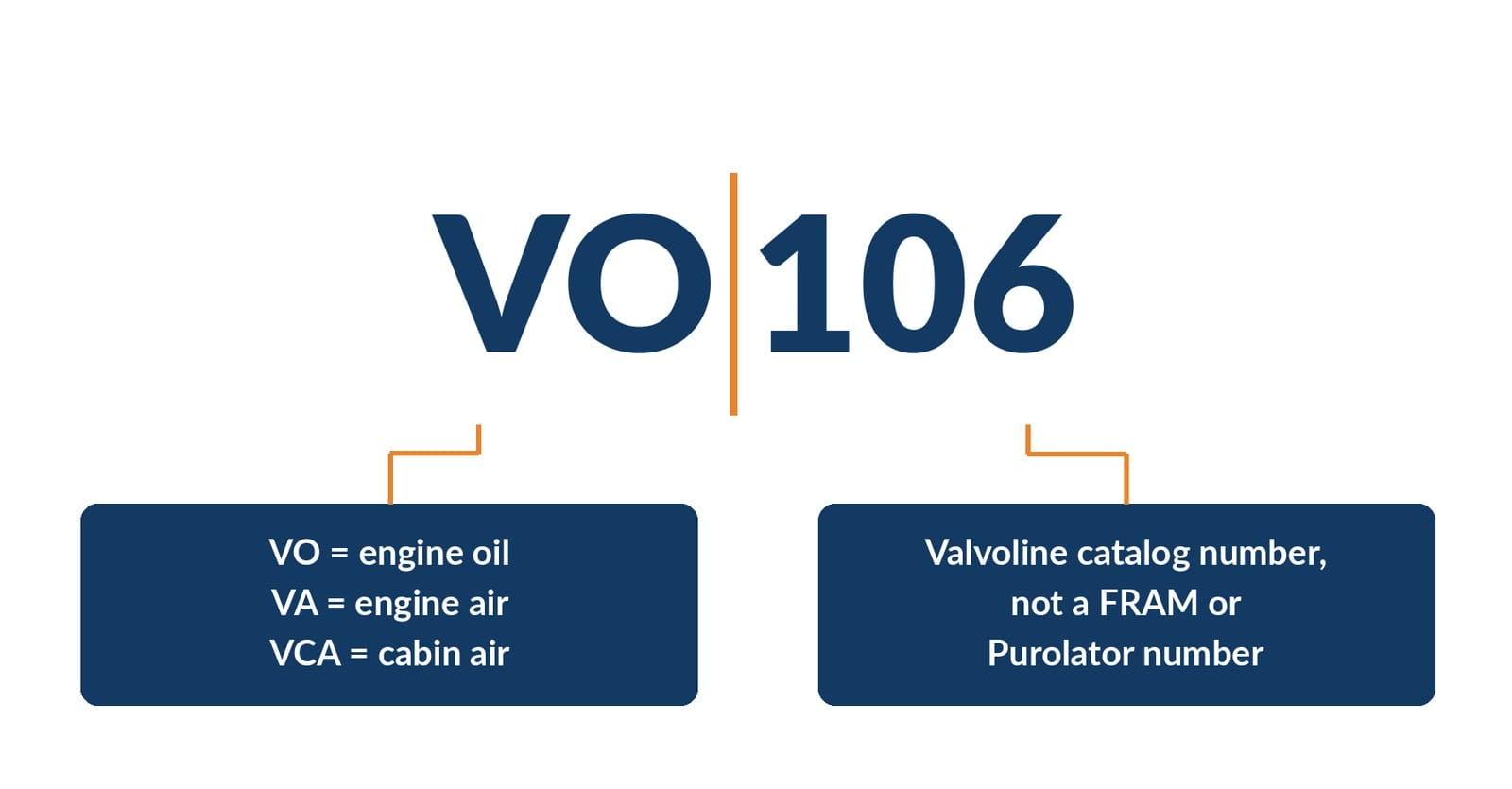
- VO is a spin-on or cartridge engine oil filter
- VA is an engine air filter
- VCA is a cabin air filter
The number after the prefix is Valvoline's own catalog number. It is not a shortened FRAM number and it is not a Purolator number, even though it maps cleanly onto one.
Why does one Valvoline number cover so many other numbers?
Because Valvoline built the catalog for quick lube bays, not for parts counters.
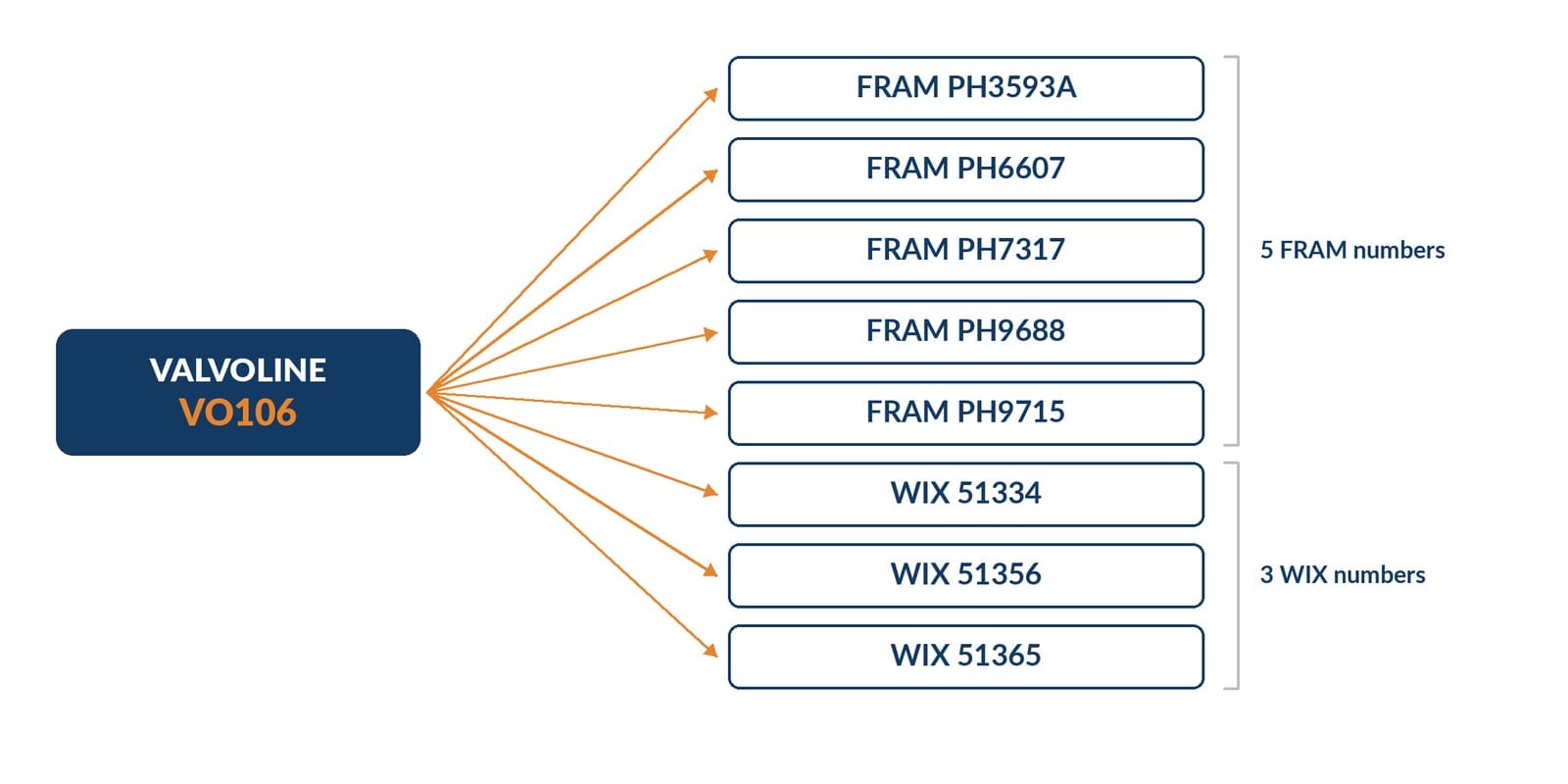
A retail shelf carries a separate number for every fitment variation. A service bay wants the smallest number of SKUs that still covers the cars driving in. Valvoline consolidated aggressively to hit that goal.
The VO106 is the clearest example. It crosses to FRAM PH3593A, PH6607, PH7317, PH9688 and PH9715 all at once, plus Purolator L14459, L14460, L14610, L14612, L14620 and L14622, plus WIX 51334, 51356 and 51365.
Five FRAM numbers. Six Purolator numbers. One Valvoline number.
This is the single most important thing to understand before using any Valvoline cross reference. Going from a Valvoline number outward gives you a list of candidates. Going from a FRAM or WIX number inward to Valvoline is the reliable direction.
What about the VO3600 style numbers?
There is a second numbering pattern on Valvoline's own retail listings, and it looks nothing like the VO106 style. Numbers such as VO2, VO8A, VO3593A, VO3600, VO10358 and VO12060 appear on consumer packaging.
Those track the number the same filter carries in another catalog. VO3593A is the FRAM PH3593A. VO3600 is the FRAM PH3600. VO10358 and VO12060 line up with Purolator's L10358 and L12060 numbers.
The overlap is real and it confuses people. The VO3593A on a retail shelf and the VO106 in a service bay can be the same filter, reached through two different numbering conventions.


As an Amazon Associate we earn from qualifying purchases.
Valvoline Oil Filter Cross Reference Chart
Every row below is an interchange group, not a one to one swap. The FRAM, WIX and Purolator numbers listed are all filters that share the group with that Valvoline part.
| Valvoline | FRAM | WIX | Purolator | Common OE numbers |
|---|---|---|---|---|
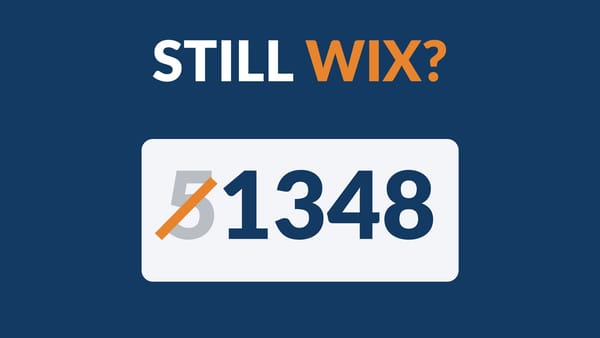
| VO25 | PH3614, PH9566 | 51348 | L10241 | Toyota 90915-YZZD1, Chrysler 4105409 |
| VO40 | PH4386, PH4967 | 51394, 51396 | L14476, L14477 | Toyota 90915-YZZF1, 90915-03001 |
| VO71 | CH8530 | 57210 | L45308 | VW 074 115 562 |
| VO81 | CH9549 | 57311, 57312, 57313 | L45515, L45526 | Ford 3C3Z-6731AA |
| VO88 | PH10060, PH3531 | 57060, 51392 | L12222, L10291 | GM 89017524 |
| VO106 | PH3593A, PH6607, PH7317, PH9688 | 51334, 51356, 51365 | L14459, L14460, L14610 | Honda 15400-PLM-A01 |
A few notes on reading this table.
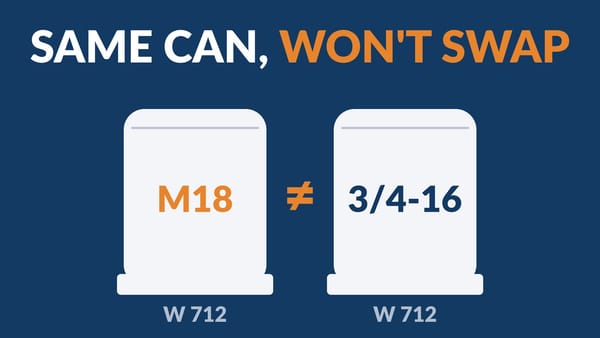
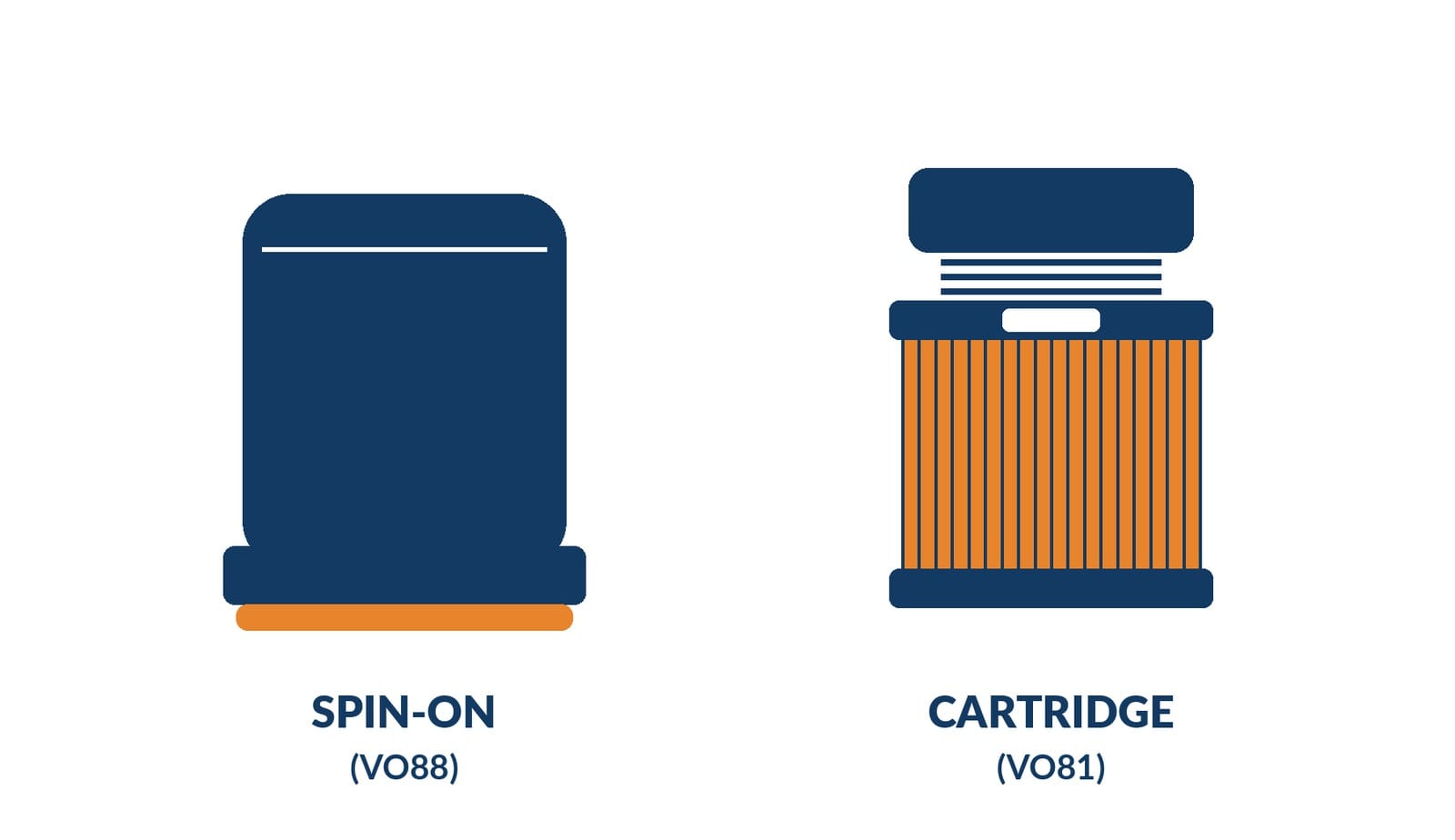
- VO71 and VO81 are cartridge elements, not spin-on canisters. Valvoline sells a separate cartridge oil filter line designed to sit inside a permanent housing, and the CH prefix on the FRAM column is the giveaway.
- The ACDelco equivalents fall out of the same groups. The VO25 group carries ACDelco PF53 and the VO88 group carries ACDelco PF48 and PF963.
- Where a group lists several numbers in one column, they are not interchangeable with each other in every application. They are interchangeable within the fitments that group covers.
What does the Valvoline VO88 fit?
The VO88 is the GM V8 filter, the one most people know by its ACDelco number. It shares its group with WIX 57060, FRAM PH10060 and Purolator L12222, and the OE number behind it is GM 89017524.
Coverage runs across Buick, Cadillac, Chevrolet and GMC from the late 2000s forward, and the same filter picked up Chrysler, Dodge and Jeep applications in the same period.
Valvoline also lists a VO27 in that identical group, which is a good reminder that even inside one brand's catalog, two numbers can be the same filter.
What does the Valvoline VO106 fit?
The VO106 is the import workhorse. Its group takes in Honda, Nissan, Subaru, Hyundai, Kia, Mitsubishi and Isuzu OE numbers, including Honda 15400-PLM-A01 and Nissan 15208-65F00.
That breadth is exactly why it needs care. A VO106 pulled off a shelf covers a 1994 Civic and a 2015 Sentra in the catalog sense, but the physical filters in those two applications are not always identical parts. Confirm against your specific year, make, engine and OE number before it goes on.
What does the Valvoline VO81 fit?
The VO81 is the Ford 6.0L and 6.4L Power Stroke cartridge. It crosses to FRAM CH9549, Purolator L45515 and Motorcraft FL2016, against Ford OE number 3C3Z-6731AA.
Diesel owners get an extra reason to be careful here. Cartridge housings are far less forgiving of a near miss than a spin-on, because the seal geometry is part of the element.
Are Valvoline Oil Filters Any Good?
The honest answer is that Valvoline publishes almost nothing you can measure.
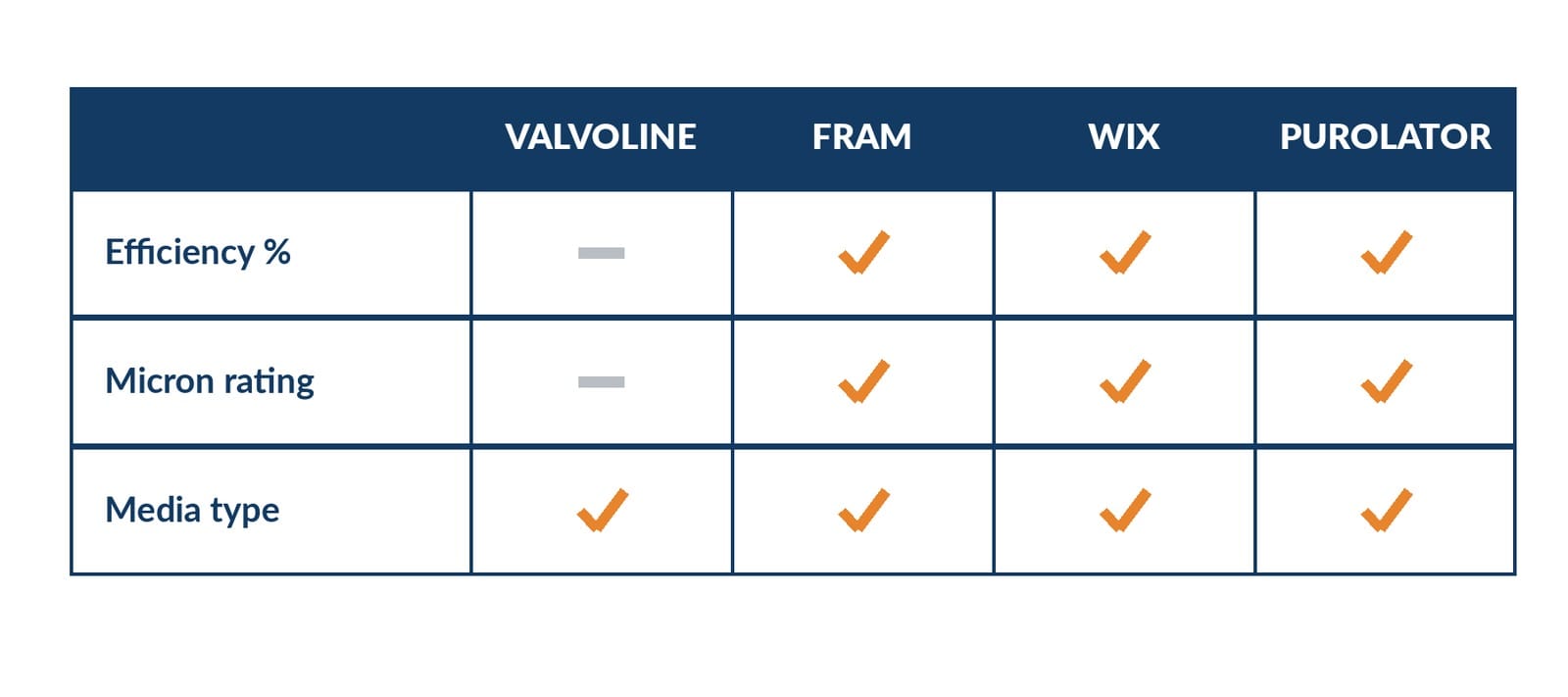
Search the Valvoline product pages and you get material and warranty language, not numbers. There is no published efficiency percentage, no micron rating and no burst pressure figure for the oil filter line. What the company does publish is a description of the media and a claim that the filters meet or exceed OEM standards.
Valvoline is more specific about why filtration matters than about its own specs. The company's own guidance points out that dirt particles in the 10 to 20 micron range do serious damage to bearings and cylinders, and that traditional cellulose media is less efficient than newer synthetic blends.
If you need a published efficiency number to make a decision, Valvoline is not the brand that gives it to you. FRAM, WIX and Purolator all put a percentage and a micron figure on the box. Valvoline does not, and neither does K&N.
That is not the same as saying the filter is bad. It means the filter is specified by fitment and by whoever is building it that year, and you are trusting the group it sits in rather than a number on a data sheet.


As an Amazon Associate we earn from qualifying purchases.
How to Find the Right Valvoline Oil Filter
Work in this order and you will not go wrong.
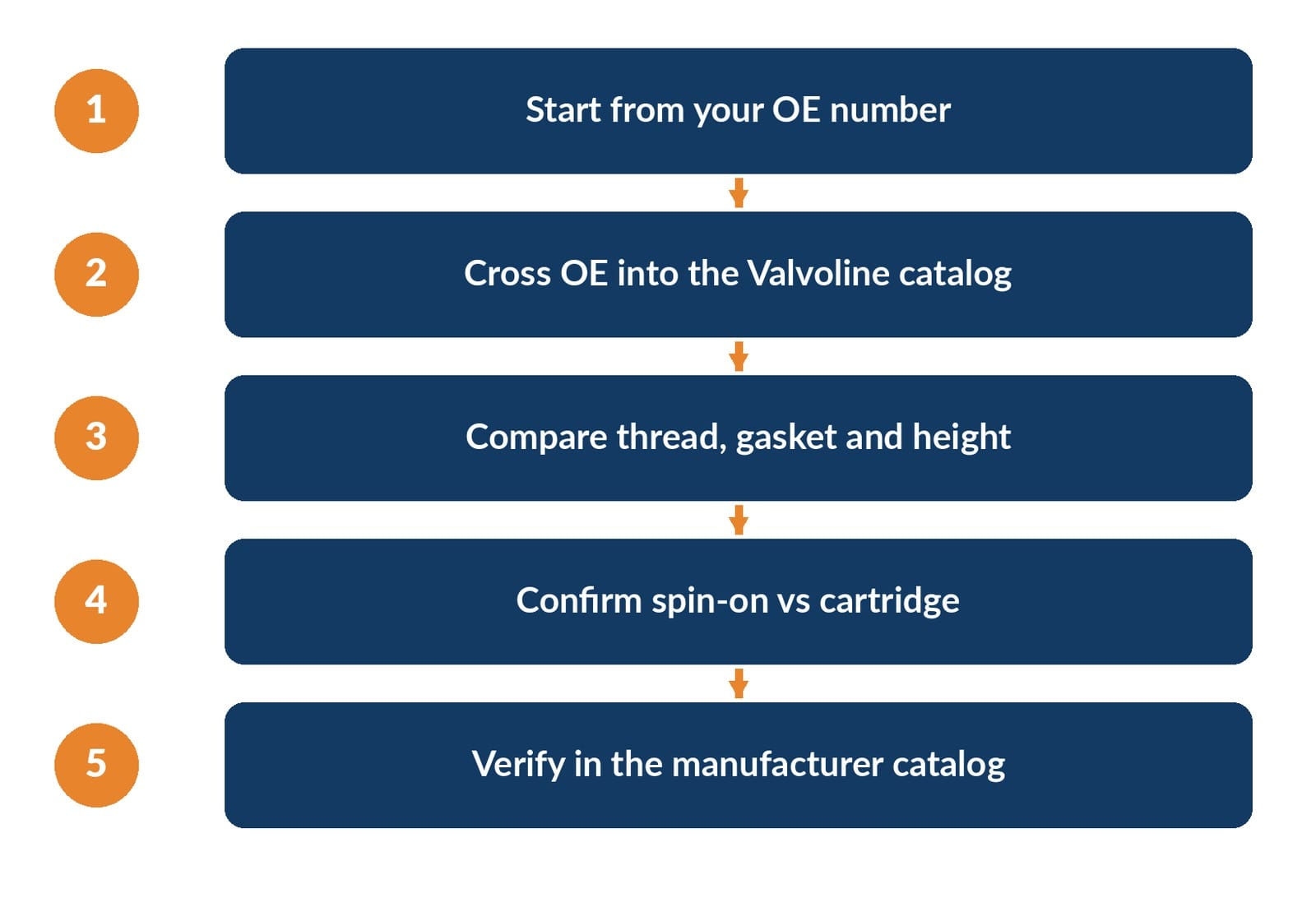
- Start from your OE number, not from a competitor's aftermarket number. Pull the filter number out of the owner's manual or off the old filter.
- Cross the OE number into the Valvoline catalog, rather than crossing a FRAM number into it. OE to Valvoline is a narrow lookup. FRAM to Valvoline is a wide one.
- Check the physical filter against the old one before installing. Thread size, gasket diameter and overall height need to match, because a consolidation number can cover more than one body size.
- Confirm the housing type. If your engine uses a cartridge element, a VO spin-on number is not a substitute, and the reverse is equally true.
- Use the manufacturer lookup as the final authority. Valvoline's own advice is that every filter manufacturer has a catalog, website or app for finding the right part, and that the owner's manual settles compatibility and warranty questions.
Frequently Asked Questions
Is the Valvoline VO106 the same as a FRAM PH3593A?
Within the catalog, yes. The VO106 group includes FRAM PH3593A, and Valvoline's own retail listing for that same filter is even numbered VO3593A. The VO106 also covers four other FRAM numbers, so the relationship runs one way rather than both ways.
What WIX filter replaces a Valvoline VO88?
WIX 57060. That group also contains FRAM PH10060, Purolator L12222 and ACDelco PF48, and traces back to GM OE number 89017524. WIX 51392 appears in the same group for other fitments in the range.
Do Valvoline oil filter numbers match FRAM numbers?
Sometimes, and only on the retail numbering. VO3600 lines up with FRAM PH3600 and VO3593A with PH3593A. The short service numbers such as VO25, VO40 and VO106 follow no FRAM logic at all, so dropping the VO and adding PH produces a part number that does not exist.
What micron rating do Valvoline oil filters have?
Valvoline does not publish one. The product pages describe a synthetic blend cellulose glass media and state that the filters meet or exceed OEM standards, but no efficiency percentage or micron figure is given for the oil filter line.
What is the VA and VCA prefix on Valvoline filters?
VA is an engine air filter and VCA is a cabin air filter. They follow the same consolidation logic as the VO oil filters and cross into the Purolator air and cabin catalogs the same way.


As an Amazon Associate we earn from qualifying purchases.
Before You Buy the Wrong Filter
Take the number off your old filter, or out of the owner's manual, and cross that into Valvoline rather than working backwards from a FRAM or WIX number you found online. The consolidation that makes this catalog convenient in a service bay is the same thing that makes a careless lookup land on the wrong body size.
If the filter you pull off does not match the one in the box on thread, gasket and height, stop and re-check the application before it goes on the engine.